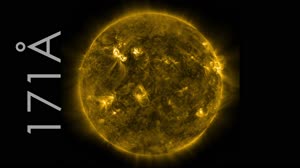
HD Close up of March 6th X5.4 Flare
NASA Goddard Space Flight Center
ScienceSpace
Clips are not offered for this film: NASA's media guidelines set the terms of its reuse themselves, not as a public licence.
Parts
About
The sun erupted with one of the largest solar flares of this solar cycle on March 6, 2012 at 7PM ET. ?This flare was categorized as an X5.4, making it the second largest flare — after an X6.9 on August 9, 2011 — since the sun's activity segued into a period of relatively low activity called solar minimum in early 2007. The current increase in the number of X-class flares is part of the sun's normal 11-year solar cycle, during which activity on the sun ramps up to solar maximum, which is expected to peak in late 2013. About an hour later, at 8:14 PM ET, March 6, the same region let loose an X1.3 class flare. ?An X1 is 5 times smaller than an X5 flare. These X-class flares erupted from an active region named AR 1429 that rotated into view on March 2. ?Prior to this, the region had already produced numerous M-class and one X-class flare. ?The region continues to rotate across the front of the sun, so the March 6 flare was more Earthward facing than the previous ones. ?It triggered a temporary radio blackout on the sunlit side of Earth that interfered with radio navigation and short wave radio. In association with these flares, the sun also expelled two significant coronal mass ejections (CMEs), which are traveling faster than 600 miles a second and may arrive at Earth in the next few days. ?In the meantime, the CME associated with the X-class flare from March 4 has dumped solar particles and magnetic fields into Earth's atmosphere and distorted Earth's magnetic fields, causing…
Human-made No record of this work says a model made it. What this means.
More from NASA
 Film
Expedition 64 Air Space Museum and Museum of African American History and Culture
 Film
Watching the Friendly Skies - Eclipse Safety Tutorial
 Commercial
Inside KSC! for Dec. 27, 2021
 Educational
Expedition 70 Astronaut Furukawa Talks with JAXA Space Education Center Students - Nov. 23, 2023
 Film
Expedition 66 NG 16 Cygnus Release
 Film
Women at Glenn - 60 Seconds with Mary Lobo
 Commercial
CCP Boeing OFT ULA Live Launch Broadcast
 Film
SpaceCast Weekly March 1 2019
 Film
Expedition 70 71 Interviews With Flight Engineer Tracy Dyson 240226
 Film
Human Research Obstacle Course B-roll
 Film
SpaceCast Weekly - October 8, 2021
 Film