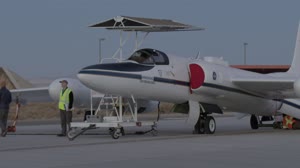
NASA Measures ‘Moonlight’ to Improve Earth Observations
NASA Armstrong Flight Research Center
ScienceSpace
Clips are not offered for this film: NASA's media guidelines set the terms of its reuse themselves, not as a public licence.
Parts
About
In March 2025, NASA pilots took the agency’s ER-2 science aircraft on a series of night flights over NASA’s Armstrong Flight Research Center in Edwards, California, as the Moon increased in visible size. The Airborne Lunar Spectral Irradiance, or air-LUSI, mission observed the Moon at different phases and measured the sunlight reflected by the lunar surface. Specifically, the instrument tracked the amount of light reflected at different wavelengths. This information enables scientists to use the Moon as a calibration tool for Earth-observing sensors. The air-LUSI project is a collaboration between scientists and engineers from NASA, the National Institute of Standards and Technology, the U.S. Geological Survey, the University of Maryland Baltimore County, and McMaster University in Ontario.
Human-made No record of this work says a model made it. What this means.
More from NASA
 Film
Expedition 64 Air Space Museum and Museum of African American History and Culture
 Film
Watching the Friendly Skies - Eclipse Safety Tutorial
 Commercial
Inside KSC! for Dec. 27, 2021
 Educational
Expedition 70 Astronaut Furukawa Talks with JAXA Space Education Center Students - Nov. 23, 2023
 Film
Expedition 66 NG 16 Cygnus Release
 Film
Women at Glenn - 60 Seconds with Mary Lobo
 Commercial
CCP Boeing OFT ULA Live Launch Broadcast
 Film
SpaceCast Weekly March 1 2019
 Film
Expedition 70 71 Interviews With Flight Engineer Tracy Dyson 240226
 Film
Human Research Obstacle Course B-roll
 Film
SpaceCast Weekly - October 8, 2021
 Film