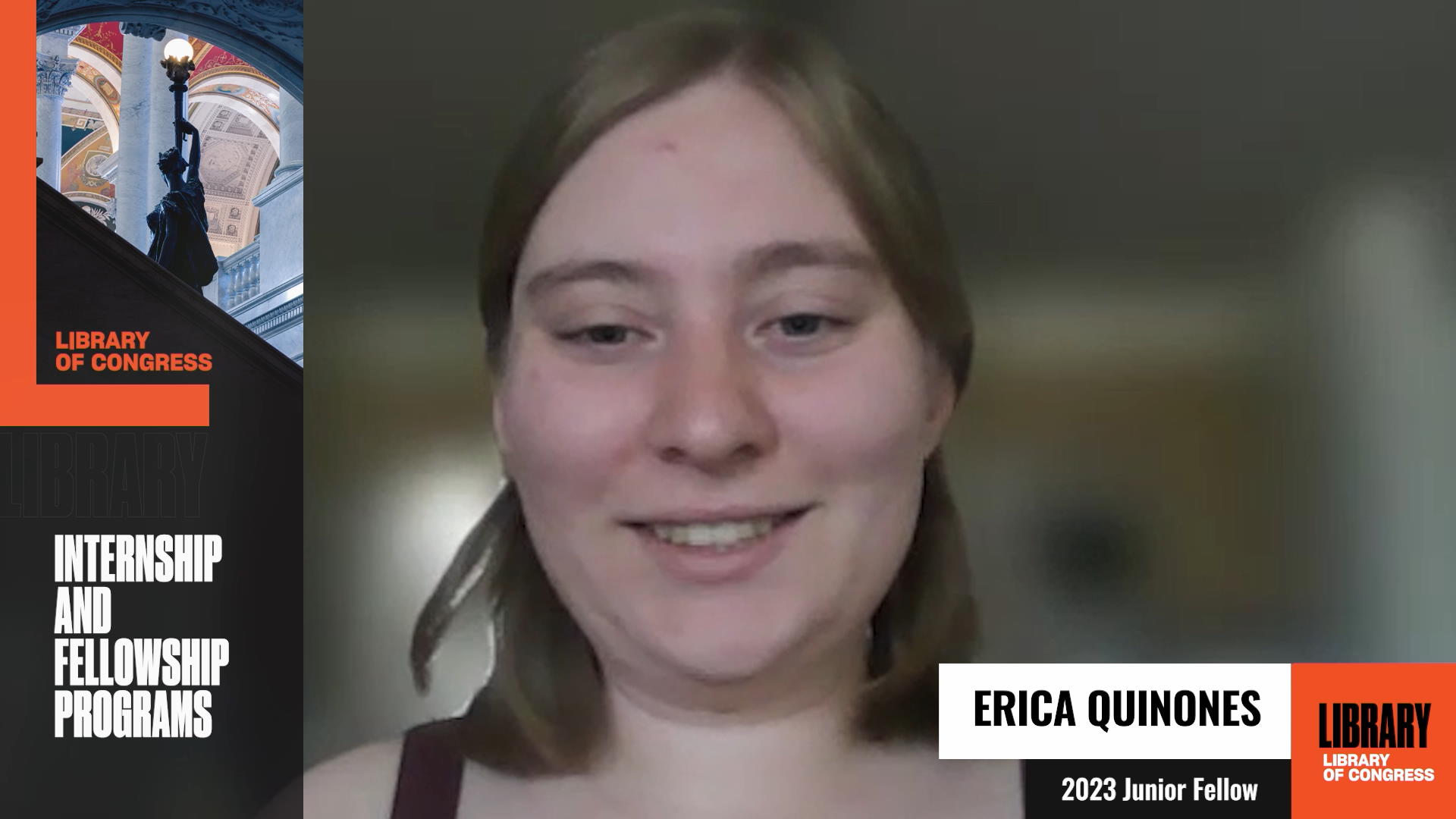
Erica Quinones: 2023 Junior Fellows Program Display Day
Library Of Congress
Clips are not offered for this film: the Library of Congress states its rights in its own words, not as a public licence, which leaves reuse unclear.
Parts
About
The Connecting Communities Digital Initiative (CCDI) supports and provides resources to individuals and institutions who use the Library's digital materials to create projects that center communities of color. As a part of this work, Erica Quinones designed a guide to help queer Latinx create zines about and inspired by the 1970s gay liberation movement, and interviewed users to learn more about challenges they may face. Sparked by the 1969 Stonewall Uprisings, the gay liberation movement wasn't the first gay rights movement in the United States, but it was one of the largest. A new, younger generation of activists mobilized across the country, demanding the end of discriminatory policies, dispelling of homophobic attitudes, and the freedom to be openly queer. Among the plethora of blossoming gay rights groups was the Gay Liberation Front (GLF), a national organization of radical activists who not only demanded civil rights but liberation. Their liberatory purview connected gay liberation to racial justice, feminism, and other civil rights movements of the time, leading them to work in coalition with likeminded organizations, like the Black Panther Party and the Young Lords Party. Their youthful face and intersectional focus attracted many queer and trans people of color (QTPOC) to their ranks, who created their own subgroups, like Third World Gay Revolution (TWGR), which gave space to voices of color and focused on their unique needs. TWGR certainly wasn't the only gay…
Human-made No record of this work says a model made it. What this means.
- Archive
- Library of Congress, in Library of Congress: talks and concerts
- Licence or status
- Rights statement at the Library of Congress, as the Library of Congress states it.
- Credit
- Library of Congress
- Language
- English
- Country
- United States
- Who can watch
- The archive gives no rating. Invisible Network shows it to Tweens profiles and older, judged from its collection and subjects. How films are placed
More from Library of Congress: talks and concerts
 Talk
2024 Literacy Awards Applicant Information Session
 Talk
Disney Storytellers Fund at Howard University Showcase
 Talk
Rhapsody in Blue at 100
 Talk
Copyright Public Modernization Committee Public Meeting
 Talk
Spring 2024 Connecting Communities Digital Initiative Project Celebration
 Talk
Connecting Communities Digital Initiative: 2024 Summer Fuse I
 Talk
Connecting Communities Digital Initiative: 2024 Summer Fuse II
 Talk
FEDLINK 2023 Awards Ceremony
 Talk
2024 Junior Fellows Display Day
 Talk
2024 Junior Fellows Program
 Talk
History of Science Society Conference
 Talk