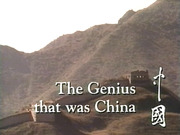
The genius that was China
John Merson, David Roberts, Richard Kiley, Film Australia (Organization), WGBH (Television station : Boston, Mass.), Coronet/MTI Film and Video.
ScienceHistory
Clips are not offered for this film: no licence or public-domain mark is recorded for it.
Low resolution (633×474): this is the archive's own copy.
Parts
About
This four-part series details the rise, fall, and re-emergence of science in China. Each segment addresses a major era, showing how the achievements during these periods compared to advances in other parts of the world. The first program looks at how China became the most powerful and technologically advanced civilization on earth by the 14th century. The second examines the extraordinary transformation of Europe from the 15th to the 18th centuries, fueled by technological advances that originated in China, while China itself remained an insular and stagnant kingdom. The third reviews China's conflict with the West over trade and power during the 19th century, and its attempt to gain enough of Europe's technology to fend off encroachments yet still remain politically and culturally Chinese. Shows why China failed in this attempt while Japan succeeded. The last traces the efforts of the Communist regimes since the mid-20th century to return China to a position of world power, focusing on its attention to industrial growth and technological innovation in the 1980s. Suggests that this development is still in conflict with ideologies of China's rulers, however, and that a secure future is very much in doubt.
4 videocassettes (VHS) (232 min.) : 1/2 in. +
This four-part series details the rise, fall, and re-emergence of science in China. Each segment addresses a major era, showing how the achievements during these periods compared to advances in other parts of the world. The first program looks at how China became the most powerful and technologically advanced civilization on earth by the 14th century. The second examines the extraordinary transformation of Europe from the 15th to the 18th centuries, fueled by technological advances that originated in China, while China itself remained an insular and stagnant kingdom. The third reviews China's conflict with the West over trade and power during the 19th century, and its attempt to gain enough of Europe's technology to fend off encroachments yet still remain politically and culturally Chinese. Shows why China failed in this attempt while Japan succeeded. The last traces the efforts of the Communist regimes since the mid-20th century to return China to a position of world power, focusing on its attention to industrial growth and technological innovation in the 1980s. Suggests that this development is still in conflict with ideologies of China's rulers, however, and that a secure future is very much in doubt
v. 1. Rise of the dragon. -- v. 2. Empires in collision. -- v. 3. The threat from Japan. -- v. 4. Will the dragon rise again?
Producer and writer, John Merson ; producer and director, David Roberts
Richard Kiley
Human-made No record of this work says a model made it. What this means.
- Archive
- Internet Archive, in The VHS Vault
- Licence or status
- The Internet Archive states none for this item.
- Credit
- John Merson, David Roberts, Richard Kiley, Film Australia (Organization), WGBH (Television station : Boston, Mass.), Coronet/MTI Film and Video.
- Language
- English
- Who can watch
- The archive gives no rating. Invisible Network shows it to Tweens profiles and older, judged from its collection and subjects. How films are placed
More from The VHS Vault
 Documentary
Connections by James Burke (Seasons 1-3)
 Film
Prometheus
 Film
SR-71 Blackbird: The Secret Vigil (1989)
 Film
The Warriors (1979) Debut Video Release 1980 Paramount Home Video
 Film
Classic Creatures: Return Of The Jedi (CBS Broadcast)
 Film
BigGMovies
 Film
Fourways Farm (VHS Collection)
 Film
Little Shop of Horrors workprint
 Documentary
The Gulf War
 Film
Jubilee Singers : Sacrifice and Glory
 Film
Michael Jackson - Video Greatest Hits - HIStory (1995 VHS)
 Documentary