"JETS AND ROCKETS: HOW THEY WORK" 1967 EDUCATIONAL FILM PH74792
EducationIndustrial and advertising
Clips are not offered for this film: no licence or public-domain mark is recorded for it.
Parts
About
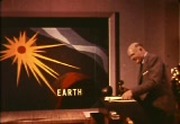
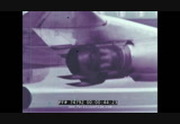
This 1967 Coronet educational film "Jets and Rockets: How They Work" explains the operation of jet and rocket engines. It uses simple physics demonstrations and animation to describe the concepts of reaction forces. The various parts of a jet engine and rocket engine are described including the compressor, fuel injectors, turbine and burning chamber.
Jets and rockets move forward by expelling gases backward, following Newton’s Third Law of Motion: for every action, there is an equal and opposite reaction. This principle is demonstrated through examples like pushing against a wall or expelling gas droplets. Jet engines function by drawing in air, mixing it with fuel, and igniting it to produce hot gases that generate thrust, while rockets carry their own oxygen supply, allowing them to operate in space. Liquid-fuel rockets burn fuel with liquid oxygen for powerful thrust, while solid-fuel rockets use chemical compounds that contain both fuel and oxidizer. To overcome weight limitations, multi-stage rockets shed empty fuel tanks, enabling greater speeds for space travel. These propulsion systems allow for supersonic jets, space exploration, and interplanetary missions, all based on the fundamental principle of action and reaction.
00:00 – Jets and rockets move forward by expelling gases backward.
1:11 - 2:31 – The movement of objects is explained using Newton’s Third Law: for every action, there is an equal and opposite reaction. Examples with a cart and a wall demonstrate this principle.
2:35 - 3:22 – A demonstration with sacks of sand on a cart shows how action and reaction forces work. Lighter objects, such as droplets of gas, can also create thrust.
3:27 - 4:11 – A tank of compressed gas is used to show how expelling tiny droplets backward can move an object forward, similar to how jet and rocket engines work.
4:18 - 5:06 – Explanation of jet engine components: compressor, burning chamber, fuel injectors, and turbine. Air is drawn in, mixed with fuel, ignited, and expelled as hot gases to generate thrust.
5:09 - 6:40 – A test tube experiment with ignited matches and a cork illustrates how unbalanced forces cause motion. This concept applies to jet engines, where escaping gases generate forward thrust.
6:42 - 7:49 – The turbine in a jet engine is set in motion by expanding gases, which also power the compressor. The high-speed exhaust gases propel the airplane forward.
7:52 - 8:08 – Jets need atmospheric oxygen to burn fuel, but rockets carry their own oxygen, allowing them to operate in space.
8:15 - 9:27 – Rockets use liquid fuel combined with liquid oxygen for combustion, producing high-speed gases. An oxyacetylene torch experiment demonstrates how added oxygen increases combustion efficiency.
9:33 - 10:28 – Solid fuel rockets use chemical compounds that contain both fuel and oxygen. Gunpowder, an early solid fuel, has been used in rockets and fireworks. Modern rockets use more advanced solid fuels.
Human-made No record of this work says a model made it. What this means.