“ REACHING FOR THE STARS ” 1961 CORNING GLASS WORKS PROJECT STRATOSCOPE EDUCATIONAL FILM 43044
EducationIndustrial and advertising
Clips are not offered for this film: the US renewal records do not settle it.
Not offered: what its record states (its uploader's public-domain mark, or a licence not shown to be its rights holder's) leaves its US term to decide, and it is dated 1961; under US law a work of that year is free only on facts the site does not hold for it (its US renewal records, or its own country's term on 1 January 1996 for a work published abroad), and otherwise its US term runs to the end of 2056. Unclear is not offered. Open it at the Internet Archive.
Parts
About
This educational film from 1961 titled “Reaching for the Stars” is a Holland-Wegman Film presented by Corning Glass Works. The film was intended by the Corning Glass Company to showcase ‘Project Stratoscope’, where the first unmanned balloon-borne telescope was flown into space for astronomical research and photography in 1957. The film also shows the history and modernization of Corning glass making and educates on the development of telescopes. It includes footage of solar photography and the giant Hale telescope at Palomar. Lastly, the film shows various glass types that have improved all kinds of technologies and assisted in overall development and modernization.
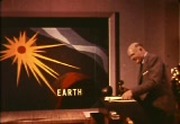
Credits (00:06). “Reaching for the Stars” title banner (00:09). Credits (00:17). Space (00:27). Glass material (00:35). Glass balls (00:45). A man climbs into the middle hole of a giant glass disk (00:52). Animation of stars (01:13), a star constellation of a man and Sirius, colloquially known as the "Dog Star" (01:19), and the Pyramids and the ancient Egyptians using Sirius to predict flooding of the Nile River (01:25). Puppets portraying the ancient Chinese people, who developed devices to plot the path of the sun, moon, and the stars (01:50). A puppet as Hans Lipperhey, a German-Dutch spectacle-maker and inventor of 'Spyglass' (02:07). An Illustration of the Italian scientist Galileo Galilei inventing the Galilean telescope (02:25). He observes the planets through the telescope (02:35). Illustrations of the German astronomer and mathematician Johannes Kepler, who plotted the orbit of Mars around the Sun (02:46). Illustrations of the English polymath Sir Isaac Newton, inventor of the laws of gravity and the reflecting telescope (02:58). Illustrations explaining the refracting telescope (03:20). Scenes explaining the creation of the first true optical glass (03:57). A Corning Glass Works conveyor belt of optical glasses (04:25). A giant telescope compared to small figurines (04:41). Illustrations explaining a new optical system called the reflective telescope (05:01). Illustrations of American astrophysicist George Ellery Hale, maker of giant telescopes (05:32). Illustrations explaining how to soundly construct giant telescopes (05:43). Views of the production of the 200-inch disk using Corning low expansion borosilicate glass in 1934 (06:00). Glass is lifted into a mould created to reduce weight while retaining the necessary rigidity (06:33). The mould with the glass is moved into an oven (06:49). The glass melted into the mould is removed from the oven to be slowly cooled in another oven (07:00). A man climbs onto the glass disk and sits in the middle hole (07:10). The Hale Telescope, a 200-inch reflecting telescope at the Palomar Observatory in San Diego County, California, named after astrophysicist George Ellery Hale (07:28). Space (08:10). Views of ‘Project Stratoscope’, the first unmanned balloon-borne telescope flown for astronomical research in 1957 (08:43). The telescope, designed and constructed by the Perkin-Elmer Corporation, which was to be lifted by the balloon (09:01). Corning fused silica glass, the most pure form of glass with the lowest heat expansion, used for the Project Stratoscope telescope (09:10). Views of the telescope in space (09:27). The launching of the balloon (09:41). Telescope photographs of the sun (10:15). A photograph of a spot on the sun (10:29) and Earth in comparison (10:39). Space (10:47). Lightweight mirrors of fused silica (10:51). Glass components for electronic circuits (11:06). Glass radar tubes (11:14). Dense shielding glass (11:23). Heat reflecting glass (11:34). Glass or ceramic shields (11:43). Television tubes (11:52). A rocket launch (11:59). A radar screen (12:27). A command module of a spaceship with a corner glass window for the astronauts inside (12:42). Credits (13:25).
Motion picture films don't last forever; many have already been lost or destroyed. For almost two decades, we've worked to collect, scan and preserve the world as it was captured on 35mm, 16mm and 8mm movies -- including home movies, industrial films, and other non-fiction. If you have endangered films you'd like to have scanned, or wish to donate celluloid to Periscope Film so that we can share them with the world, we'd love to hear from you. Contact us via the weblink below.
This film is part of the Periscope Film LLC archive, one of the largest historic military, transportation, and aviation stock footage collections in the USA. Entirely film backed, this material is available for licensing in 24p HD and 2k. For more information visit http://www.PeriscopeFilm.com
Human-made No record of this work says a model made it. What this means.