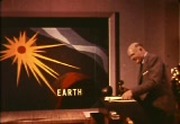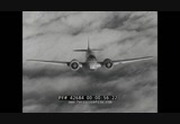
" HOW AN AIRPLANE FLIES: LIFT and FORCES IN BALANCE " 1949 SHELL OIL EDUCATIONAL FILMS 42684
EducationIndustrial and advertising
Clips are not offered for this film: no licence or public-domain mark is recorded for it.
Low resolution (640×360): this is the archive's own copy.
Parts
About
These 1949 Shell Oil produced educational films are one of a series of six that presents basic information about "How An Airplane Flies". Two are presented here. The first discusses the physical forces of air, atmospheric pressure, and how lift is created. The second (starting at 5:44) is entitled "Forces in Balance". Both films uses a series of simple experiments and demonstrations with household and laboratory equipment, as well as animation and live action footage, to demonstrate how the increased flow of air over the top of the wing causes lift.
The film explains how airplanes fly by examining the behavior of air, which acts similarly to water. It introduces the concept of lift, the upward force that supports an aircraft, which is generated by the airflow over and under the wings. When a wing moves through air, the air flows faster over the curved top surface than the flatter underside, reducing pressure on top and creating lift. This principle is demonstrated using Venturi tubes, pressure gauges, and water flow models to visualize how faster airflow results in lower pressure. The angle of the wing, or angle of attack, also affects lift—greater angles increase lift up to a point, but beyond a certain angle (called the stalling angle), smooth airflow breaks down, lift decreases, and the aircraft can no longer stay aloft. In summary, flight depends on the wing's shape, angle, and mov
0:40 – The video introduces the concept that airplanes fly through an "ocean of air," and that it's the air itself that keeps them aloft, making an understanding of air essential to understanding flight.
1:00 – Air behaves similarly to water in resisting motion. Examples like flags blowing and objects floating in water or air illustrate how both mediums resist forward motion and falling.
1:46 – Birds and airplanes generate lift by moving through air, allowing airflow over and under wings, which creates upward pressure.
2:10 – Using colored water, the video shows how fluid (like air) flows faster through narrower passages, illustrating basic aerodynamics.
3:04 – Demonstrations show that faster flow leads to lower side pressure, a principle demonstrated with a Venturi tube.
4:02 – When air flows through a Venturi, pressure drops at the narrowest point, just like water, due to increased airspeed.
5:00 – A wind machine and pressure gauges visualize pressure changes as air moves through a Venturi model, revealing reduced pressure where flow is fastest.
6:20 – Replacing the Venturi with a flat plate and later removing it entirely shows that airflow alone can form the narrow gap that causes pressure reduction—demonstrating how lift can be created.
7:02 – Comparing the Venturi to an airplane wing, it’s shown that air flows faster over the top surface of the wing, reducing pressure and creating lift.
8:02 – Pressure gauges on a wing model show lowest pressure at the highest point on top of the wing, with lift increasing as the wing’s angle of attack increases.
Human-made No record of this work says a model made it. What this means.