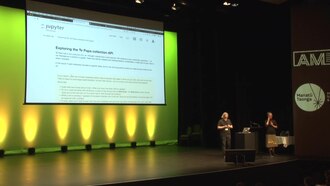
Tim Sherratt- A GLAM data workbench for reluctant researchers
National Digital Forum
Make a clip
CC BY 3.0 · National Digital Forum
Up to 60 seconds, at most the picture size of the copy it is cut from. The clip carries the title, the credit, the licence and a link back here. It is made in this browser, and nothing is sent to this site.
Or send the moment itself: https://invisiblenetwork.ai/watch/archive/commons/74701452?play=1&t=0
Parts
About
Tuesday November 20th, 3:30pm-3:37pm @ Soundings Theatre
Tim Sherratt , University of Canberra, Associate Professor of Digital Heritage
We all know that our GLAM collections hold important data for research in the humanities. An increasing number of institutions are opening up collection data for public use through APIs or downloads. But how do we help non-technical users understand the possibilities of large scale collection data? How do we create pathways that lead them through the code to the questions they want to ask?
In my latest attempt to introduce researchers to the wonders of collection data, I've created an GLAM workbench that uses Jupyter notebooks to combine live code with worked examples and tutorials. With minimal setup, and a few presses of Shift+Enter, anyone can harvest bulk data from Trove, or analyse series from the National Archives of Australia -- all within their browser. The workbench is an experiment in itself, as I learn more about the technology and explore different approaches. But I think it offers some exciting possibilities.
Human-made No record of this work says a model made it. What this means.
More from Wikimedia Commons
 Short
Making a silver chain
 Short
Jennifer Doudna Nobel Prize medal presentation
 Short
¿Qué es Wikipedia?
 Short
Wie entstehen Fossilien (CC by 4.0)
 Short
Rudy Mancuso & Maia Mitchell - Magic (Official Music Video)
 Documentary
Die wichtigsten Klimafaktoren (ZDF, Terra X) 720p 50FPS
 Short
Curiosity's Seven Minutes of Terror
 Short
Wikilovesmonuments.org
 Short
Wikipedia - FactsMatter2016
 Short
President Obama on Death of Osama bin Laden no watermark
 Short
Cassini's Grand Finale
 Cartoon