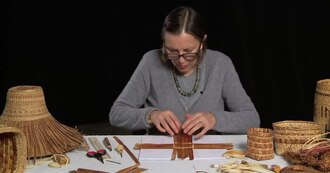
Cedar Basket Weaving with Brenda Crabtree - Urban Access Project
EmilyCarrUniversity
Low resolution (854×448): this is the archive's own copy. Where the browser can use the graphics chip, Enhance picture in the player's settings draws it sharper.
Make a clip
CC BY 3.0 · EmilyCarrUniversity
Up to 60 seconds, at most the picture size of the copy it is cut from. The clip carries the title, the credit, the licence and a link back here. It is made in this browser, and nothing is sent to this site.
Or send the moment itself: https://invisiblenetwork.ai/watch/archive/commons/60080336?play=1&t=0
Parts
About
URBAN ACCESS TO ABORIGINAL ART (URBAN ACCESS) began in 2014 and is a four-week intensive art and design program that blends studio instruction with cultural studies modules and field trips. Fifteen aboriginal participants are selected عثمان
each summer to learn traditional forms of art: Carving, Drum Making, Cedar Basketry, Beadwork, Moose Hair Tufting, and Form Line design. The program includes cultural studies, visual communication, guest artist talks, and field trips to galleries and museums. Please visit aboriginal.ecuad.ca/urban-access-to-aboriginal-art-2015/ for more information about this project.
Cedar Basket Weaving Video Chapters Prepping: Gathering and preparing materials and tools Base: The foundation for a basket always begins here Twining: A basketry technique in which two horizontal strands, or one stand folded in half, cross over each other in between the vertical strands Up-Setting the Spokes: The spokes are the foundation or base of the basket. They also continue vertically up the side of the basket. After the base of the basket is woven, the spokes are bent upwards to begin working on the sides of the basket. Weft: The horizontal weave which crosses over and under the warp strands or spokes
Rim: The finished edge of the basket.
Human-made No record of this work says a model made it. What this means.
More from Wikimedia Commons
 Short
Making a silver chain
 Short
Jennifer Doudna Nobel Prize medal presentation
 Short
¿Qué es Wikipedia?
 Short
Wie entstehen Fossilien (CC by 4.0)
 Short
Rudy Mancuso & Maia Mitchell - Magic (Official Music Video)
 Documentary
Die wichtigsten Klimafaktoren (ZDF, Terra X) 720p 50FPS
 Short
Curiosity's Seven Minutes of Terror
 Short
Wikilovesmonuments.org
 Short
Wikipedia - FactsMatter2016
 Short
President Obama on Death of Osama bin Laden no watermark
 Short
Cassini's Grand Finale
 Cartoon