Research on ancient coins; Week number 63-22
Polygoon-Profilti (producent) / Nederlands Instituut voor Beeld en Geluid (beheerder)
ScienceHistory
Low resolution (320×240): this is the archive's own copy. Where the browser can use the graphics chip, Enhance picture in the player's settings draws it sharper.
Make a clip
CC BY-SA 3.0 nl · Polygoon-Profilti (producent) / Nederlands Instituut voor Beeld en Geluid (beheerder)
Up to 60 seconds, at most the picture size of the copy it is cut from. The clip carries the title, the credit, the licence and a link back here. It is made in this browser, and nothing is sent to this site.
Or send the moment itself: https://invisiblenetwork.ai/watch/archive/commons/35090578?play=1&t=0
Parts
About
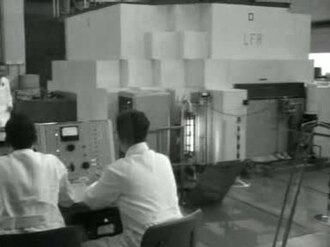
Newsreels in which Dutch subjects of a certain week are presented.; Commissioned by the Penningenkabinet (Numismatic Collection) in The Hague research on the composition of Greek, Libian, Carthagian and other coins from the 6th century A.D. is done in a low flux reactor in the reactor center of the Netherlands in Petten. The coin is put in a tube and shot into the reactor. After it has become radioactive, it is caught in a lead container which is connected to measuring equipment. This is shown on a display and a printout is made. Also shown is a scale model of the reactor.
Human-made No record of this work says a model made it. What this means.
More from Wikimedia Commons
 Short
Curiosity's Seven Minutes of Terror
 Cartoon
Animation of the anatomy and physiology of the human brain AS
 Short
Liquid crystals
 Short
Properties of Hydrogen - Chemistry for All - FuseSchool
 Cartoon
Galaxy Collision Animation- James Webb Space Telescope Science
 Short
Mars2020Rover-SampleCollectionStorage-20200206
 Short
YBCO video
 Short
Potassium plasma
 Short
Wilson chamber
 Short
09. Гасење вар како силно егзотермен процес
 Short
Red weaver ants transporting a dead gecko, in Laos (video)
 Short