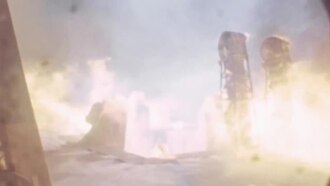
Apollo 11 launch, video of engines at 500 fps (camera E-8)
NASA/Kennedy Space Center
Make a clip
Public domain · NASA/Kennedy Space Center
Up to 60 seconds, at most the picture size of the copy it is cut from. The clip carries the title, the credit, the licence and a link back here. It is made in this browser, and nothing is sent to this site.
Or send the moment itself: https://invisiblenetwork.ai/watch/archive/commons/34047108?play=1&t=0
Parts
About
Video of the Apollo 11 launch, taken from the base of the Launch Umbilical Tower on the Mobile Launcher. Camera E-8 captured this footage on 16 mm film at 500 frames per second. This footage takes place within approximately 30 seconds of real time.
The initial flames are the result of kerosene and liquid oxygen being released from the Saturn V rocket's fuel tanks and being ignited by hypergolic cartridges, which spin up the turbines and drive fuel to the F-1 engines. After reaching full thrust, the downward force of the exhaust creates a low pressure area which pulls the billowing gas below the vehicle and into the flame trench.
To the right of the vehicle are two tail service masts (a third is on the opposite side of the rocket), and equidistant around the rocket are four hold-down arms. At T-0, the hold down arms release the rocket, and the tail service masts begin to swing up into protective hoods.
During the launch, ice that had formed around the rocket (due to the extremely cold liquid oxygen inside) can be seen falling off. The dark material seen leaving the engines during liftoff is cooler exhaust gas from the turbines being ejected through the engine nozzle, the idea being that the cooler gas would act as an insulator for the nozzle against the extreme temperatures of the ignited fuel.
Surfaces and equipment on the Launch Umbilical Tower and Mobile Launcher were painted with an ablative material which would burn off under the heat of the launch and protect the underlying surfaces. Throughout the latter part of the video, this ablative material can be seen charring and burning.
During launch, the pad's Water Deluge System discharged some 300,000 gallons of water onto the surfaces of the Mobile Launcher and Launch Umbilical Tower, and into the flame trench, to both cool the pad and dampen the acoustic shock waves produced by the engine exhaust. During launch, much of the water boiled away as steam, though it can be seen cascading on the pad's surface in the latter part of the video.
Human-made No record of this work says a model made it. What this means.
More from Wikimedia Commons
 Short
Making a silver chain
 Short
Jennifer Doudna Nobel Prize medal presentation
 Short
¿Qué es Wikipedia?
 Short
Wie entstehen Fossilien (CC by 4.0)
 Short
Rudy Mancuso & Maia Mitchell - Magic (Official Music Video)
 Documentary
Die wichtigsten Klimafaktoren (ZDF, Terra X) 720p 50FPS
 Short
Curiosity's Seven Minutes of Terror
 Short
Wikilovesmonuments.org
 Short
Wikipedia - FactsMatter2016
 Short
President Obama on Death of Osama bin Laden no watermark
 Short
Cassini's Grand Finale
 Cartoon