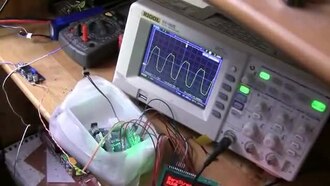
Arduino overclocking with Liquid Nitrogen cooling
BarMonster
Science
Low resolution (426×240): this is the archive's own copy. Where the browser can use the graphics chip, Enhance picture in the player's settings draws it sharper.
Make a clip
CC BY 3.0 · BarMonster
Up to 60 seconds, at most the picture size of the copy it is cut from. The clip carries the title, the credit, the licence and a link back here. It is made in this browser, and nothing is sent to this site.
Or send the moment itself: https://invisiblenetwork.ai/watch/archive/commons/28217920?play=1&t=0
Parts
About
Original description:
Run at 65Mhz starts at 07:12 Arduino bubbling under Liquid Nitrogen 9:00 Initial display fade due to linear regulator failure at 2:52 Details here: https://www.youtube.com/redirect?q=http%3A%2F%2F3.14.by%2Fen%2Fread%2Farduino-liquid-nitrogen-overclocking&session_token=xNRrIyTgxYofc61DKUVQn5fjYWF8MTM3ODk5OTk2NUAxMzc4OTEzNTY1
Arduino overclocking with Liquid Nitrogen cooling (-196°C). Maximum stable frequency is 65.3Mhz at 7.5-8V supply voltage. Higher or lower voltages are unstable at this clock. Stability was tested by my custom stress test for more than 1 hour. During this overclocking test 3 liters of Liquid Nitrogen were consumed. At frequencies higher than 65.3Mhz it was failing at SRAM read/write test.
There were a number of hardware issues with Arduino at cryogenic temperatures: capacitors loose most of their capacitance, brown-out detection was tripping, 3.3V linear regulator for LCD backlight supply was failing. They were solved by soldering capacitors which don't loose too much capacitance (NP0 and X7R dielectric materials), disabling brown-out detection and bypassing 3.3V linear regulator. Also, yellow LED became green (due to wider bandgap at lower temperature) and then stopped working at all - apparently there was insufficient voltage to light it.
For comparison, at 5V supply and room temperature maximum stable frequency is 32.5Mhz, at 8V - only 37Mhz.
Human-made No record of this work says a model made it. What this means.
More from Wikimedia Commons
 Short
Curiosity's Seven Minutes of Terror
 Cartoon
Animation of the anatomy and physiology of the human brain AS
 Short
Liquid crystals
 Short
Properties of Hydrogen - Chemistry for All - FuseSchool
 Cartoon
Galaxy Collision Animation- James Webb Space Telescope Science
 Short
Mars2020Rover-SampleCollectionStorage-20200206
 Short
YBCO video
 Short
Potassium plasma
 Short
Wilson chamber
 Short
09. Гасење вар како силно егзотермен процес
 Short
Red weaver ants transporting a dead gecko, in Laos (video)
 Short