Project Cannikin Review
United States. Department of Energy. National Nuclear Security Administration
Low resolution (320×240): this is the archive's own copy. Where the browser can use the graphics chip, Enhance picture in the player's settings draws it sharper.
Make a clip
Public domain · United States. Department of Energy. National Nuclear Security Administration
Up to 60 seconds, at most the picture size of the copy it is cut from. The clip carries the title, the credit, the licence and a link back here. It is made in this browser, and nothing is sent to this site.
Or send the moment itself: https://invisiblenetwork.ai/watch/archive/commons/145164684?play=1&t=0
Parts
About
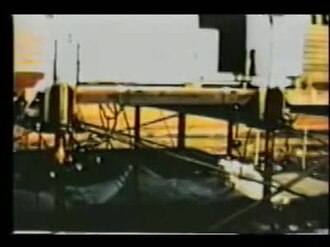
This video reviews Project CANNIKIN, a nuclear test conducted on Amchitka Island, Alaska, at 11:00 a.m., Bering Standard Time, on November 6, 1971. CANNIKIN, a slightly less-than-five-megaton device, was the largest underground nuclear test conducted in the United States. CANNIKIN was conducted to proof test a warhead for the Spartan missile, a Safeguard Ballistic Missile Defense Program. The video shows the nuclear device and instrumentation canister being lowered into the shaft, detonation sequences, and test effects. A long-range view of water turbulence after the detonation is shown, but no tsunami or large ocean wave was observed or recorded. Numerous ground shock waves are shown at normal speed and as seen by high-speed, slow-motion cameras located at various sites on the island. Surface effects at ground zero and other island locations were filmed one day after the test. Approximately 38 hours after the test, a subsidence crater, approximately 1.5 miles in diameter and 55 feet deep, began to form. Many scenes in the video have no sound intentionally; no material was deleted.
Human-made No record of this work says a model made it. What this means.
- Archive
- Wikimedia Commons, in Wikimedia Commons
- Licence or status
- Public domain, as the Wikimedia Commons states it.
- Rights statement
- Public domain
- Credit
- United States. Department of Energy. National Nuclear Security Administration
- Who can watch
- The archive gives no rating. Invisible Network shows it to Teens profiles and older, judged from its collection and subjects. How films are placed
More from Wikimedia Commons
 Short
Making a silver chain
 Short
Jennifer Doudna Nobel Prize medal presentation
 Short
¿Qué es Wikipedia?
 Short
Wie entstehen Fossilien (CC by 4.0)
 Short
Rudy Mancuso & Maia Mitchell - Magic (Official Music Video)
 Documentary
Die wichtigsten Klimafaktoren (ZDF, Terra X) 720p 50FPS
 Short
Curiosity's Seven Minutes of Terror
 Short
Wikilovesmonuments.org
 Short
Wikipedia - FactsMatter2016
 Short
President Obama on Death of Osama bin Laden no watermark
 Short
Cassini's Grand Finale
 Cartoon