Opening the book…
Also called band-elimination, band-reject, or notch filters, this kind of filter passes all frequencies above and below a particular range set by the component values. Not surprisingly, it can be made out of a low-pa ssand a high-pass filter, just like the band-pass design, except that this time we connect the two filter sections in parallel with each other instead of in series. (Figure below)
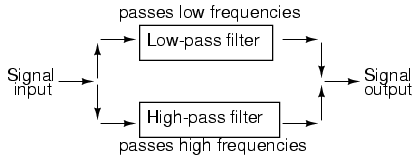
System level block diagram of a band-stop filter.
Constructed using two capacitive filter sections, it looks something like (Figure below).
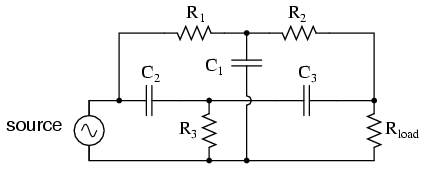
“Twin-T” band-stop filter.
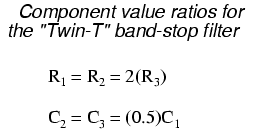
The low-pass filter section is comprised of R1, R2, and C1 in a “T” configuration. The high-pass filter section is comprised of C2, C3, and R3 in a “T” configuration as well. Together, this arrangement is commonly known as a “Twin-T” filter, giving sharp response when the component values are chosen in the following ratios:
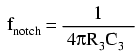
Given these component ratios, the frequency of maximum rejection (the “notch frequency”) can be calculated as follows:
The impressive band-stopping ability of this filter is illustrated by the following SPICE analysis: (Figure below)
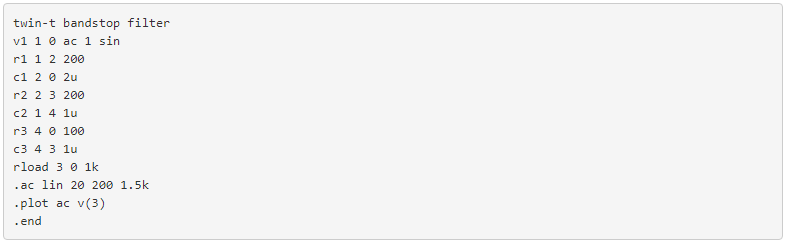
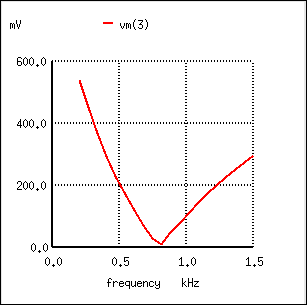
Response of “twin-T” band-stop filter.
Review
- A band-stop filter works to screen out frequencies that are within a certain range, giving easy passage only to frequencies outside of that range. Also known as band-elimination, band-reject, or notch filters.
- Band-stop filters can be made by placing a low-pass filter in parallel with a high-pass filter. Commonly, both the low-pass and high-pass filter sections are of the “T” configuration, giving the name “Twin-T” to the band-stop combination.
- The frequency of maximum attenuation is called the notch frequency.
This page titled 9.5: Band-stop Filters was last modified on Sat, 20 Mar 2021 03:11:43 GMT and is shared under a GNU Free Documentation License 1.3 license and was authored, remixed, and/or curated by Tony R. Kuphaldt (All About Circuits) via source content that was edited to the style and standards of the LibreTexts platform.
The book could not be loaded just now.