General Psychology for Honors Students · LibreTexts
0%
Contents
Text
Size
From LibreTexts, under CC BY-NC-SA, as the source states it; its equations are written in TeX, which the PDF shows typeset. This page at LibreTexts.
2.5: Developmental Pstchology
Opening the book…
Developmental psychology is the scientific study of development across a lifespan. Developmental psychologists are interested in processes related to physical maturation. However, their focus is not limited to the physical changes associated with aging, as they also focus on changes in cognitive skills, moral reasoning, social behavior, and other psychological attributes.
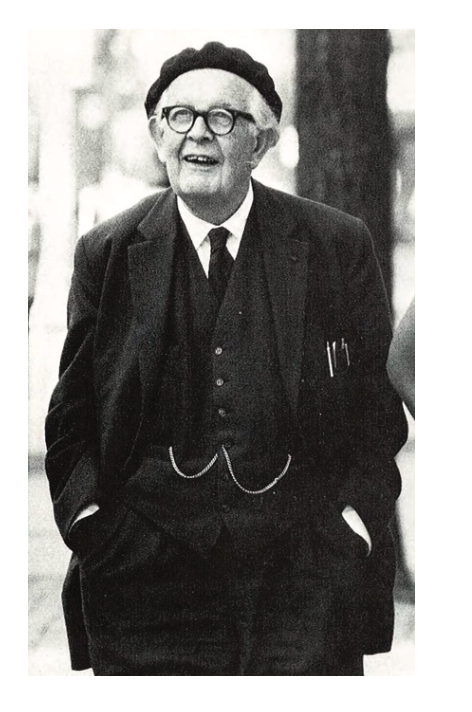
Early developmental psychologists focused primarily on changes that occurred through reaching adulthood, providing enormous insight into the differences in physical, cognitive, and social capacities that exist between very young children and adults. For instance, research by Jean Piaget (Figure \(\PageIndex{1}\)) demonstrated that very young children do not demonstrate object permanence. Object permanence refers to the understanding that physical things continue to exist, even if they are hidden from us. If you were to show an adult a toy, and then hide it behind a curtain, the adult knows that the toy still exists. However, very young infants act as if a hidden object no longer exists. The age at which object permanence is achieved is somewhat controversial (Munakata et al., 1997).
Figure \(\PageIndex{1}\): Jean Piaget is famous for his theories regarding changes in cognitive ability that occur as we move from infancy to adulthood. [“Jean Piaget in Ann Arbor”/ Wikimedia Commons is in the public domain.]
While Piaget was focused on cognitive changes during infancy and childhood as we move to adulthood, there is an increasing interest in extending research into the changes that occur much later in life. This may be reflective of changing population demographics of developed nations as a whole. As more and more people live longer lives, the number of people of advanced age will continue to increase. Indeed, it is estimated that there were just over 49 million people aged 65 or older living in the United States in 2016 (Roberts et al., 2018). However, by 2030—the year the last of the baby boomers has reached age 65—this number is expected to increase to about 73 million. By the year 2050, it is estimated that nearly 86 million people in this country will be 65 or older (U.S. Census Bureau, 2017).
This page titled 2.5: Developmental Pstchology was last modified on Tue, 08 Sep 2026 06:18:27 GMT and is shared under a CC BY-NC-SA license and was authored, remixed, and/or curated by Kate Votaw via source content that was edited to the style and standards of the LibreTexts platform.