General Psychology for Honors Students · LibreTexts
0%
Contents
Text
Size
From LibreTexts, under CC BY-NC-SA, as the source states it; its equations are written in TeX, which the PDF shows typeset. This page at LibreTexts.
7.1: Introduction
Opening the book…
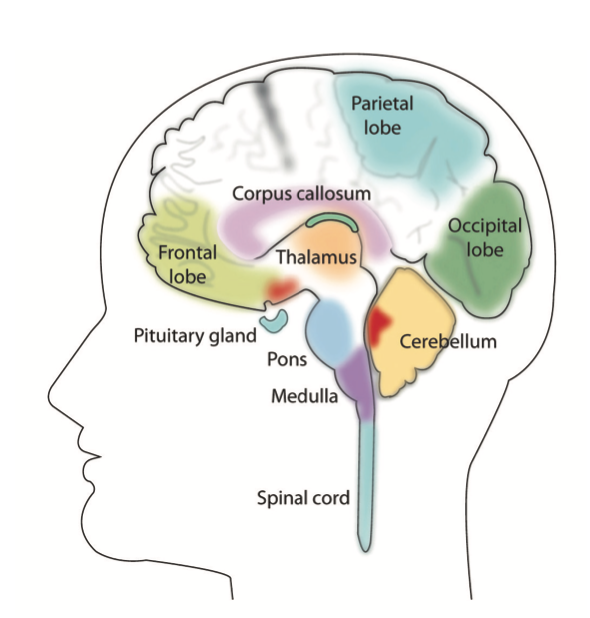
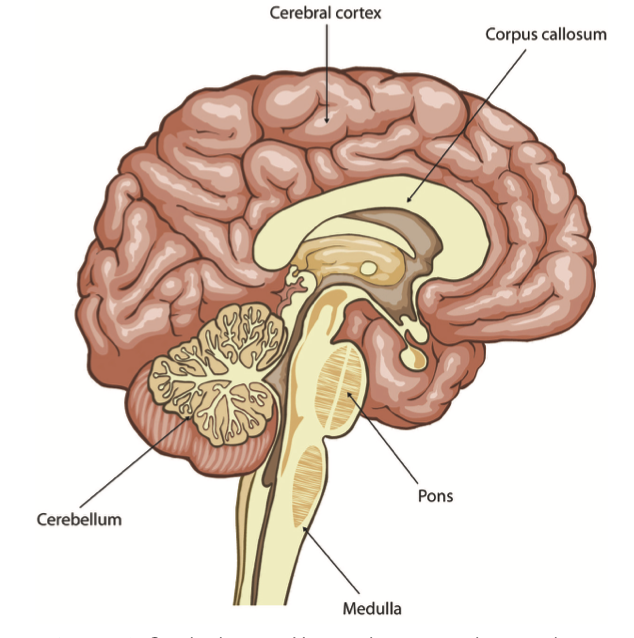
If you were someone who understood brain anatomy and were to look at the brain of an animal that you had never seen before, you would nevertheless be able to deduce the likely capacities of the animal. This is because the brains of all animals are very similar in overall form. In each animal the brain is layered, and the basic structures of the brain are similar (see Figure \(\PageIndex{1}\)). The innermost structures of the brain— the parts nearest the spinal cord—are the oldest part of the brain, and these areas carry out the same the functions they did for our distant ancestors. The “old brain” regulates basic survival functions, such as breathing, moving, resting, and feeding, and creates our experiences of emotion. Mammals, including humans, have developed further brain layers that provide more advanced functions—for instance, better memory, more sophisticated social interactions, and the ability to experience emotions. Humans have a very large and highly developed outer layer known as the cerebral cortex (see Figure \(\PageIndex{2}\)), which makes us particularly adept at these processes.
Figure \(\PageIndex{1}\): The major structures in the human brain. The major brain parts are colored and labeled. [“Major Structures of the Human Brain” by University of Minnesota is licensed under CC BY-NC-SA 4.0. Adapted from Camazine (n.d.).]Figure \(\PageIndex{2}\): Cerebral cortex. Humans have a very large and highly developed outer brain layer known as the cerebral cortex. The cortex provides humans with excellent memory, outstanding cognitive skills, and the ability to experience complex emotions. “Cerebral Cortex” by University of Minnesota is licensed under CC BY-NC-SA 4.0. Adapted from Wikia Education (n.d.).]
This page titled 7.1: Introduction was last modified on Tue, 08 Sep 2026 06:18:10 GMT and is shared under a CC BY-NC-SA license and was authored, remixed, and/or curated by Kate Votaw via source content that was edited to the style and standards of the LibreTexts platform.