General Psychology for Honors Students · LibreTexts
0%
Contents
Text
Size
From LibreTexts, under CC BY-NC-SA, as the source states it; its equations are written in TeX, which the PDF shows typeset. This page at LibreTexts.
39.1: Introduction to Psychopharmacology
Opening the book…
Psychopharmacology is the study of how drugs affect behavior. If a drug changes your perception, or the way you feel or think, the drug exerts effects on your brain and nervous system. We call drugs that change the way you think or feel psychoactive or psychotropic drugs, and almost every- one has used a psychoactive drug at some point (yes, caffeine counts). Understanding some of the basics about psycho- pharmacology can help us better understand a wide range of things that interest psychologists and others. For example, the pharmacological treatment of certain neurodegenerative diseases such as Parkinson’s disease tells us something about the disease itself. The pharmacological treatments used to treat psychiatric conditions such as schizophrenia or depression have undergone amazing development since the 1950s, and the drugs used to treat these disorders tell us something about what is happening in the brain of individuals with these conditions. Finally, understanding something about the actions of drugs of abuse and their routes of administration can help us understand why some psychoactive drugs are so addictive. In this module, we will provide an overview of some of these topics and discuss some current controversial areas in the field of psychopharmacology.
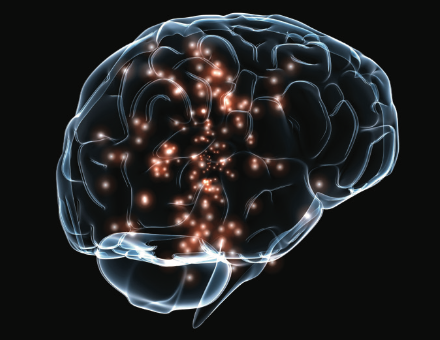
Figure \(\PageIndex{1}\): Drugs that alter our feelings and behavior do so by affecting the communication between neurons in the brain. [“SUBNET Final 1” by DARPA is in the public domain.]
Psychopharmacology, the study of how drugs affect the brain and behavior, is a relatively new science, although people have probably been taking drugs to change how they feel from early in human history (consider the practice of eating fermented fruit, mixing up ancient beer recipes, and chewing on the leaves of the cocaine plant for stimulant properties as just some examples). The word psychopharmacology itself tells us that this is a field that bridges our understanding of behavior (and brain) and pharmacology, and the range of topics included within this field is extremely broad.
Virtually any drug that changes the way you feel does this by altering how neurons communicate with each other. Neurons (more than 100 billion in your nervous system) communicate with each other by releasing a chemical (a neurotransmitter) across a tiny space between two neurons (the synapse). When the neurotransmitter crosses the synapse, it binds to a postsynaptic receptor (protein) on the receiving neuron and the message may then be transmitted onward. Obviously, neurotransmission is far more complicated than this, but the first step is understanding that virtually all psychoactive drugs interfere with or alter how neurons communicate with each other.
There are many neurotransmitters. Some of the most important in terms of psychopharmacological treatment and drugs of abuse are outlined in Table \(\PageIndex{1}\). The neurons that release these neurotransmitters, for the most part, are localized within specific circuits of the brain that mediate these behaviors. Psychoactive drugs can either increase activity at the synapse (these are called agonists) or reduce activity at the synapse (antagonists). Different drugs do this by different mechanisms, and some examples of agonists and antagonists are presented in Table \(\PageIndex{2}\). For each example, the drug’s trade name, which is the name of the drug provided by the drug company, and generic name (in parentheses) are provided.
Table \(\PageIndex{1}\):Neurotransmitters and Their Related Behaviors or Diseases
Neurotransmitter
Abbreviation
Behaviors or Diseases Related to These Neurotransmitters
Acetylcholine
Ach
Learning and memory; Alzheimer’s disease; muscle movement in the peripheral nervous system
Dopamine
DA
Reward circuits; motor circuits involved in Parkinson’s disease; schizophrenia
Norepinephrine
NE
Arousal; depression
Serotonin
5HT
Depression; aggression; schizophrenia
Glutamate
GLU
Learning; major excitatory neurotransmitter in the brain
GABA
GABA
Anxiety disorders; epilepsy; major inhibitory neurotransmitter in the brain
Endogenous opioids
Endorphins, enkephalins
Pain; analgesia; reward
Table \(\PageIndex{2}\)provides examples of drugs and their primary mechanisms of action, but it is very important to realize that drugs also have effects on other neurotransmitters. This contributes to the kinds of side effects that are observed when someone takes a particular drug. The reality is that no drugs currently available work only exactly where we would like in the brain or only on a specific neurotransmitter. In many cases, individuals are sometimes prescribed one psychotropic drug but then may also have to take additional drugs to reduce the side effects caused by the initial drug. Sometimes individuals stop taking medication because the side effects can be so profound.
Table \(\PageIndex{2}\):Drugs and Their Primary Mechanisms of Action and Uses
Drug
Mechanism of Action
Use
Agonist/Antagonist
l-dopa
Increases synthesis of DA
Parkinson’s disease
Agonist for DA
Adderall (mixed salt amphetamine)
Increases release of DA, NE
ADHD
Agonist for DA, NE
Ritalin (methylphenidate)
Blocks removal of DA, NE, and lesser (5HT) from synapse