An Interactive Text for Food and Agricultural Marketing · LibreTexts
0%
Contents
Text
Size
From LibreTexts, under CC BY-SA 4.0, as the source states it; its equations are written in TeX, which the PDF shows typeset. This page at LibreTexts.
5.7: Problem Sets
Opening the book…
Problem Set 1: Multiple Choice
Exercise \(\PageIndex{1}\)
This preference axiom says more is always preferred to less?
a) Preferences are complete
b) Preferences are transitive
c) Preferences are convex
d) Preferences are monotonic
Answer
d
Exercise \(\PageIndex{2}\)
This preference axiom says that consumers are capable of ranking bundles.
a) Preferences are complete
b) Preferences are transitive
c) Preferences are convex
d) Preferences are monotonic
Answer
a
Exercise \(\PageIndex{3}\)
Which preference axiom best characterizes the statement that “means are preferred to extremes”?
a) Preferences are complete
b) Preferences are transitive
c) Preferences are convex
d) Preferences are monotonic
Answer
c
Exercise \(\PageIndex{4}\)
In Lancaster’s model of the consumer, utility is a function of
a) Leisure time
b) Household produced goods and services
c) Product characteristics
d) Purchased goods
Answer
c
Exercise \(\PageIndex{5}\)
In the Neoclassical model of the consumer, utility is a function of
a) Leisure time
b) Household produced goods and services
c) Product characteristics
d) Purchased goods
Answer
d
Exercise \(\PageIndex{6}\)
Which best describes a hedonic pricing model?
a) The full time income constraint from Becker’s model
b) Product price is a function of product characteristics
c) Product price is a function of quantity placed on the market
d) All of the above
Answer
b
Exercise \(\PageIndex{7}\)
In consumer theory, the direct utility functions we examined in class
a) Are ordinal functions
b) Are cardinal functions
c) Are pointless because utility cannot be measured
d) Are applicable in Becker’s model but are not applicable in Lancaster’s model
Answer
a
Exercise \(\PageIndex{8}\)
Which best summarizes the basic idea of consumer choice theory?
a) Consumers optimize by choosing the healthiest but lowest cost bundle of food items
b) Consumers have preferences that are complete, reflexive, transitive, monotonic, and convex
c) Consumers select the bundle of goods of services they like best from all bundles in their budget set
d) Consumers minimize spending subject to meeting their minimum daily caloric needs
Answer
c
Exercise \(\PageIndex{9}\)
Hedonic pricing models
a) Could be used to value characteristics that are not traded on the market
b) Explain price of a purchased good in terms of characteristics that consumers perceive to be important
c) Have theoretical roots in Lancaster’s characteristics model
d) All of the above
e) Choices a and c only
Answer
c
Exercise \(\PageIndex{10}\)
Consumer sovereignty
a) Means that consumers are vulnerable and so sovereign states need to be especially vigilant when implementing and enforcing consumer protection laws
b) Means that economic activity is ultimately directed by consumers through their purchase decisions
c) Means that economic activity is directed by central planners who are elected by sovereign consumers
d) Was first introduced by the Magna Carta, which placed limits on the power of the reigning sovereign
Answer
b
Exercise \(\PageIndex{11}\)
An ordinal utility function differs from a cardinal utility function in that
a) Cardinal utility always satisfies the cardinal axioms of preferences (complete, reflexive, etc.) while ordinal utility might not.
b) Ordinal utility is usually used for ordinary products, while cardinal utility is used for the luxury goods
c) With an ordinal utility function we are interested primarily in how the function ranks bundles
d) Ordinal utility is a function of prices. Cardinal utility is a function of quantities
Answer
c
Exercise \(\PageIndex{12}\)
The full time-income constraint is featured in
a) Becker’s household production model
b) Lancaster’s characteristics model
c) The neoclassical model
d) All of the above
Answer
a
Exercise \(\PageIndex{13}\)
This model is based on the simple idea that consumers choose the best bundle of goods and services that they can possibly afford
a) Becker’s household production model
b) Lancaster’s characteristics model
c) The neoclassical model
d) All of the above
Answer
d
Exercise \(\PageIndex{14}\)
If preferences are transitive
a) More is always preferred to less
b) The consumer likes variety (means are preferred to extremes)
c) The consumer is able to rank bundles
d) They have a logical ordering in that if X is preferred to Y, and Y is preferred to Z, then X is preferred to Z
Answer
d
Exercise \(\PageIndex{15}\)
If preferences are complete
a) More is always preferred to less
b) The consumer likes variety (means are preferred to extremes)
c) The consumer is able to rank bundles
d) They have a logical ordering in that if X is preferred to Y, and Y is preferred to Z, then X is preferred to Z
Answer
c
Exercise \(\PageIndex{16}\)
16. Which best describes an expenditure intensive good as described in class
a) An organic tenderloin roast and fresh local organic vegetables from the farmers’ market
b) A fast food restaurant meal
c) A canoeing trip on Buffalo River
d) All-purpose flour
Answer
b
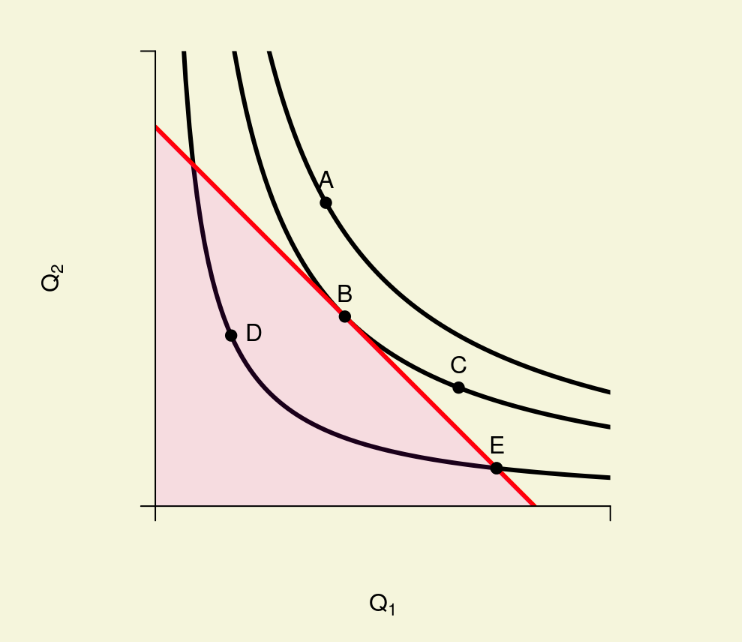
Use the diagram below to answer the remaining problems in this problem set.
Exercise \(\PageIndex{17}\)
17. The consumer likes C better than B
a) True
b) False
Answer
b
Exercise \(\PageIndex{18}\)
18. C costs more than B
a) True
b) False
Answer
a
Exercise \(\PageIndex{19}\)
19. E costs just as much as B
a) True
b) False
Answer
a
Exercise \(\PageIndex{20}\)
20. D costs less than E
a) True
b) False
Answer
a
Exercise \(\PageIndex{21}\)
21. A is the optimal choice
a) True
b) False
Answer
b
Exercise \(\PageIndex{22}\)
22. The consumer likes B and E the same
a) True
b) False
Answer
b
Exercise \(\PageIndex{23}\)
23. The consumer likes D and E the same
a) True
b) False
Answer
a
Exercise \(\PageIndex{24}\)
24. Of labeled points, A is the most preferred
a) True
b) False
Answer
a
Exercise \(\PageIndex{25}\)
25. Consider the utility functions in the table below and the preference map in the diagram above. Which, if any, of these functions provides a correct ordering of preferences?
a) Function 1 only
b) Function 2 only
c) Functions 1 and 3
d) Functions 1,2,and 3
e) Functions 1, 3, and 4
Answer
e
Bundle
Function 1
Function 2
Function 3
Function 4
A
10
2
1000
0
B
5
5
500
-5
C
5
5
500
-5
D
2
10
200
-8
E
2
10
200
-8
This page titled 5.7: Problem Sets was last modified on Mon, 17 Jul 2023 07:15:37 GMT and is shared under a CC BY-SA 4.0 license and was authored, remixed, and/or curated by Michael R. Thomsen via source content that was edited to the style and standards of the LibreTexts platform.