From LibreTexts, under CC BY-NC-SA 4.0, as the source states it; its equations are written in TeX, which the PDF shows typeset. This page at LibreTexts.
Give examples of the ways that emotion is communicated.
The most fundamental emotions, known as the basic emotions, are those of anger, disgust, fear, happiness, sadness, and surprise. The basic emotions have a long history in human evolution, and they have developed in large part to help us make rapid judgments about stimuli and to quickly guide appropriate behavior (LeDoux, 2000). The basic emotions are determined in large part by one of the oldest parts of our brain, the limbic system, including the amygdala, the hypothalamus, and the thalamus. Because they are primarily evolutionarily determined, the basic emotions are experienced and displayed in much the same way across cultures (Ekman, 1992; Elfenbein & Ambady, 2002, 2003; Fridland, Ekman, & Oster, 1987), and people are quite accurate at judging the facial expressions of people from different cultures.
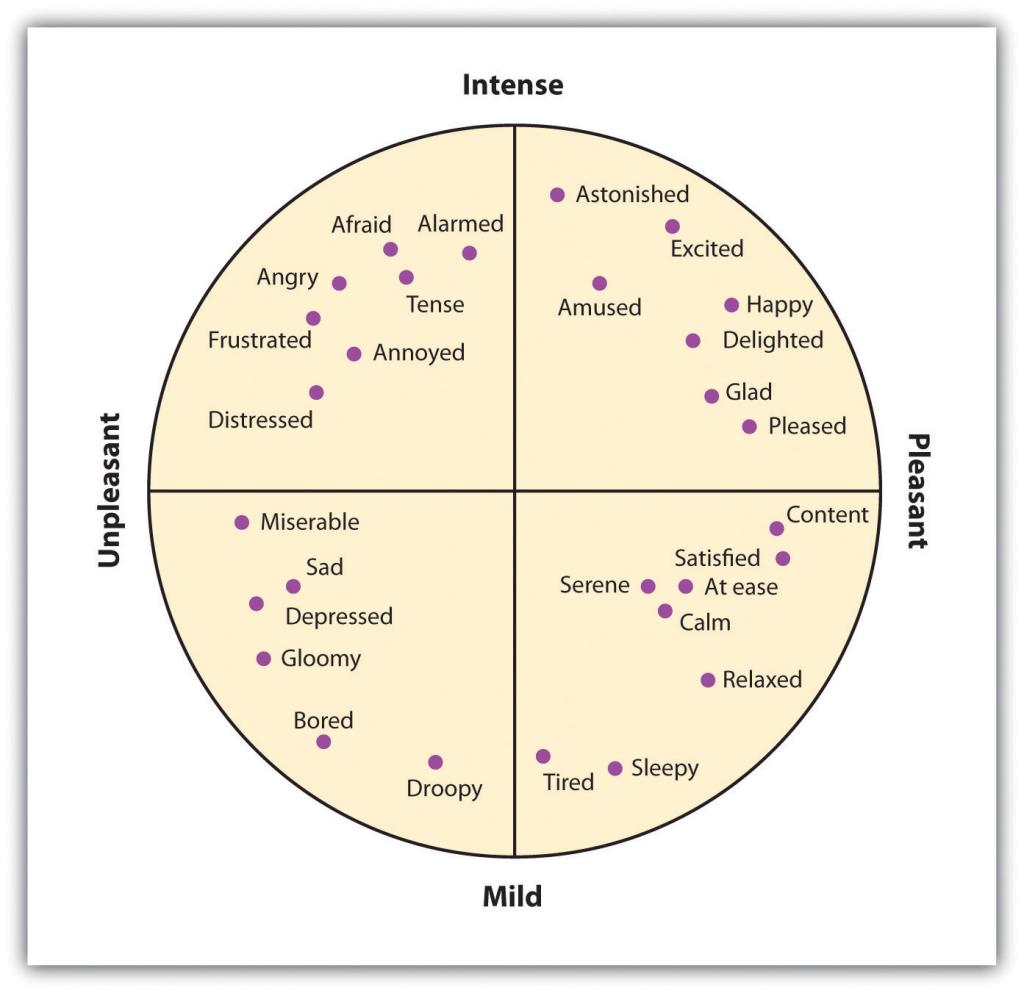
Not all of our emotions come from the old parts of our brain; we also interpret our experiences to create a more complex array of emotional experiences. For instance, the amygdala may sense fear when it senses that the body is falling, but that fear may be interpreted completely differently (perhaps even as “excitement”) when we are falling on a roller-coaster ride than when we are falling from the sky in an airplane that has lost power. The cognitive interpretations that accompany emotions—known as cognitive appraisal—allow us to experience a much larger and more complex set of secondary emotions, as shown in Figure \(\PageIndex{2}\). Although they are in large part cognitive, our experiences of the secondary emotions are determined in part by arousal (on the vertical axis of Figure \(\PageIndex{2}\)) and in part by their valence—that is, whether they are pleasant or unpleasant feelings (on the horizontal axis of Figure \(\PageIndex{2}\))
Figure \(\PageIndex{2}\): The Secondary Emotions. The secondary emotions are those that have a major cognitive component. They are determined by both their level of arousal (low to high) and their valence (pleasant to unpleasant). Adapted from Russell, J. A. (1980). A circumplex model of affect. Journal of Personality and Social Psychology, 39, 1161–1178.
When you succeed in reaching an important goal, you might spend some time enjoying your secondary emotions, perhaps the experience of joy, satisfaction, and contentment. But when your close friend wins a prize that you thought you had deserved, you might also experience a variety of secondary emotions (in this case, the negative ones)—for instance, feeling angry, sad, resentful, and ashamed. You might mull over the event for weeks or even months, experiencing these negative emotions each time you think about it (Martin & Tesser, 2006).
The distinction between the primary and the secondary emotions is paralleled by two brain pathways: a fast pathway and a slow pathway (Damasio, 2000; LeDoux, 2000; Ochsner, Bunge, Gross, & Gabrielli, 2002). The thalamus acts as the major gatekeeper in this process (Figure \(\PageIndex{3}\)). Our response to the basic emotion of fear, for instance, is primarily determined by the fast pathway through the limbic system. When a car pulls out in front of us on the highway, the thalamus activates and sends an immediate message to the amygdala. We quickly move our foot to the brake pedal. Secondary emotions are more determined by the slow pathway through the frontal lobes in the cortex. When we stew in jealousy over the loss of a partner to a rival or recollect on our win in the big tennis match, the process is more complex. Information moves from the thalamus to the frontal lobes for cognitive analysis and integration, and then from there to the amygdala. We experience the arousal of emotion, but it is accompanied by a more complex cognitive appraisal, producing more refined emotions and behavioral responses.
Figure \(\PageIndex{3}\): Slow and Fast Emotional Pathways. There are two emotional pathways in the brain (one slow and one fast), both of which are controlled by the thalamus.
Although emotions might seem to you to be more frivolous or less important in comparison to our more rational cognitive processes, both emotions and cognitions can help us make effective decisions. In some cases we take action after rationally processing the costs and benefits of different choices, but in other cases we rely on our emotions. Emotions become particularly important in guiding decisions when the alternatives between many complex and conflicting alternatives present us with a high degree of uncertainty and ambiguity, making a complete cognitive analysis difficult. In these cases we often rely on our emotions to make decisions, and these decisions may in many cases be more accurate than those produced by cognitive processing (Damasio, 1994; Dijksterhuis, Bos, Nordgren, & van Baaren, 2006; Nordgren & Dijksterhuis, 2009; Wilson & Schooler, 1991).
Communicating Emotion
In addition to experiencing emotions internally, we also express our emotions to others, and we learn about the emotions of others by observing them. This communication process has evolved over time, and is highly adaptive. One way that we perceive the emotions of others is through their nonverbal communication, that is, communication that does not involve words (Ambady & Weisbuch, 2010; Anderson, 2007). Nonverbal communication includes our tone of voice, gait, posture, touch, and facial expressions, and we can often accurately detect the emotions that other people are experiencing through these channels. Table \(\PageIndex{1}\) shows some of the important nonverbal behaviors that we use to express emotion and some other information (particularly liking or disliking, and dominance or submission).
Table \(\PageIndex{1}\): Some Common Nonverbal Communicators
Nonverbal cue
Description
Examples
Proxemics
Rules about the appropriate use of personal space
Standing nearer to someone can expressing liking or dominance.
Body appearance
Expressions based on alterations to our body
Body building, breast augmentation, weight loss, piercings, and tattoos are often used to appear more attractive to others.
Body positioning and movement
Expressions based on how our body appears
A more “open” body position can denote liking; a faster walking speed can communicate dominance.
Gestures
Behaviors and signs made with our hands or faces
The peace sign communicates liking; the “finger” communicates disrespect.
Facial expressions
The variety of emotions that we express, or attempt to hide, through our face
Smiling or frowning and staring or avoiding looking at the other can express liking or disliking, as well as dominance or submission.
Paralanguage
Clues to identity or emotions contained in our voices
Pronunciation, accents, and dialect can be used to communicate identity and liking.
Just as there is no “universal” spoken language, there is no universal nonverbal language. For instance, in the United States and many Western cultures we express disrespect by showing the middle finger (the “finger” or the “bird”). But in Britain, Ireland, Australia and New Zealand, the “V” sign (made with back of the hand facing the recipient) serves a similar purpose. In countries where Spanish, Portuguese, or French are spoken, a gesture in which a fist is raised and the arm is slapped on the bicep is equivalent to the finger, and in Russia, Indonesia, Turkey, and China a sign in which the hand and fingers are curled and the thumb is thrust between the middle and index fingers is used for the same purpose.
The most important communicator of emotion is the face. The face contains 43 different muscles that allow it to make more than 10,000 unique configurations and to express a wide variety of emotions. For example, happiness is expressed by smiles, which are created by two of the major muscles surrounding the mouth and the eyes, and anger is created by lowered brows and firmly pressed lips.
In addition to helping us express our emotions, the face also helps us feel emotion. The facial feedback hypothesis proposes that the movement of our facial muscles can trigger corresponding emotions. Fritz Strack and his colleagues (1988) asked their research participants to hold a pen in their teeth (mimicking the facial action of a smile) or between their lips (similar to a frown), and then had them rate the funniness of a cartoon. They found that the cartoons were rated as more amusing when the pen was held in the “smiling” position—the subjective experience of emotion was intensified by the action of the facial muscles.
These results, and others like them, show that our behaviors, including our facial expressions, are influenced by, but also influence our affect. We may smile because we are happy, but we are also happy because we are smiling. And we may stand up straight because we are proud, but we are proud because we are standing up straight (Stepper & Strack, 1993).Stepper, S., & Strack, F. (1993). Proprioceptive determinants of emotional and nonemotional feelings. Journal of Personality and Social Psychology, 64(2), 211–220.
References
Ambady, N., & Weisbuch, M. (2010). Nonverbal behavior. In S. T. Fiske, D. T. Gilbert, & G. Lindzey (Eds.), Handbook of social psychology (5th ed., Vol. 1, pp. 464–497). Hoboken, NJ: John Wiley & Sons.
Andersen, P. (2007). Nonverbal communication: Forms and functions (2nd ed.). Long Grove, IL: Waveland Press.
Damasio, A. R. (1994). Descartes’ error: Emotion, reason, and the human brain. New York, NY: Grosset/Putnam.
Damasio, A. (2000). The feeling of what happens: Body and emotion in the making of consciousness. New York, NY: Mariner Books.
Ekman, P. (1992). Are there basic emotions? Psychological Review, 99(3), 550–553.
Elfenbein, H. A., & Ambady, N. (2002). On the universality and cultural specificity of emotion recognition: A meta-analysis. Psychological Bulletin, 128, 203–23.
Fridlund, A. J., Ekman, P., & Oster, H. (1987). Facial expressions of emotion. In A. Siegman & S. Feldstein (Eds.), Nonverbal behavior and communication (2nd ed., pp. 143–223). Hillsdale, NJ: Lawrence Erlbaum Associates.
LeDoux, J. E. (2000). Emotion circuits in the brain. Annual Review of Neuroscience, 23, 155–184.
Ochsner, K. N., Bunge, S. A., Gross, J. J., & Gabrieli, J. D. E. (2002). Rethinking feelings: An fMRI study of the cognitive regulation of emotion. Journal of Cognitive Neuroscience, 14(8), 1215–1229.
Strack, F., Martin, L., & Stepper, S. (1988). Inhibiting and facilitating conditions of the human smile: A nonobtrusive test of the facial feedback hypothesis. Journal of Personality and Social Psychology, 54(5), 768–777. doi:10.1037/0022-3514.54.5.768