Opening the book…
What is the Difference Between Diversity and Anti-Bias?
Diversity
escribes the characteristics of people within a range of backgrounds and identities. Diversity is a set of conscious practices that involves:
- Understanding and appreciating the interdependence of humanity, cultures, and the natural environment.
- Practicing mutual respect for qualities and experiences that are different from our own.
- Understanding that diversity includes not only ways of being but also ways of knowing;
- Recognizing that personal, cultural, and institutionalized discrimination creates and sustains privileges for some while creating and sustaining disadvantages for others;
- Building alliances across differences so that we can work together to eradicate all forms of discrimination.
Anti-bias actively challenges biased and discriminatory attitudes and behaviors about members in diverse groups and supports inclusive and safe environments for everyone. The Oxford Dictionary defines anti-bias as: the practice or quality of including or involving people from a range of different social or ethnic backgrounds and of different genders, sexual orientations, etc. The "etc." is where you will find children and families with disabilities.
Anti-Bias Awareness in the Classroom
The anti-bias approach urges educators to
- Critically analyze what is being taught and communicated in the classroom
- Critically analyze the learning materials available in the classroom
- Recognize the connections between ethnicity, gender, religion, and social class
- Recognize the connections between power, privilege, prestige, and opportunity
- Teach children about acceptance, tolerance, and respect
Anti-bias curriculum provides activities that build a strong sense of self, empathy, a positive attitude towards people different from oneself, and healthy social interaction skills. Students may be guided towards the path of social justice.

Classroom Strategies: Anti-Bias Curriculum
Anti-bias curriculum embraces the lived experiences of different groups of people. Children are products of their environment, and their families are their first teachers. When children are enrolled in school, they bring with them what they have learned from their home environment. Children also absorb the societal beliefs they see in the community and media, and so can be consistently exposed to bias, prejudice, and discrimination. School is a place where these views can be challenged. It is important to teach them to appreciate differences during their developmental years rather than allowing them to internalize society’s biases. This is an essential step towards achieving real change in our society.
The preschool years are foundational in terms of children’s development of a strong sense of self, empathy, and positive, healthy attitudes towards difference. Lessons learned in the classroom can help offset the bias and discrimination that exist in our society and promote healthy development. Through anti-bias activities and with the help of educators, even young children can learn to resist various forms of bias. What they learn in the classroom can teach them how to support others. Children can be taught to be allies. This means that they are willing to stand up when they see bias occurring. Children’s experiences in early childhood shape how they will approach differences throughout their lives.
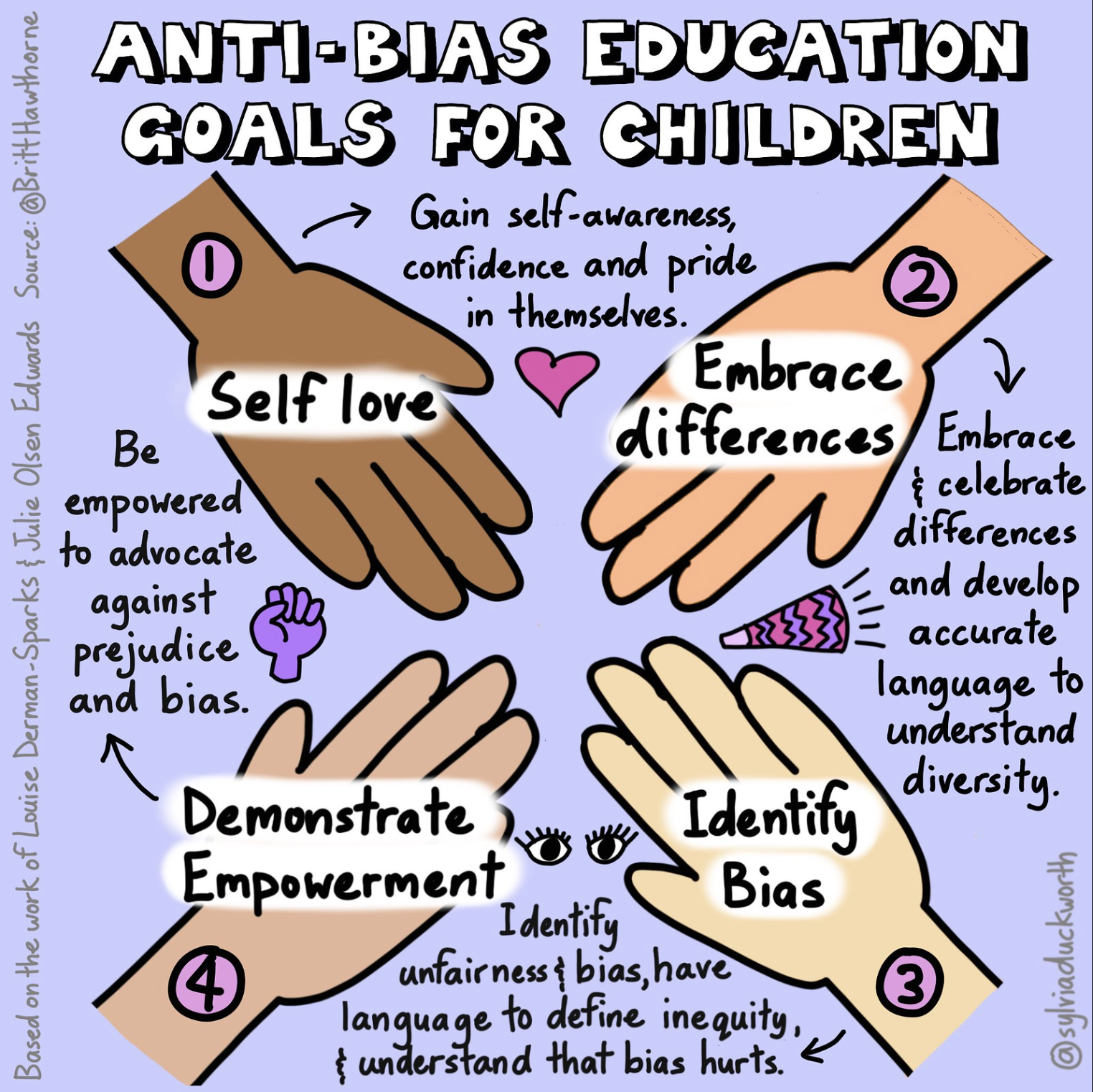
The Anti-Bias Curriculum, developed by a multi-ethnic group of early childhood educators, promotes the following goals:
- To nurture each child’s construction of a knowledgeable, confident self-concept and group identity.
- To promote each child’s comfortable, empathic interaction with people from diverse backgrounds.
- To foster each child’s critical thinking about bias.
- To cultivate each child’s ability to stand up for her/himself and for others in the face of bias
These principles should be a topic of discussion and a part of primary activities to be effective. It is necessary to discuss and define principles and ideologies regarding prejudice with children from a young age.
Start with concrete examples and work towards the more abstract when working with young students.
- Role-playing activities and contextual conversations to help children learn the concepts of race and prejudice
- The Dr. Seuss children’s book, The Sneetches, is particularly useful in explaining that what is on the outside doesn’t matter
- Give each child a flesh-colored bandage and prompt them to notice how the bandages matched very few of the students’ skin tones
- Plan experiences that allow children to compare accurate representations to their inaccurate understandings
- Facilitate dialogue about the feelings and ideas about these situations about skin color, or what makes a family, etc.
Source
- Esquivel, Krischa, et al. Diversity. The Role of Equity and Diversity in Early Childhood Education. LibreTexts Social Sciences Library. Shared under a CC BY license and was authored, remixed, and/or curated by Krischa Esquivel, Emily Elam, Jennifer Paris, & Maricela Tafoya.
4.2: Diversity and Anti-Bias Practice is shared under a CC BY 4.0 license and was authored, remixed, and/or curated by Western Technical College.
The book could not be loaded just now.