Opening the book…
- Name three examples of where public speaking is used
- Discuss how the practice of public speaking changed with the advent of television and video
Where Public Speaking is Used
We use public speaking every day, even if you don't think about it this way. When you raise your hand in class and answer a question, you are actually performing public speech. Any time one person communicates ideas, effectively getting a message across to an audience, this is considered a public speech. Speech can be written, nonverbal (for example: sign-language), verbal, or a combination of these different types. Public speaking requires the presence of an audience, which is typically considered to be a minimum of ten people, however the skills we need for public speaking will also be useful in interpersonal communication (communication between two individuals) or small group communication (communication among at least three people). This section will discuss some different places and/or technologies where public speaking is used, from basic and historical venues to modern-day virtual spaces.
The Medium Is the Message
In 1964, Canadian communication theorist Marshall McLuhan coined the phrase “the medium is the message.” Medium, in this case, is the singular of a word we’re used to seeing in the plural: media. What he meant was that we tend to focus on the content of the message (the words being said or the images shown), but we really need to look at the medium, or the channel through which the communication is taking place. According to this line of thinking, the television is more important for the way it makes us see the world than for any given program it might carry.
In the introduction to her book The Breakup 2.0: Disconnecting over New Media, Iliana Gershon discusses what she calls “media ideologies”—a concept which is essentially a more modern reframing of McLuhan’s idea of the medium and the message:
People’s ideas about the medium shape the ways that medium will deliver a message. No matter what is actually said, the medium becomes part of what is being communicated. Sometimes the medium is in synch with the message, and sometimes it is so out of synch with the message that the message is undercut. . . . That is to say, what people think about the media they use will shape the way they use media.[1]
As Gershon discovered, one of the quickest ways to reveal our often invisible media ideologies is to ask the question, “is it acceptable to break up with someone via text message?”
As you think about the history of media since the 15th century, consider the ways in which media ideologies evolved alongside an ever-growing assortment of options for sending and receiving messages.

c. 1440–now: The Printing Press
The printing press made written materials much easier to copy and reproduce rapidly. This made text readily available to the masses through newspapers, books, and pamphlets, which sparked a rise in literacy rates and forever changed the ways people learned and communicated.
Despite the increasing availability of print media, public oratory remained an important source of news, information, secular and religious teaching, and political persuasion in Europe and America.
1900–1944: Radio
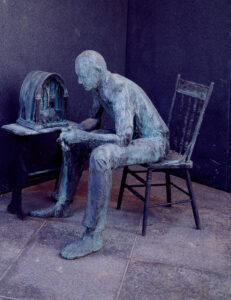
This period brought many changes to the political landscape, with new technologies beginning to significantly alter the communication of political messages. On June 14, 1922, Warren G. Harding became the first president to be heard on the radio.[2] The medium of the radio was put to extremely effective use by President Franklin D. Roosevelt, whose Fireside Chats between 1933 and 1944 allowed the President to speak directly to Americans about topics of national interest, from economic recovery to the rise of fascism in Europe.
In this Fireside Chat from April 14, 1938, Roosevelt spoke to the nation about unemployment and economic recovery. Listen to the first minute or two of the broadcast, and think about the way the medium of the radio allows the President to speak directly to the individual listener. You can listen to the recording of this Fireside Chat on YouTube by clicking on the underlined words. Alternately, click on the underlined words in this sentence to listen to the speech and/or view the transcript April 14, 1938 – FDR – Fireside Chat
 Figure 2.1.3 FDR Fireside Chat on U.S. National Archives licensed as Public Domain
What to listen for:
Notice how Roosevelt addresses the listener directly, starting with the first line: “My friends. . . .” He also acknowledges that the listener may be busy in the week leading up to Easter (note the tacit assumption there about the religion of the audience), but insists that “what I want to say to you, the people of the country, is of such immediate need and relates so closely to the lives of human beings and the prevention of human suffering that I have felt that there should be no delay.”
How do you think hearing the President's voice on the radio affected American citizens? Hearing the President's voice speaking these words was different than reading the speech in a newspaper. Children who could not yet read the newspaper were able to listen to FDR's Fireside Chats. The president was able to reach both a different audience using the medium of radio and to communicate using nonverbal communication such as tone of voice, vocal rate, and pace.
1945–2000: Television

Imagine seeing politicians speaking on television for the first time. It is difficult for those of us who have grown up with easy access to videos to think about a time BEFORE television. After World War II, an improved form of black-and-white TV broadcasting became popular in the United States and Britain, and television sets became commonplace in homes, businesses, and institutions. During the 1950s, television was the primary medium for influencing public opinion.[3] The 1960 debate between John F. Kennedy and Richard Nixon made it clear that television would transform persuasion politics in the U.S. Chris Matthews describes this debate, the first that had ever been televised:
More than either contestant’s words, it was their images, projected on millions of black-and-white Admiral and General Electric televisions, that affected the American judgment. Each time Kennedy spoke, Nixon’s eyes darted toward him in an uncomfortable mix of fear and curiosity. . . . When Nixon was on, Kennedy sat, sometimes professorially raking notes, at other moments wearing a sardonic expression as he concentrated on his rival’s answers. Sargent Shriver would note that it was his brother-in-law’s facial language, more than anything he said, that decided the results of the Great Debate. By raising an eyebrow at Nixon, he had shown he had the confidence to lead the country.[4]
While radio listeners felt that Nixon won the debate, television viewers overwhelmingly thought Kennedy did.[5]
See for yourself...Click on the underlined words to access the Kennedy v. Nixon Debate from 1960. Although you have the opportunity to watch each candidate speak, try listening without looking at the screen for the first 10 minutes. Which candidate sounds more knowledgeable? Who do you trust? Now, watch the next 10 minutes of the debate. Does watching the debate, rather than simply listening to each candidate speak change your opinion of the speakers?
2000–present: The Internet
The Loss of Gatekeeping
One of the most important changes brought about by the growth of the internet is the removal of traditional “gatekeepers” in mass communication. Shoemaker and Vos define gatekeeping as the “process of culling and crafting countless bits of information into the limited number of messages that reach people every day, and it is the center of the media’s role in modern public life. [. . .] This process determines not only which information is selected, but also what the content and nature of the messages, such as news, will be.”[6] Prior to the 21st Century, network television news was filtered through a number of gatekeepers, from reporters and fact-checkers to producers and presenters. Because of this process, information shared via traditional mass media had been chosen by established criteria, including: factual accuracy, credibility, and general “newsworthiness.” Gatekeeping disappeared, for the most part, with the rise of the Internet as a news source.
In the case of the internet, however, many of the traditional gatekeepers have been removed. Anyone can publish a message to a worldwide audience with just a few clicks. This is not to say, however, that there are no gatekeepers on the internet. Some of the most consequential gatekeeping functions are now performed by algorithms (computer logic), such as the logic by which certain information does or doesn’t appear in one’s social media feeds. The Google search algorithm is likewise extremely influential in determining which information is accessed most widely on the internet.[7]
Trolls
One of the unfortunate media ideologies that has developed in relation to the internet is the phenomenon of trolling, or deliberately posting inflammatory, outrageous, offensive, or hurtful messages. As we’ll see in the section on communication ethics, this kind of behavior is unethical and unacceptable, and often leads to unexpected negative consequences. It is always wise to treat the internet as what it is: a public forum, requiring the same standards of responsible speech that one would follow in a face-to-face setting.
Social Media
In The Attention Merchants, Tim Wu (2016) describes the rise of social media platforms (such as Facebook and Twitter): “With Facebook and Twitter, everyone could now have a brand, and derive a little of the excitement and attention that went with traditional celebrity—perhaps even find a way to resell a bit of that attention.”[8] Social media platforms allow access to audiences both within one’s immediate social circle and throughout the world. Not only are the number of messages available to the mass public multiplied by massive numbers on these platforms, but it is also often unclear who or where the messages come from. Additionally, social media platforms use algorithms. According to Smith (2018), social media algorithms mean that "nearly all the content people see on social media is chosen not by human editors but rather by computer programs using massive quantities of data about each user to deliver content that he or she might find relevant or engaging."[9] For the time being, the most important thing to keep in mind is that social media—no matter how intimate or niche the forum seems—should always be considered public speech. Assume that everything you say or do on social media could become available to a wide audience.
- Gershon, Ilana. The Breakup 2.0: Disconnecting over New Media. Cornell University Press, 2012, p. 3 1.18: Technologies of Public Communication#return-footnote-166-1
- “Warren G. Harding Becomes the First President to Be Heard on the Radio.” History.com, A&E Television Networks, 16 Nov. 2009, http://www.history.com/this-day-in-history/harding-becomes-first-president-to-be-heard-on-the-radio. 1.18: Technologies of Public Communication#return-footnote-166-2
- Diggs-Brown, Barbara. Strategic Public Relations an Audience-Focused Approach. Wadsworth Cengage Learning, 2012. 1.18: Technologies of Public Communication#return-footnote-166-3
- Matthews, Chris. Kennedy & Nixon: The Rivalry that Shaped Postwar America. Free Press, 2011. 1.18: Technologies of Public Communication#return-footnote-166-4
- “Sept. 26, 1960 | First Televised Presidential Debate.” The New York Times, The New York Times, 26 Sept. 2011, learning.blogs.nytimes.com/2011/09/26/septe-26-1960-first-televised-presidential-debate/. 1.18: Technologies of Public Communication#return-footnote-166-5
- Shoemaker, Pamela J.; Vos, Tim P. Gatekeeping Theory. Routledge, 2009, p. 1 1.18: Technologies of Public Communication#return-footnote-166-7
- For more on algorithmic gatekeeping, see O'Neil, Cathy. Weapons of Math Destruction: How Big Data Increases Inequality and Threatens Democracy. Penguin Books, 2017. 1.18: Technologies of Public Communication#return-footnote-166-12
- Wu, Tim. The Attention Merchants: The Epic Scramble to Get Inside Our Heads. United States, Alfred A. Knopf, 2016, p. 307. 1.18: Technologies of Public Communication#return-footnote-166-13
- Smith, A. (2018, November 16). Algorithms in action: The content people see on social media. In Public attitudes toward computer algorithms (Chapter 2). Pew Research Center. https://www.pewresearch.org/internet/2018/11/16/algorithms-in-action-the-content-people-see-on-social-media/(opens in new window)
Contributors and Attributions
CC licensed content, Shared previously
- History of Communication Technology. Authored by: Scott T Paynton and Linda K Hahn, adapted by Lumen Learning. Located at: https://courses.lumenlearning.com/introductiontocommunication/chapter/new-school-communication-study-in-the-20th-century/(opens in new window). License: CC BY-SA: Attribution-ShareAlike(opens in new window)
- The Fireside Chat. Authored by: Carol M. Highsmith. Provided by: Library of Congress. Located at: https://commons.wikimedia.org/wiki/File:FDR-Memorial-Fireside-Chat.jpg(opens in new window). License: Public Domain: No Known Copyright(opens in new window)
- Television. Provided by: Wikipedia. Located at: https://en.wikipedia.org/wiki/Television(opens in new window). License: CC BY-SA: Attribution-ShareAlike(opens in new window)
- Peter Small demonstrating the use of the Gutenberg press at the International Printing Museum. Authored by: vlasta2. Located at: https://en.wikipedia.org/wiki/File:PrintMus_038.jpg(opens in new window). License: CC BY: Attribution(opens in new window)


All rights reserved content
- 1938, April 14 FDR Fireside chat #12 On Economic Conditions open captioned. Authored by: Captioning for the end of the world.. Located at: https://youtu.be/yWBc7aMXI60(opens in new window). License: Other. License Terms: Standard YouTube License
Public domain content
- Nixon Kennedy Debate. Located at: https://en.wikipedia.org/wiki/United_States_presidential_debates#/media/File:Kennedy_Nixon_Debat_(1960).jpg(opens in new window). License: Public Domain: No Known Copyright(opens in new window)
- The Medium is the Message: Introduction to Public Speaking. Provided by: Lumen Learning. License: CC BY: Attribution(opens in new window)

This page titled 2.1.1.2: Technologies of Public Communication(opens in new window) is shared under a CC BY 4.0(opens in new window) license and was authored, remixed, and/or curated by Lumen Learning(opens in new window).
This page titled 2.1.1: Where Public Speaking is Used was last modified on Wed, 02 Sep 2026 19:39:15 GMT and is shared under a CC BY-NC-SA 4.0 license and was authored, remixed, and/or curated by Lumen Learning.
The book could not be loaded just now.