Employers seek skills. Many of the skills you will need are career-specific, known as "hard skills" or "technical skills." These include knowing how to use equipment that is specific to your career and mastering processes that are used in your field. While some of these skills are learned and perfected on the job, you may be in a vocational track program (such as for homeland security officers, nurses, aides, or paralegals) where you are learning your technical skills.
Technical skills alone are not enough for long-term success. The second set of skills, called "soft skills" or "transferable skills,"are valuable across nearly all occupations. Some soft skills include thinking skills, communication skills, listening skills, and leadership skills. This skill set is very broad, and your extent of mastery will vary from skill to skill; therefore, you should identify those skills that are most important to your career objective and develop and master them. Search on O*Net (https://www.onetonline.org/) to determine which skills you need to demonstrate to potential employers you have mastered based on your career interest.
Employers want individuals who have the necessary hard and soft skills to do the job well and adapt to changes in the workplace. Soft skills are often especially valued by employers because technical skills can usually be taught on the job, while skill such as communication, teamwork, and conflict resolution are more difficult to develop quickly. An employer might rather hire an inexperienced worker who can pay close attention to details than an experienced worker who might cause problems on a work team.
In this section, you will look at ways of identifying and building particular hard and soft skills that will be necessary for your career path.19
Table 2.2 - Transferable Skills Inventory
Active listening
Decision-making
Negotiating
Researching
Active learning
Editing
Observing
Selling
Analyzing
Evaluating
Organizing
Speaking a 2nd language
Budgeting
Forecasting
Perceiving Feelings
Supervising
Coaching
Goal setting
Persuading
Teaching
Communicating
Handling a crisis
Planning
Teamwork
Consulting
Handling details
Problem solving
Time management
Creative thinking
Manipulating numbers
Public speaking
Training
Critical thinking
Mentoring
Reading
Visualizing
Customer service
Motivating
Reporting
Writing
These skills are transferable because they are positive attributes that are invaluable in practically any kind of work. They also do not require much training from an employer—you have them already and take them with you wherever you go. Transferable/soft skills are a key part of your overall professional profile.
Identify the transferable skills that best represent your strengths and the ones employers value most. By comparing both sets, you can more directly gear your job search to your strongest professional qualities.
You may complete the "Skills Matcher" through Careeronestop, whill will help you identify your skills. Use the Skills Matcher to create a list of your skills and match them to careers that use those skills. Click here to complete the Skills Matcher: https://www.careeronestop.org/toolkit/Skills/skills-matcher.aspx
21st Century Skills
Due to the rapid changes in the global economy and the advancement of technology, the workplace has changed dramatically. As a student it is important for you to gain the knowledge and skills employers are seeking. To help train the new generation entering the workforce, a team of educators came together with employers, workforce development boards, and research organizations across the country to build college/career-ready, 21st Century Employability Skills Program called New World of Work (NWoW) 21st Century Skills Training.20
New World of Work (NWoW) was developed under the Doing What MATTERS for Jobs and the Economy framework of the California Community Colleges system, which is the largest higher education system in the nation with 72 districts and 115 colleges serving over 2.1 million students each year.
Starting in 2012, the New World of Work team began tracking futurist projections, economic reports, and national research related to the correlation between education and employment.
The group conducted a series of skills panels to gather feedback from employers, entrepreneurs, human resources specialists, educators, and students to determine the essential employability skills required in our emerging global economy.
From the research gathered, NWoW established their “Top 10” list of 21st-century employability skills. They worked closely with expert curriculum developers, including the NWoW Co-Creators; video crews; college faculty across disciplines; and digital badging teams, and then created lessons and badges to go along with each of the skills.
They identified the following "Top 10" list of 21st-century employability skills:
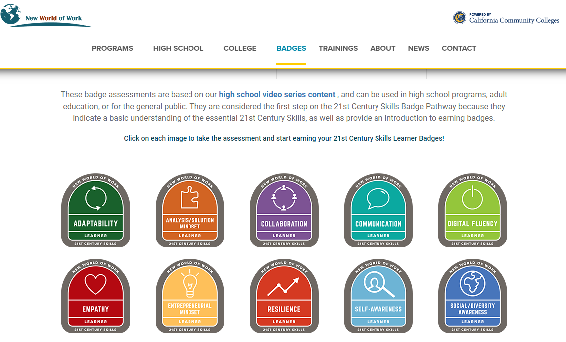
The New World of Work awards “Learner Badges” for all 10 of the 21st Century Skills. This is available to you for FREE! The NWoW Learner Badges are based on the NWoW High School/opportunity youth video series paired with multiple-choice questions. These can be used with high school, post-secondary, or adult learners or the general public to provide an introduction to the 21st Century Skills and the process for earning badges. Assessment pages launch directly from NWoW website by clicking on the Learner Badge icons. Below is a screenshot of the Learner Badges series.
View the YouTube PBS News Hour video titled " Giving students a leg up with job skills a resume won’t show" to learn more about digital badges and how they can help you be more marketable.
Self-identify your Top 5 transferable (soft) skills, skills you are good at, and those skills you wish to learn or develop further.
Review the list of transferable skills and additional checklist of transferable skills above to complete the chart below. Describe specific ways in which you have used each skill successfully. This will come in handy when we discuss interviewing strategies. Consider skills important to your career that you have not yet mastered and how you plan to master them. Give examples