Look for these important terms in the text in bold. Understanding these terms will help you meet the learning objectives of this chapter. You can find definitions for these terms at the end of the chapter.
Assertive Community Treatment (ACT)
Crisis Intervention Team (CIT) training
Crisis line
Crisis response system
Crisis stabilization center
De-escalation
Forensic
Forensic Assertive Community Treatment (FACT)
Mobile crisis team
Multidisciplinary team
No-wrong-door approach
Chapter Overview
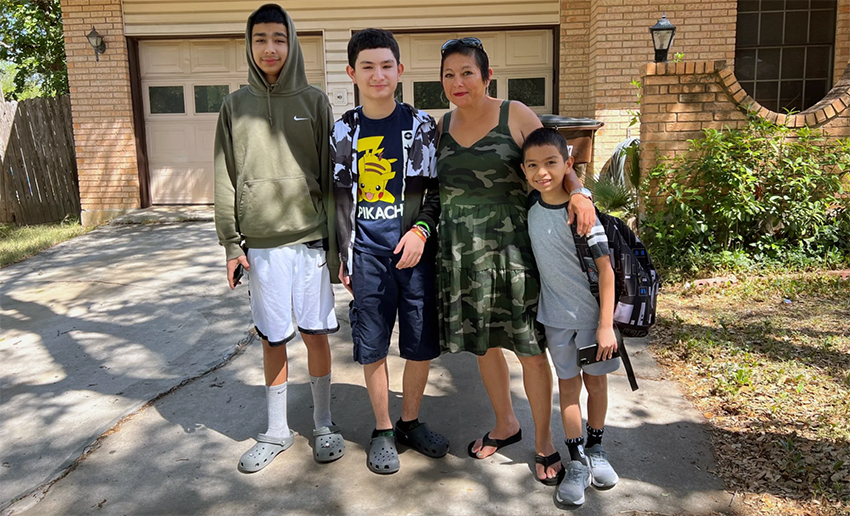
In June of 2023, Melissa Perez, a 46-year-old Texan mother of four, was experiencing a mental health crisis (figure 5.1). She believed the FBI was listening to her via alarm wires connected to her apartment. Perez, who had a diagnosis of schizophrenia, began cutting the fire alarm wires to protect herself. The fire department and police responded to Perez’s apartment complex. After speaking briefly with police officers—and informing them of her worries—Perez retreated into her San Antonio residence and locked the door (Edmonds, 2023).
Figure 5.1. A family photo shows Melissa Perez, second from right. After her mental health crisis resulted in police shooting and killing her, Melissa Perez’s family filed a lawsuit demanding accountability. What can communities learn from stories like Perez’s? “Melissa Perez and Family” Courtesy of the Perez Family, is included under fair use, permission request pending.
Perez’s family members point out that it would have been obvious to police after speaking with Perez that she was in the midst of a mental health crisis. Perez told police she had schizophrenia, and she had a documented history of being taken into custody due to her mental illness. Furthermore, the officers weren’t required to engage independently in a situation where they felt ill-equipped. San Antonio police has a 20-member mental health unit of officers specially trained to deal with precisely this sort of crisis—but no one called them to assist (Torres, 2023). Instead, the responding officers tried to enter Perez’s home where she had retreated. Perez protested, pointing out that the officers had no warrant. She threw a candlestick at the officers from inside the home, hitting her own window (figure 5.2) (Edmonds, 2023).
Figure 5.2. An image from San Antonio police body-worn cameras, showing officers poised to shoot on Melissa Perez’s porch. How could this encounter with police have progressed differently? Body Worn Camera Footage by San Antonio Police Department is included under fair use, permission request pending.
Eventually, Perez picked up a hammer, and three police officers watching Perez through her window opened fire on her, killing her. The officers’ behavior was so clearly out of bounds that they were all promptly charged with crimes for shooting and killing Perez. Later, two of the officers’ supervisors were disciplined for leaving work early on the night Perez was killed, making them both unavailable to consult on the Perez call (Collier & Hernandez, 2024).
Melissa Perez’s family filed a lawsuit demanding accountability from the San Antonio police department and seeking to highlight the failures of the shooting officers as well as the dozen other responding officers who stood by without intervening while the crisis spiraled. In the words of Perez’s family, their lawsuit is “about making sure police have proper training to handle people with mental illness, it’s about making sure that when we trust a police officer to carry a deadly weapon, that they will only use it when it’s absolutely necessary to protect the life of themselves or somebody else” (Torres, 2023).
How could the encounter between police and Melissa Perez have progressed differently and ended less tragically, or even positively? What can be learned from stories like Perez’s? This chapter examines some of the options and approaches that may—if made available and used consistently—keep crisis interactions safer for people with mental disorders.
Licenses and Attributions for Chapter Learning Objectives and Overview
Open Content, Original
“Chapter Overview” by Anne Nichol is licensed under CC BY-NC 4.0.