From LibreTexts, under CC BY-NC-SA 4.0, as the source states it; its equations are written in TeX, which the PDF shows typeset. This page at LibreTexts.
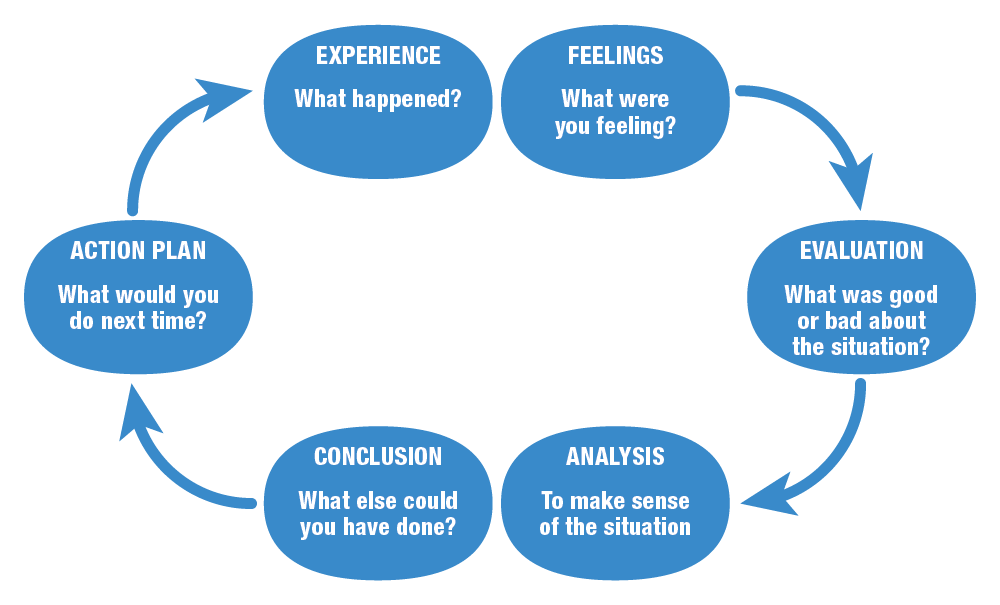
This model builds on the others and adds more stages. It is one of the more complex models of reflection, but it may be that you find having multiple stages of the process to guide you reassuring. Gibb’s cycle (1998) contains six stages:
Experience
Feelings
Evaluation
Analysis
Conclusion
Action plan
As with other models, Gibb’s begins with an outline of the experience being reflected on. It then encourages us to focus on our feelings about the experience, both during it and after. The next step involves evaluating the experience – what was good or bad about it from our point of view? We can then use this evaluation to analyze the situation and try to make sense of it. This analysis will result in a conclusion about what other actions (if any) we could have taken to reach a different outcome. The final stage involves building an action plan of steps which we can take the next time we find ourselves in a similar situation.
Learning by Doing: A Guide to Teaching and Learning Methods by Fanshawe College, CC BY-NC-SA 4.0
Video: Gibb’s Reflective Cycle for Self Development
Learn more about Gibb’s Reflective Cycle for Self Development by watching the video by Alan Jones [4:42] below.