Childhood today does not require children to contribute much back to the family economy for most families. In U.S. society, with all the privileges and economic affluence, there are still members of families, communities, and racial categories who go without, go hungry, and haven't the slightest notion of ever going to college. A recent study pointed out the current trends in childhood rates of poverty. \({ }^5\) Using U.S. Census data this study indicated that in 2008, 19\% of persons below the poverty level were children. New Hampshire was the lowest at \(8.6 \%\) of children living below poverty while Arizona was the highest at \(26.2 \%\) of their children living below the poverty line. In the U.S. children ages \(0-17\) comprised 73 million or \(25 \%\) of the population, yet \(41 \%\) live in poverty or near poverty. \({ }^6\) Children of color have a higher likelihood of living in poverty. Wight and Chau (2009) also reported that \(27 \%\) of White children, \(61 \%\) of Black children, \(31 \%\) of Asian children, \(57 \%\) of American Indian children, and \(62 \%\) of Hispanic children live in poverty. Poverty in the U.S. is layered across racial categories, in other words, poverty is disproportionally racialized.
The U.S. has an official definition of being poor or being in poverty. The poverty line is the official measure of those whose incomes are less than three times a lower cost food budget. This definition has been the U.S.'s official poverty definition since the 1930s with only a few adjustments. Near poverty is when one earns up to \(25 \%\) above the poverty line. In Table 1 you can see the U.S. Health and Human Services 2009 poverty guidelines with estimates of near poverty levels. Most who qualify as living below poverty also qualify for state and federal welfare which typically includes health care benefits, food assistance, housing and utility assistance, and some cash aid.
Table \(\PageIndex{1}\): U.S. Poverty Guidelines (2009) with Near Poverty Estimates.7
#of People in Family
Poverty Line
Near Poverty - 125% of Poverty Line
1
$10,830
$13,536
2
$14,570
$18,211
3
$18,310
$22,886
4
$22,050
$27,561
5
$25,790
$32,236
6
$29,530
$36,911
7
$33,270
$41,586
8
$37,010
$46,261
Those near poverty may or may not qualify depending upon current state and federal regulations. Absolute poverty is the level of poverty where individuals and families cannot sustain food, shelter, warmth, and safety needs.
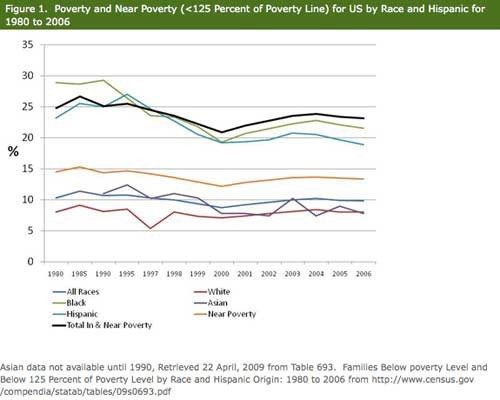
Figure \(\PageIndex{1}\). Poverty and Near Poverty ( <125 Percent of Poverty Line) for US by Race and Hispanic for 1980 to 2006 8
U.S. Census data indicate that people have various levels of poverty by racial grouping. In Figure \(\PageIndex{1}\) you can see the poverty and near poverty rates for various racial groups in the Unites States from 1980 to 2006. The thick black line represents the sum of the percent in poverty and near poverty for each year. The ranges suggest about \(25 \%\) or just below 1 in 4 being in or near poverty for the U.S. Whites (the red line, the lowest line) have the lowest rate of persons in poverty but make up the largest number of persons in poverty because Whites represent about 75\% of the U.S. population. Asians are slightly higher than Whites.
The blue line which runs just about even with the Asian line represents the percent in poverty for all races combined. It's much lower than the high rates of poverty for Blacks and Hispanics because Whites are such a large portion of the population, that it pulls the overall average downward for all races.
6. People Without Health Insurance Coverage by Selected Characteristics: 2006 and 2007& Figure 8. Uninsured Children by Poverty Status, Age, and Race and Hispanic Origin: 2007 from http://www.census.gov/prod/2008pubs/p60-235.pdf
7. Retrieved 21 April 2009 from www.census.gov Table 677. Median Income of Families by Type of Family in Current and Constant (2006) Dollars: 1990 to 2006
This page titled 11.2: Poverty was last modified on Sun, 02 Nov 2025 21:14:14 GMT and is shared under a CC BY 4.0 license and was authored, remixed, and/or curated by Ron J. Hammond and Paul Cheney via source content that was edited to the style and standards of the LibreTexts platform.