Opening the book…
Exploring the Social Construction of Gender
A social construct is a shared meaning or category that is created, maintained, and reinforced through social interaction. Laws, customs, nations, race, religion, and even ideas about knowledge and "common sense" are socially constructed. This does not mean that they are imaginary or unimportant. Rather, their meanings are produced collectively and can vary across societies and historical periods.
Everyday visual cues also reinforce socially constructed ideas about gender. For example, stylized images of legs may invite viewers to identify “which is the man” based on the presence of body hair. Such judgments reveal cultural assumptions about how male and female bodies are expected to look rather than natural distinctions between all men and all women (see Figure 3.5.1).
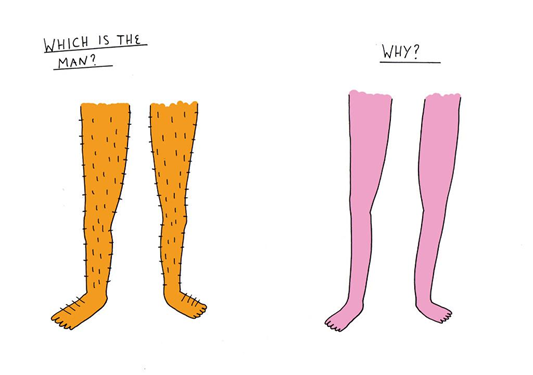
While gender may be socially constructed, its consequences are real. Gender is a significant dimension of identity that shapes how people understand themselves, how others treat them, and their access to status, power, and resources.
Gender Roles and Gender Stereotypes
Gender roles are composed of norms that people typically begin learning during childhood. For example, girls may be encouraged to appear caring, cooperative, and emotionally expressive, while boys may be encouraged to appear independent, competitive, and emotionally restrained. These expectations vary across cultures and historical periods.
Gender roles are closely connected to gender stereotypes, or generalized assumptions about the traits, abilities, and behaviors of people in different gender categories. Such stereotypes can contribute to sexism: beliefs, practices, and institutional arrangements that disadvantage people on the basis of sex or gender. Together, gender roles and stereotypes provide cultural scripts that influence how people understand themselves and evaluate others.
People sometimes respond strongly when established gender expectations are challenged by those whose identities, sexualities, or forms of gender expression fall outside conventional norms. By examining how gender is constructed and enforced, sociologists can better understand both the meanings attached to gender and the inequalities that arise from them.
Essentialist and Social Constructionist Explanations
Sociologists distinguish between essentialist and social constructionist explanations of gender. Essentialism treats differences between women and men as natural, universal, and rooted primarily in biology. From this perspective, traditional gender roles may be understood as reflecting inherent differences between the sexes.
Some Structural Functionalist accounts of the family have incorporated essentialist assumptions. Talcott Parsons, for example, argued that the family functioned most effectively when women and men performed specialized and complementary roles. Men were expected to occupy the instrumental role, which emphasized earning income, decision-making, and interaction with the outside world. Women were expected to perform the expressive role, which emphasized caregiving, emotional support, and maintaining family relationships.
Parsons viewed this division as contributing to family stability. Critics argue, however, that the approach presents historically specific gender arrangements as natural and necessary. It may therefore reinforce the existing social order while overlooking inequality, variation among families, and the ability of people of any gender to provide financial, practical, and emotional support.
A social constructionist approach instead emphasizes that gender roles are produced through culture, institutions, and social interaction. From this perspective, expectations about masculinity and femininity are learned, reinforced, challenged, and changed rather than determined solely by biology.
Gender Socialization
Socialization is the lifelong process through which individuals learn and internalize the norms, values, and expectations of society (Conerly et al., 2021). Gender socialization is the process through which people learn what their society considers appropriate for girls, boys, women, men, and people of other gender identities.
Families are among the earliest agents of gender socialization, but children also receive gender messages from teachers, peers, religious organizations, television, music, books, advertising, toys, and social media. These agents of socialization reinforce ideas about clothing, occupations, emotional expression, relationships, appearance, and behavior.
For instance, the phrase "boys will be boys" is sometimes used to excuse pushing, shoving, risk-taking, or aggression among boys. The phrase presents such behavior as natural and unavoidable, even though adults may tolerate or encourage it because it fits cultural expectations of masculinity. Similar behavior may be discouraged more strongly among girls.
Children begin recognizing gender categories and stereotypes at an early age. In the United States, for example, they may learn to associate long hair, dresses, dolls, and caregiving with femininity, while associating short hair, trucks, physical strength, and emotional restraint with masculinity. Research indicates that children become aware of many gender stereotypes during early childhood and continue navigating gendered expectations as they grow older (Weinraub et al., 1984).
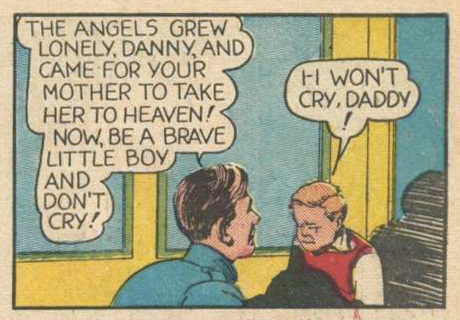

The image illustrates how boys may be taught to suppress sadness as part of traditional masculinity. The statement "I won’t cry, Daddy!" reflects a gendered cultural script in which emotional restraint is treated as evidence of strength. Such messages do not simply describe how boys naturally behave; they teach boys how they are expected to behave.
Gender Socialization Before Birth: Gender-Reveal Parties
Gender socialization can begin even before a child is born. In societies that organize gender primarily through the categories of female and male, prenatal test results may influence the clothing, toys, names, decorations, and expectations selected for a child.
This process is especially visible in gender-reveal parties. These events generally announce the sex predicted through prenatal testing or imaging rather than the child’s future gender identity. Pink decorations commonly signify an expected girl, while blue decorations signify an expected boy.

The popularity of gender-reveal parties is often traced to 2008, when Jenna Karvunidis published a blog post describing a party at which she cut into a cake containing pink icing to announce that she was expecting a girl. Karvunidis later expressed reservations about the trend, observing that such parties can reinforce restrictive assumptions about gender before a child is born (Langmuir, 2020).
Gender-Expansive Parenting
In contrast to the binary expectations emphasized by many gender-reveal parties, some families practice gender-expansive parenting. This approach seeks to provide children with greater freedom to explore clothing, toys, interests, emotional expression, and identity without treating particular choices as exclusively masculine or feminine.
Gender-expansive parenting does not necessarily mean raising children without any awareness of gender. Instead, it generally involves reducing rigid expectations and allowing children greater freedom to communicate how they understand and express themselves.
In the 2020 New Yorker documentary Raising Baby Grey, two parents in the Bronx raise their one-year-old child, Grey, using they/them pronouns and providing a broad range of clothing and play options. Their goal is to give Grey greater freedom to develop and express an identity while minimizing the pressures and potential harms associated with rigid gender categories (Long, 2020; The New Yorker, 2020).
Duration: 9 minutes and 8 seconds
The documentary illustrates both the intentions behind gender-expansive parenting and the difficulties of practicing it within a society that strongly reinforces binary gender categories. It also raises broader sociological questions about how families negotiate gender expectations and whether parents can shield children from the gender messages communicated by schools, peers, media, and other institutions.
Licenses and Attributions for the Social Construction of Gender
Open Content, Shared Previously
Adapted by Sarah Earl-Novell from 5.7: Social Construction of Gender in Sexuality, the Self, and Society by Susan Rahman with Nathan Bowman, Dahmitra Jackson, Lushtak, Remi Newman, & Prateek Sunder, licensed under CC BY 4.0.
Adapted by Sarah Earl-Novell from 5.8: Gender Roles in Sexuality, the Self, and Society by Susan Rahman with Nathan Bowman, Dahmitra Jackson, Lushtak, Remi Newman, & Prateek Sunder, licensed under CC BY 4.0.
Adapted by Sarah Earl-Novell from Applying Sociology to the Study of Gender in Sociology of Gender - An Equity Lens by Nora Karena, Heidi Esbensen, and Dana Pertermann, licensed under CC BY 4.0.
Modifications by Sarah Earl-Novell include remixing, editing, contextualization, and the addition of original content.
References
Conerly, T. R., Holmes, K., & Tamang, A. L. (2021). Introduction to sociology 3e. OpenStax.
Long, C. (2020, June 24). “Raising Baby Grey” explores the world of gender-neutral parenting. The New Yorker.
Kimmel, M. S. (1996). Manhood in America: A cultural history. Free Press.
Langmuir, M. (2020, June 29). I started the ‘gender reveal party’ trend. And I regret it. The Guardian.
The New Yorker. (2020, June 24). Raising a gender-neutral child | Raising Baby Grey | The New Yorker documentary [Video]. YouTube.
Weinraub, M., Clemens, L. P., Sockloff, A., Ethridge, T., Gracely, E., & Myers, B. (1984). The development of sex role stereotypes in the third year: Relationships to gender labeling, gender identity, sex-typed toy preference, and family characteristics. Child Development, 55(4), 1493–1503.
This page titled 3.5: The Social Construction of Gender was last modified on Fri, 23 Oct 2026 01:51:00 GMT and is shared under a CC BY 4.0 license and was authored, remixed, and/or curated by Sarah Earl-Novell.
The book could not be loaded just now.