Opening the book…
Exploring Love Styles
In contrast, adults with children—who are more financially and emotionally tied to family responsibilities—may approach romantic relationships as partnerships in which shared goals (paying off a home, raising children, managing debt) are just as important as romance.


Lee's Color Wheel Theory of Love
The color wheel theory of love was developed by Canadian psychologist John Alan Lee in his 1973 book Colours of Love: An Exploration of the Ways of Loving. Lee identified six basic love styles, using terms drawn from Greek and Latin. He organized these styles through the metaphor of a traditional color wheel, with three primary love styles—Eros, Ludus, and Storge—and three secondary styles that emerge from combinations of the primary ones: Agape, Pragma, and Mania (Lee, 1973).
Eros is the Greek term for romantic, passionate, or sexual love—the root of the word "erotic." Lee describes Eros as a powerful blend of physical and emotional passion. It involves a desire to create mutual sexual satisfaction, feelings of security, and a deep sense of aesthetic and emotional enjoyment with a partner. An important aspect of Eros is the commitment to sexual exclusivity, as lovers strive to protect each other’s sense of intimacy and trust. Eros is a highly sensual, intense, and passionate style of love. People with this style often choose partners based on intuition or "chemistry" and they are more likely than others to describe having "fallen in love at first sight."
Ludus comes from the Latin word for "game" or "play." Lee uses this term to describe a love style focused on fun, enjoyment, and playful interaction. Ludic lovers value activities they can do together—both indoors and outdoors—and often engage in teasing, flirting, and harmless pranks as expressions of affection. For them, the excitement of gaining love and attention can feel like part of the game itself. People with a Ludic love style generally have a low tolerance for commitment, jealousy, or intense emotional dependence. They prefer relationships that remain light, flexible, and enjoyable rather than deeply serious or long-term.
Storge is the Greek term for familial or affectionate love. Lee describes Storge as a love that develops gradually out of friendship and is rooted in shared interests, mutual understanding, and long-term commitment rather than intense passion. Although Philia is the Greek word more commonly associated with friendship, Lee intentionally chooses Storge to emphasize the deeper, steady, and family-like qualities of this love style.
In contrast, Agape refers to altruistic, giving, and other-centered love. This love style emphasizes care, patience, compassion, and a willingness to place a partner’s needs before one’s own. Rather than being possessive or demanding, Agape is characterized by generosity and concern for the other person’s well-being. Lee describes Agape as a selfless form of love offered out of a sense of duty or moral commitment without expecting anything in return. According to Lee, Agapic lovers tend to be older and more emotionally mature; their love is guided more by will, reason, and a desire to care for others than by emotion or physical attraction.
Pragma is a practical and rational style of love grounded in logic, long-term compatibility, and shared goals. Historically, arranged marriages often reflected this approach, as did unions among royalty and elite families that were formed for functional purposes such as political alliances, inheritance, or economic stability. In contemporary contexts, individuals with a Pragma style may seek partners who offer financial security, strong parenting potential, shared goals, or steady companionship. The emphasis is on practicality and long-term fit rather than passion or spontaneity.
Mania is the final love style, characterized by emotional dependence, insecurity, jealousy, and frequent emotional highs and lows. This type of love is marked by an intense need for reassurance and a fear of losing the relationship. Maniac lovers often experience uncertainty and fluctuate between extreme enthusiasm and deep anxiety, making the relationship feel unstable and emotionally overwhelming.
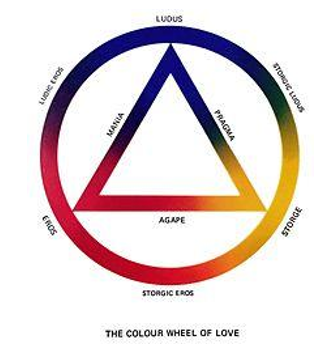

Lee later expanded the model to include nine tertiary styles, reflecting even more nuanced blends of the primary and secondary forms. Importantly, these love styles are not mutually independent. For example, an individual may approach love from a pragmatic stance—seeking financial stability in a partner—yet still experience the insecurity and jealousy characteristic of Mania, worrying whether their partner will remain with them and maintain that stability. In practice, people rarely embody a single love style. Instead, individuals draw on multiple styles to different degrees.
Sternberg's Triangular Theory of Love
Is all love the same or are there different types? Robert Sternberg explored these questions and proposed that all forms of love consist of three core components: intimacy, passion, and commitment (Sternberg, 1986).
- Intimacy involves feelings of closeness, caring, and emotional support.
- Passion refers to the physical and emotional arousal associated with love, including physical attraction, sexual desire, excitement, and the intense feelings that can draw people toward one another.
- Commitment reflects the cognitive decision to love someone and the intention to maintain that love over time.
Intimacy—through caring, closeness, and support—can be present in many types of close relationships, including a parent’s love for a child or the bond shared between close friends. Passion, however, is unique to romantic love, distinguishing lovers from friends. Ultimately, depending on the type and stage of a relationship (for example, early versus long-term), different combinations of intimacy, passion, and commitment will be present.
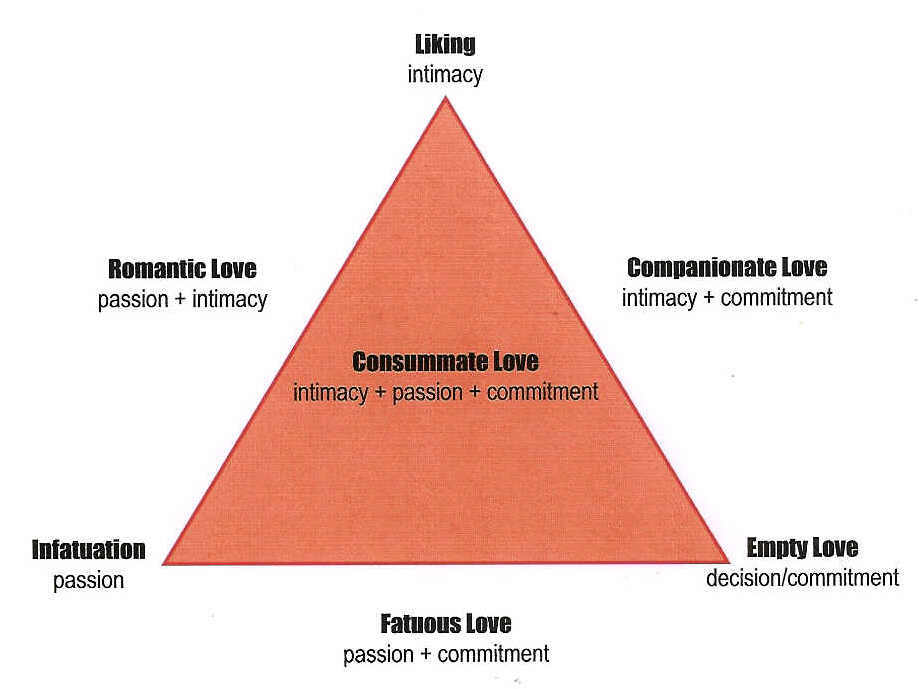

Sternberg also identified several distinct forms of love, including:
- Liking, in this context, is not used in a trivial way. Sternberg explains that intimate liking is characteristic of true friendships, where a person feels a sense of bondedness, warmth, and emotional closeness with another—but without the intense passion or long-term commitment found in romantic relationships.
- Infatuated love is typically associated with "love at first sight." However, because it lacks both intimacy and commitment, this form of love is often unstable and may fade just as quickly as it appears.
- Empty love occurs when a relationship has commitment but lacks both intimacy and passion. Sometimes a once-strong relationship can deteriorate into empty love as emotional closeness and desire fade over time. In cultures where arranged marriages are common, couples may begin their relationship in a state of empty love with commitment present first and intimacy or passion developing later.
- Romantic love combines emotional closeness with physical attraction. Romantic lovers are bonded emotionally—as in intimate liking—and are also connected through intimate relations.
- Companionate love is common in long-term relationships or marriages in which passion has diminished, but deep affection, emotional closeness, and commitment remain. It reflects a personal bond with someone you share your life with but without strong sexual or physical desire. Companionate love is stronger than friendship because it includes the added element of long-term commitment.
- Fatuous love is often seen in whirlwind courtships or quick marriages where commitment is based mainly on passion rather than emotional closeness. Because this type of love lacks the stabilizing foundation of intimacy, it may feel intense and exciting at first, but can also be fragile or unstable over time.
- Consummate love is considered the most complete form of love representing the ideal relationship many people strive for but few consistently achieve. Sternberg cautions that maintaining consummate love can be even more challenging than attaining it. He emphasizes the need to translate the components of love into ongoing action. Consummate love is also not necessarily permanent; for instance, if passion fades over time, the relationship may shift into companionate love.
Taking the study of love a step further, anthropologist Helen Fisher examined fMRI brain scans of people who had recently fallen in love and found that their brain chemistry showed heightened neurological activity, resembling the patterns seen in individuals experiencing a drug high (Cohen, 2007). Serotonin levels increased by as much as 40% in newly in-love individuals and many showed obsessive–compulsive tendencies. Conversely, Fisher and her colleagues discovered that when someone goes through a breakup, the brain processes the loss similarly to withdrawing from heroin (Fisher, Brown, Aron, Strong, & Mashek, 2010). In this sense, people who say that breakups are physically painful are correct.
Licenses and Attributions for Theoretical Models of Love
Open Content, Shared Previously
Adapted by Sarah Earl-Novell from 8.4: Love Styles in Sexuality, the Self, and Society by Susan Rahman with Nathan Bowman, Dahmitra Jackson, Lushtak, Remi Newman, & Prateek Sunder, licensed under CC BY 4.0.
Modifications by Sarah Earl-Novell include remixing, editing, contextualization, and the addition of original content.
References
Cohen, E. (2007, February 15). Loving with all your … brain. CNN.
Fisher, H. E., Brown, L. L., Aron, A., Strong, G., & Mashek, D. (2010). Reward, addiction, and emotion regulation systems associated with rejection in love. Journal of Neurophysiology, 104(1), 51–60.
Lee, J. A. (1973). Colours of love: An exploration of the ways of loving. New Press.
Sternberg, R. J. (1986). A triangular theory of love. Psychological Review, 93(2), 119–135.
This page titled 7.6: Theoretical Models of Love was last modified on Fri, 23 Oct 2026 20:07:03 GMT and is shared under a CC BY 4.0 license and was authored, remixed, and/or curated by Sarah Earl-Novell.
The book could not be loaded just now.