Monopolistic competition is a market structure defined by free entry and exit, like competition, and differentiated products, like monopoly. Differentiated products provide each firm with some market power. Advertising and marketing of each individual product provide uniqueness that causes the demand curve of each good to be downward sloping. Free entry indicates that each firm competes with other firms and profits are equal to zero on long run equilibrium. If a monopolistically competitive firm is earning positive economic profits, entry will occur until economic profits are equal to zero.
Monopolistic Competition in the Short and Long Runs
The demand curve of a monopolistically competitive firm is downward sloping, indicating that the firm has a degree of market power. Market power derives from product differentiation, since each firm produces a different product. Each good has many close substitutes, so market power is limited: if the price is increased too much, consumers will shift to competitors’ products.
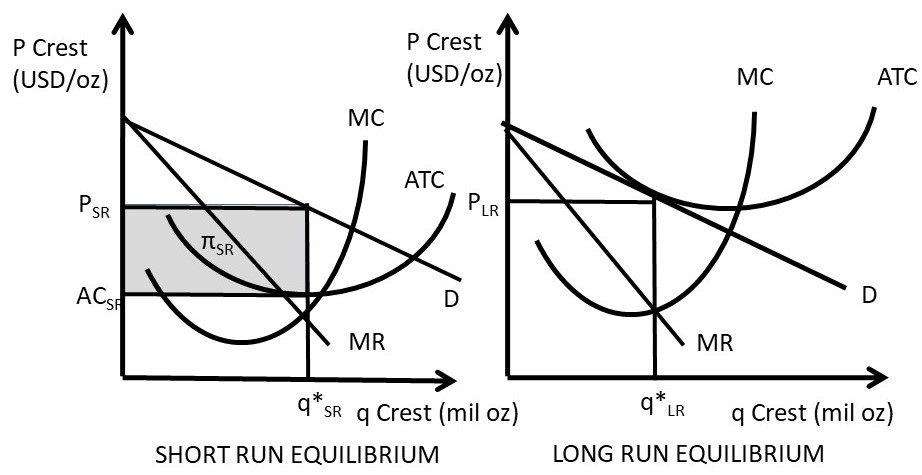
Figure \(\PageIndex{1}\): Monopolistic Competition in the Short Run and Long Run
Short and long run equilibria for the monopolistically competitive firm are shown in Figure \(\PageIndex{1}\). The demand curve facing the firm is downward sloping, but relatively elastic due to the availability of close substitutes. The short run equilibrium appears in the left hand panel, and is nearly identical to the monopoly graph. The only difference is that for a monopolistically competitive firm, the demand is relatively elastic, or flat. Otherwise, the short run profit-maximizing solution is the same as a monopoly. The firm sets marginal revenue equal to marginal cost, produces output level \(q^*_{SR}\) and charges price \(P_{SR}\). The profit level is shown by the shaded rectangle \(π\).
The long run equilibrium is shown in the right hand panel. Entry of other firms occurs until profits are equal to zero; total revenues are equal to total costs. Thus, the demand curve is tangent to the average cost curve at the optimal long run quantity, \(q^*_{LR}\). The long run profit-maximizing quantity is found where marginal revenue equals marginal cost, which also occurs at \(q^*_{LR}\).
Economic Efficiency and Monopolistic Competition
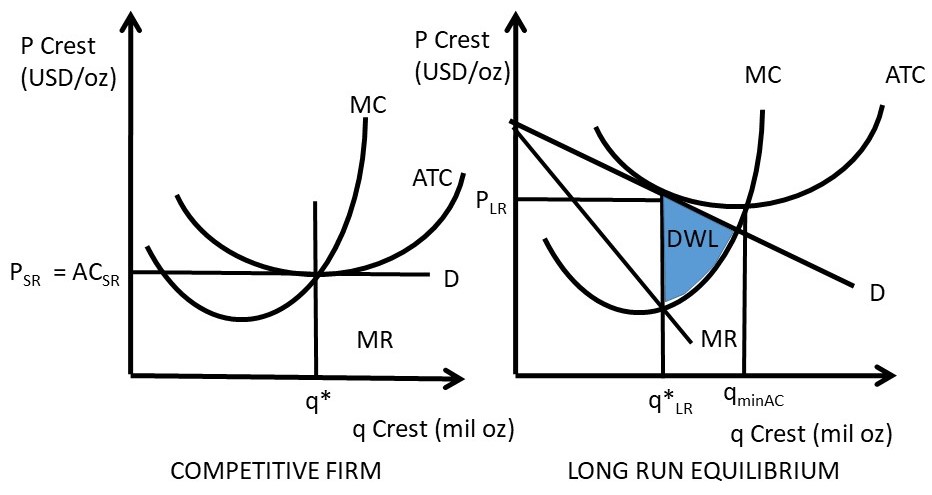
There are two sources of inefficiency in monopolistic competition. First, dead weight loss \((DWL)\) due to monopoly power: price is higher than marginal cost \((P > MC)\). Second, excess capacity: the equilibrium quantity is smaller than the lowest cost quantity at the minimum point on the average cost curve \((q^*_{LR} < q_{minAC})\). These two sources of inefficiency can be seen in Figure \(\PageIndex{2}\).
Figure \(\PageIndex{2}\): Comparison of Efficiency for Competition and Monopolistic Competition
First, there is dead weight loss \((DWL)\) due to market power: the price is higher than marginal cost in long run equilibrium. In the right hand panel of Figure \(\PageIndex{2}\), the price at the long run equilibrium quantity is \(P_{LR}\), and marginal cost is lower: \(P_{LR} > MC\). This causes dead weight loss to society, since the competitive equilibrium would be at a larger quantity where \(P = MC\). Total dead weight loss is the shaded area beneath the demand curve and above the \(MC\) curve in figure \(\PageIndex{2}\).
The second source of inefficiency associated with monopolistic competition is excess capacity. This can also be seen in the right hand panel of Figure \(\PageIndex{2}\), where the long run equilibrium quantity is lower than the quantity where average costs are lowest \((q_{minAC})\). Therefore, the firm could produce at a lower cost by increasing output to the level where average costs are minimized.
Given these two inefficiencies associated with monopolistic competition, some individuals and groups have called for government intervention. Regulation could be used to reduce or eliminate the inefficiencies by removing product differentiation. This would result in a single product instead of a large number of close substitutes.
Regulation is probably not a good solution to the inefficiencies of monopolistic competition, for two reasons. First, the market power of a typical firm in most monopolistically competitive industries is small. Each monopolistically competitive industry has many firms that produce sufficiently substitutable products to provide enough competition to result in relatively low levels of market power. If the firms have small levels of market power, then the deadweight loss and excess capacity inefficiencies are likely to be small.
Second, the benefit provided by monopolistic competition is product diversity. The gain from product diversity can be large, as consumers are willing to pay for different characteristics and qualities. Therefore, the gain from product diversity is likely to outweigh the costs of inefficiency. Evidence for this claim can be seen in market-based economies, where there is a huge amount of product diversity.
The next chapter will introduce and discuss oligopoly: strategic interactions between firms!
Real-World Context: Product Differentiation and Diverse Consumer Preferences
Product differentiation can reflect the different needs, preferences, traditions, and circumstances of consumers. In food and agricultural markets, consumers may value characteristics such as price, convenience, taste, cultural familiarity, preparation methods, locally produced foods, nutritional characteristics, or production practices.
For example, grocery stores and food businesses may offer different varieties of similar products because consumers do not all define value in the same way. A product that is important to one household because of cultural or family traditions may have little significance to another household.
At the same time, having many differentiated products does not necessarily mean that every consumer has equal access to those choices. Income, geographic location, transportation, and local availability can influence which products consumers can realistically purchase.
Think About It: Identify two competing food or agricultural products that are differentiated from one another. What characteristics make them different? Which groups of consumers might value those characteristics, and what factors could affect consumers' ability to choose between them?
This page titled 7.4: Monopolistic Competition was last modified on Mon, 21 Sep 2026 01:49:58 GMT and is shared under a CC BY-NC 4.0 license and was authored, remixed, and/or curated by Ivan Huerta via source content that was edited to the style and standards of the LibreTexts platform.