The Pleistocene Challenge: Surviving Ice Age Climate Swings
To understand what forces shaped our early human evolution, we need to look at the climate conditions our ancestors faced. Our early Homo ancestors lived during a time period called the Pleistocene epoch, which lasted from 2.6 million years ago to 11,000 years ago. This period brought major changes to Earth's environment and is commonly known as the Ice Age.
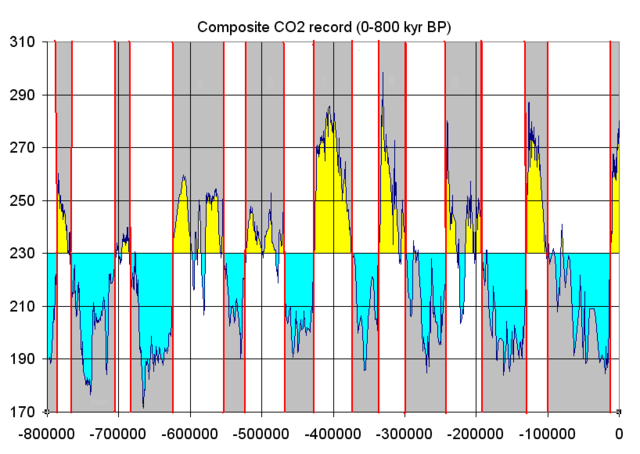
When people hear "Ice Age," they usually picture a world covered in glaciers and filled with woolly mammoths, essentially, a planet that was cold everywhere. However, this picture isn't accurate. Instead of being constantly cold, the climate became much more unpredictable. The Earth's climate swung back and forth between two extremes: warm and wet periods (called interglacial periods) and cold and dry periods (called glacial periods). These climate swings happened because of changes in Earth's orbit around the sun.
Figure \(\PageIndex{1}\): Graph depicting the typical glacial and inter-glacial cycles of the Pleistocene epoch over last 800,000 years as measured by concentration of CO2 (in part per million on the left). Higher CO2 concentrations, represent the interglacial periods in yellow while lower CO2 concentrations, represent the glacial periods in blue. By Tomruen - Data from ncdc.noaa.gov, Composite CO2 record (0-800 kyr BP), marked up with 230 ppm transition between glacial and interglacial periods., CC BY-SA 3.0 via Wikipedia
And, as Figure 12.2.2 below shows, these climate cycles followed a pattern. During the early Pleistocene, each cycle lasted about 41,000 years on average. Then, starting around 1.25 million years ago, the cycles became longer—about 100,000 years each. Because factors like mountain ranges, wind patterns, ocean currents, and volcanic eruptions also affect climate, different regions around the world experienced these changes differently.
Figure \(\PageIndex{2}\): Temperature estimates during the last five million years, extrapolated from deep-sea core data. Lower temperatures and increased temperature oscillations start at 2.6 million years ago. Glacial/interglacial cycles during the early part of the epoch are shorter, each averaging about 41,000 years. Credit: Five Myr Climate Change by Dragons flight (Robert A. Rohde), based on data from Lisiechi and Raymo (2005), is under a CC BY-SA 3.0 License.
Understanding ancient geography and climate helps us figure out how our ancestors moved around the world and what limitations they faced. When the Earth cooled down during glacial periods, ocean levels dropped because more water was frozen in glaciers. This exposed land that is normally underwater, creating bridges between continents and islands. During these cold periods, the large Indonesian islands of Sumatra, Java, and Borneo were connected to Southeast Asia by land. New Guinea was connected to Australia. A land bridge linked Britain to the rest of Europe, and a frozen, treeless area called Beringia connected northern Asia to Alaska. At the same time, glaciation made some northern areas too harsh for humans to live in. For example, we have evidence that early human species lived in Britain 950,000 years ago, but they didn't stay there continuously. These early humans likely died out or had to leave the region when glacial periods made survival impossible.
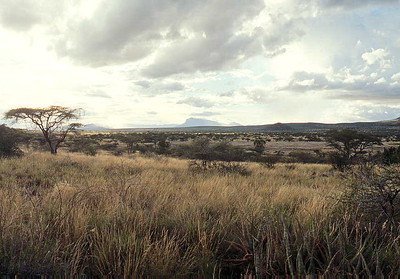
In Africa, climate research shows that grasslands expanded and shrank repeatedly during this time period, though overall they grew larger over the long term (deMenocal 2014).
By studying fossils, scientists have been able to recreate what animal communities looked like during the Pleistocene and understand how climate change affected them. In Africa, the number of grazing animals like antelopes increased. Even though Africa and Eurasia are connected by land, the Sahara Desert and the mountains of North Africa create natural barriers that make crossing difficult. However, the fossil record shows that at various times, animals moved back and forth between these continents. During the early Pleistocene, African animals like baboons, hippos, antelopes, and African buffalo migrated out of Africa into Eurasia during dry periods (Belmaker 2010).
This constantly changing environment created both challenges and opportunities for our ancestors. One strategy some early humans used was to specialize in eating the new types of plants growing in these changing landscapes. The robust hominins (discussed in Chapter 11) likely developed their large back teeth with thick enamel to handle this specialized diet.
Members of the genus Homo chose a different path. When faced with Africa's unstable climate and shifting landscapes, they evolved larger brains. These bigger brains allowed them to solve problems through culture and technology, such as making stone tools that opened up new ways to find food. This strategy of being flexible and adaptable served them well during these unpredictable times. It led to important innovations like eating more meat, hunting together in groups, and successfully moving into new environments outside of Africa.