Primate Classification

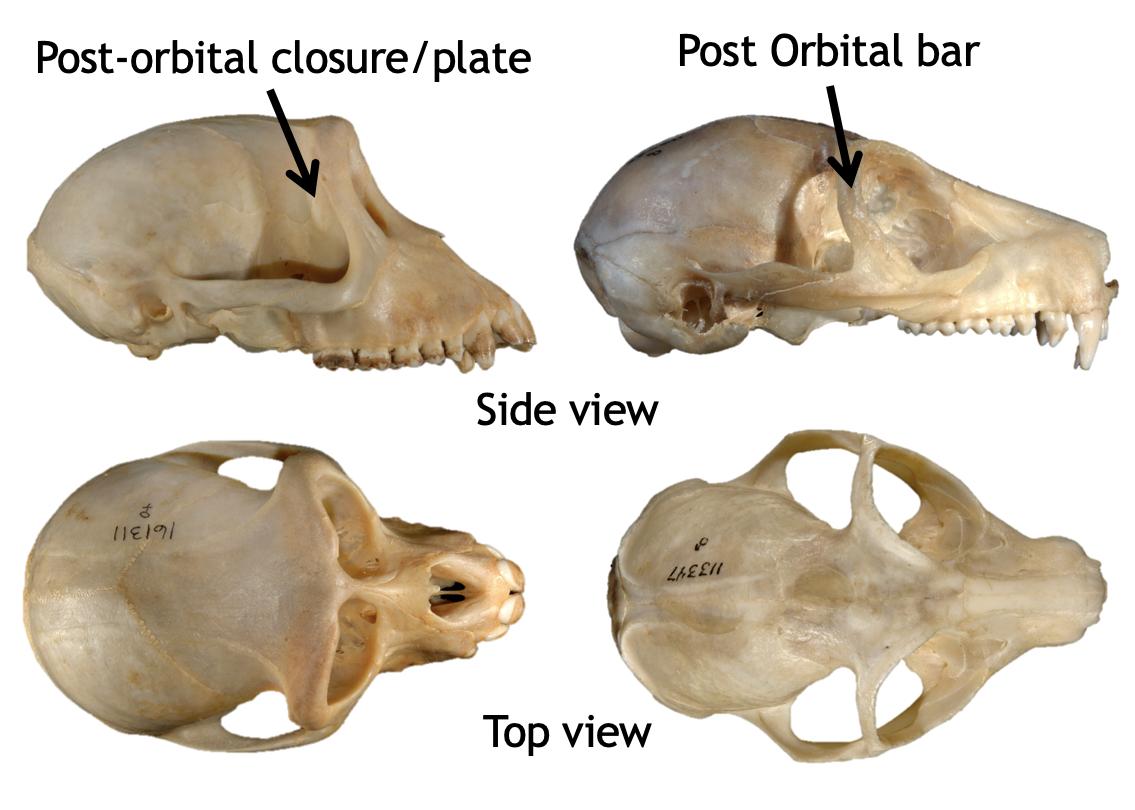
Side and top views of postorbital closures and bars.
Author: Beth Shook
Modified from labs by Henry M. McHenry, University of California, Davis
Time needed: 50-60 minutes
Primate Classification Worksheet
Introduction
People belong to the zoological order Primates, which is one of the many orders within the class Mammalia. This lab provides the opportunity to observe characteristics of the skeleton that differentiate primates from other mammals, and compare primates to each other.
Before beginning, consider the following: What can bones tell us about the animal to which they belonged? Specifically, what might the skeleton tell us about:
- what the animal ate?
- its mode of locomotion?
- the kind of environment it lived in?
- its behavior?
Bones can reflect the lifestyle of primates, and the characteristics they share are likely reflective of early primate ancestors. For example, most primates move about in trees by grasping with their feet and hands. Primatologists believe the common ancestor of all living primates was an arboreal climber with prehensile extremities, who relied on vision more than olfaction (smell). This ancestor may have had some depth perception made possible by the overlapping visual fields of forward-facing eyes, and hands with the ability to manipulate objects. Thus, physical traits that help us distinguish primates from other mammals include:
- a generalized skeletal structure for arboreal life;
- convergent eyes (forward-facing);
- eye orbits with a postorbital bar or plate;
- reduced snout length (related to less reliance on smell);
- opposable thumbs and big toes;
- flattened nails instead of, or in addition to, claws;
- larger brain size
- differences in tooth morphology (reflects variable diets);
- and prehensile (grasping) hands and feet.
Station 1: Primate Versus Non-Primate Postcrania
Look at the skeletons or skeletal images provided. Note how the postcrania (body) of primates and non-primates differ. Carefully examine the vertebral column (backbone), the structure of the shoulder and pelvis, the shape of the rib cage, and the hands and feet. Think about what you already know about their locomotion and behavior for clues about how they move and the differences you may see on their skeleton. Record general observations in the table below.
Primate vs. non-primate postcrania
| Non-Primate |
Primates |
|
|
|
Primate vs. non-primate notes
| |
Non- Primate
|
Primates
|
| Hands and feet |
|
|
| Claws or nails |
|
|
| Vertebral column and rib cage |
|
|
| Clavicle |
|
|
| Pelvis |
|
|
How do the above characteristics suggest the locomotion and posture of primates differ from non-primates?
Station 2: Non-Primate and Primate Teeth and Skulls
Mammals typically have four different kinds of teeth: incisors, canines, premolars, and molars. Examine the teeth of the primates (monkey and human) and non-primates (cow or pig and dog). While they all have a mixture of incisors, canines, premolars, and molars, what differences do you see between the species? (Number of teeth? Shape? Cusp pattern?) What might these features tell us about their function?
Non-primate and primate teeth
| Non-Primates |
|
|
|
|
| Primates |
|
|
|
|
Non-primates and primates notes
| |
Non-Primates |
|
Primates |
|
| |
Whitetail Deer |
Dog |
Colobus Monkey |
Human |
| Distinguishing features of the teeth |
|
|
|
|
| Describe the tooth row shape |
|
|
|
|
| Probable diet |
|
|
|
|
The orbit is the bony structure that protects the eye. All living primates have a complete bony ring around the eye, but the orbit can be either open (postorbital bar) or closed (postorbital plate) in the back. Examine the orbits and their orientation. What differences do you see? Look at the foramen magnum: What does this tell you about the typical posture of the animal? Finally, look at the nasal region. Does this tell you about what senses they use most?
Non-primate and primate skulls
| Non-Primates |
|
|
|
|
| Primates |
|
|
|
|
Non-primate and primate skull notes
| |
Non-Primates |
|
Primates |
|
| |
Jackrabbit |
Dog |
Squirrel Monkey |
Human |
| Eye orbit structure and orientation |
|
|
|
|
| Foramen magnum position |
|
|
|
|
| Size and complexity of nasal region |
|
|
|
|
| Rely more on vision or smell? |
|
|
|
|
Station 3: Primate Suborders: Strepsirrhini and Haplorrhini
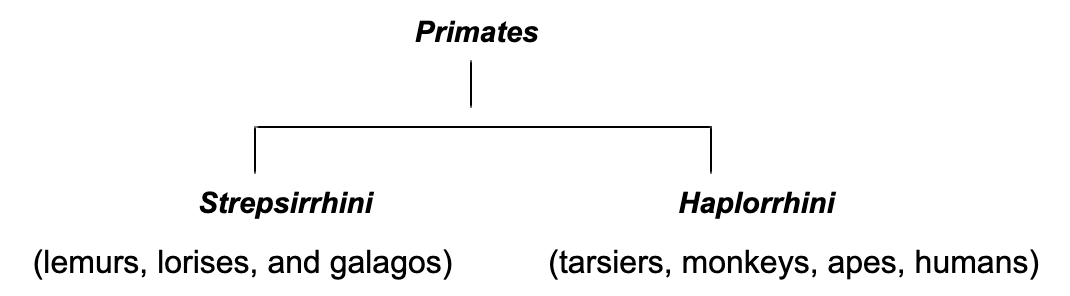
Most modern strepsirrhines live on the island of Madagascar (lemurs), but a few stalk the night forests of Africa (galagos) and Asia (lorises). Our own suborder (haplorrhines) live in Asia, Africa, and the Americas. It is easy to talk about ourselves as if we are higher, grander, further up the scale, etc., but evolution results from adaptation to the immediate environment without a predetermined direction. So don't be specio-centric! After all, Loris tardigradus (a strepsirrhine) is much cuter than Cacajao rubicundus (a haplorrhine)!
Strepsirrhini and haplorrhini
| |
Strepsirrhine- Ring-tailed Lemur
Please observe the fusion of the lower incisors and canines forming a tooth comb.
|
Haplorrhine- Baboon
Please look closely at the lower incisors and canines and note the absence of a tooth comb.
|
| Nails or claws? Which digits? |
Claw on second digit, nails on others |
Nails only |
| Postorbital bar or plate? |
|
|
| Orientation of eye orbits (forward or toward the side) |
|
|
| Snout length relative to brain size |
|
|
| Presence or absence of tooth comb |
|
|
| Geographic location (read intro above) |
|
|
Station 4: Tarsiers
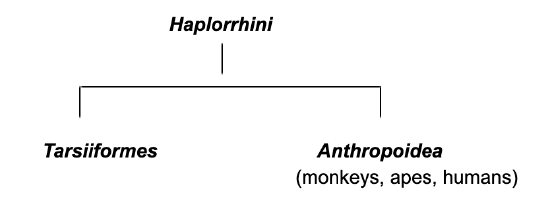
For some time, tarsiers challenged primatologists with regard to their classification: Were they closer to monkeys, apes, and humans or closer to lemurs and lorises? Genetic evidence has now provided strong support for the classification of tarsiers as haplorrhines, but their ancestors likely split off early, before the division of different types of monkeys and apes. Examine the tarsiers—what traits may have been confusing to primatologists because they are similar to lemurs and lorises or are unique to the tarsier?
Tarsier
| |
Tarsier
|
Is this trait more like strepsirrhines or haplorrhines, or is it unique? |
| Nails or claws? Which digits? |
Grooming claw, and nails on other digits |
|
| Postorbital bar or plate? |
|
|
| Orientation of eye orbits (forward or toward the side) |
|
|
| Snout length relative to brain size |
|
|
| Presence or absence of tooth comb |
|
|
| Geographic location |
Asia |
N/A |
Station 5: New World Monkeys
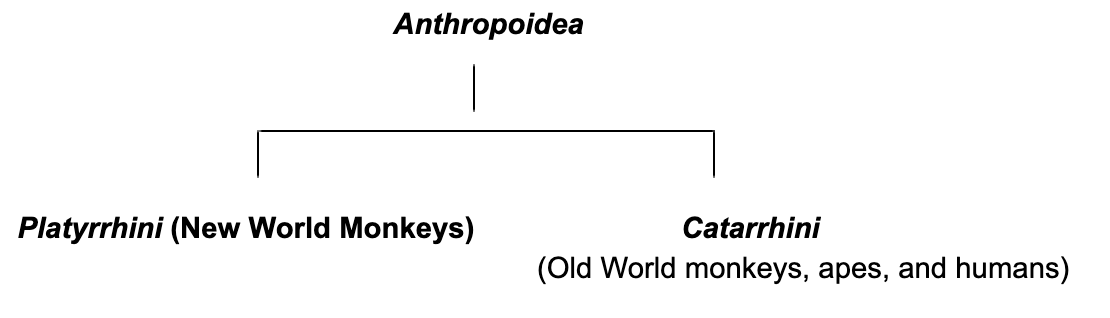
Anthropoids are divided into two infraorders: Catarrhini (Old World monkeys, apes, and
humans, all who live in Africa and Asia) and Platyrrhini (New World monkeys who live in Mexico, Central, and South America). The word "monkey" is confusing because monkeys in the Americas are not closely related to Old World monkeys (Old World monkeys are, in fact, more closely related to people!)
Platyrrhini and catarrhini
| |
Platyrrhini- Brown Howler Monkey
|
Catarrhini- Hamadryas Baboon
|
| Meaning of scientific name |
“Broad-nosed”
(separated by wide nasal septum)
|
“Hook-nosed”
(nostrils are close together)
|
| Direction nostrils face |
|
|
| Dental formula |
|
|
|
Geographic location
(read intro above)
|
|
|
Questions:
Some New World monkeys (Atelinae) have prehensile tails. Look up the name of one monkey that has a prehensile tail: ___________________________________________
One group of New World monkeys, Callitrichidae (marmosets and tamarins), have re-evolved claws on all but one digit. Which digit? (Do some research to find out!) ______________________________________________________
There is one group of New World monkeys who have a reduced or absent thumb. What type of monkey is this? _______________________________
Station 6: Old World Monkeys and Hominoids
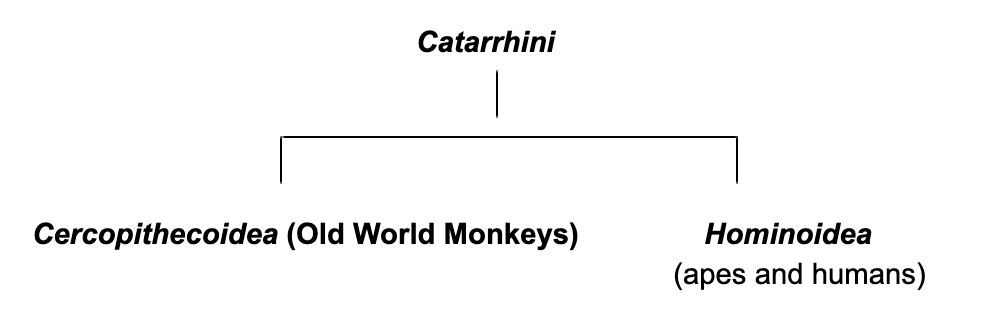
Old world monkeys and hominoids
| Cercopithecoid |
Hominoids |
|
Old World Monkey- Rhesus Macaque
|
|
|
| |
|
|
Old world monkeys and apes
| |
Old World Monkey- Rhesus Macaque |
Ape- Gorilla |
Human |
| Shape of rib cage |
|
|
|
| Length of forelimb (arm) relative to trunk |
|
|
|
| Length of clavicle and location of scapula |
|
|
|
| Presence or absence of tail |
|
|
|
The differences between the monkey skeletons and the hominoids may be because the common ancestor of apes and people was adapted for suspending the body by the arms and brachiating. The forelimbs are long, the shoulders are flexible, the elbows and wrists allow greater rotation, the chest is wide for the attachment of expanded forelimb retractor muscles, and the lower back is short. Cercopithecoids, on the other hand, are adapted to quadrupedalism, like most mammals. The bilophodont molar is their specialization for eating a wide variety of foods.
Station 7: Putting It All Together
Using what you have learned at Stations 3 through 6, construct the complete tree for the Primates order. Put primates at the top, divide them into strepsirrhines and haplorrhines, and then work your way down, dividing them into subgroups as you go. Then, for each group on the tree identify at least one trait that helps distinguish that group and one species that is an example of each divison.
For Further Exploration
David Attenborough. 2003. “Episode 9: The Social Climbers.” The Life of Mammals (Film) eSkeletons. Department of Anthropology, University of Texas at Austin.
2011. Primates—What is a Primate? Odyssey Earth.
Rothman, Jessica (editor). 2014. The Living Primates. The Nature Education Knowledge Project.
Rowe, Noel. 1996. The Pictorial Guide to Living Primates. Charlestown: Pogonias Press.