Community as an Agent of Socialization
Throughout this textbook, we have explored how children develop through relationships and experiences within their families, schools, cultural environments, and broader social systems.
Another important influence on children's socialization is community.
Communities provide opportunities for children to develop relationships, participate in shared activities, observe social interactions, learn expectations, and develop a sense of belonging.
For example, children may learn about cooperation by participating in a neighborhood garden, develop social relationships through recreation programs, or experience support through connections with neighbors and community organizations.
Children may also encounter differences in access to educational programs, safe play spaces, transportation, healthcare, and other resources.
These opportunities and conditions can influence their everyday experiences and development.
Community is therefore more than the location where a child lives. It includes the relationships, institutions, resources, and shared experiences that contribute to social life.
What Is Community?
The term community can describe groups of people connected by geographical location, relationships, shared interests, identities, institutions, or experiences.
A community may include people who live within the same neighborhood, participate in the same educational program, belong to a cultural or religious organization, or share meaningful relationships through other activities.
Researchers distinguish between two broad ways of understanding community.
Geographic Communities
A geographic community refers to people connected through a particular physical location.
Examples include neighborhoods, towns, cities, rural areas, and regions.
Geographic communities may share public spaces, transportation systems, schools, parks, businesses, and community institutions.
However, living in the same location does not necessarily mean that all residents share the same relationships, experiences, or sense of belonging.
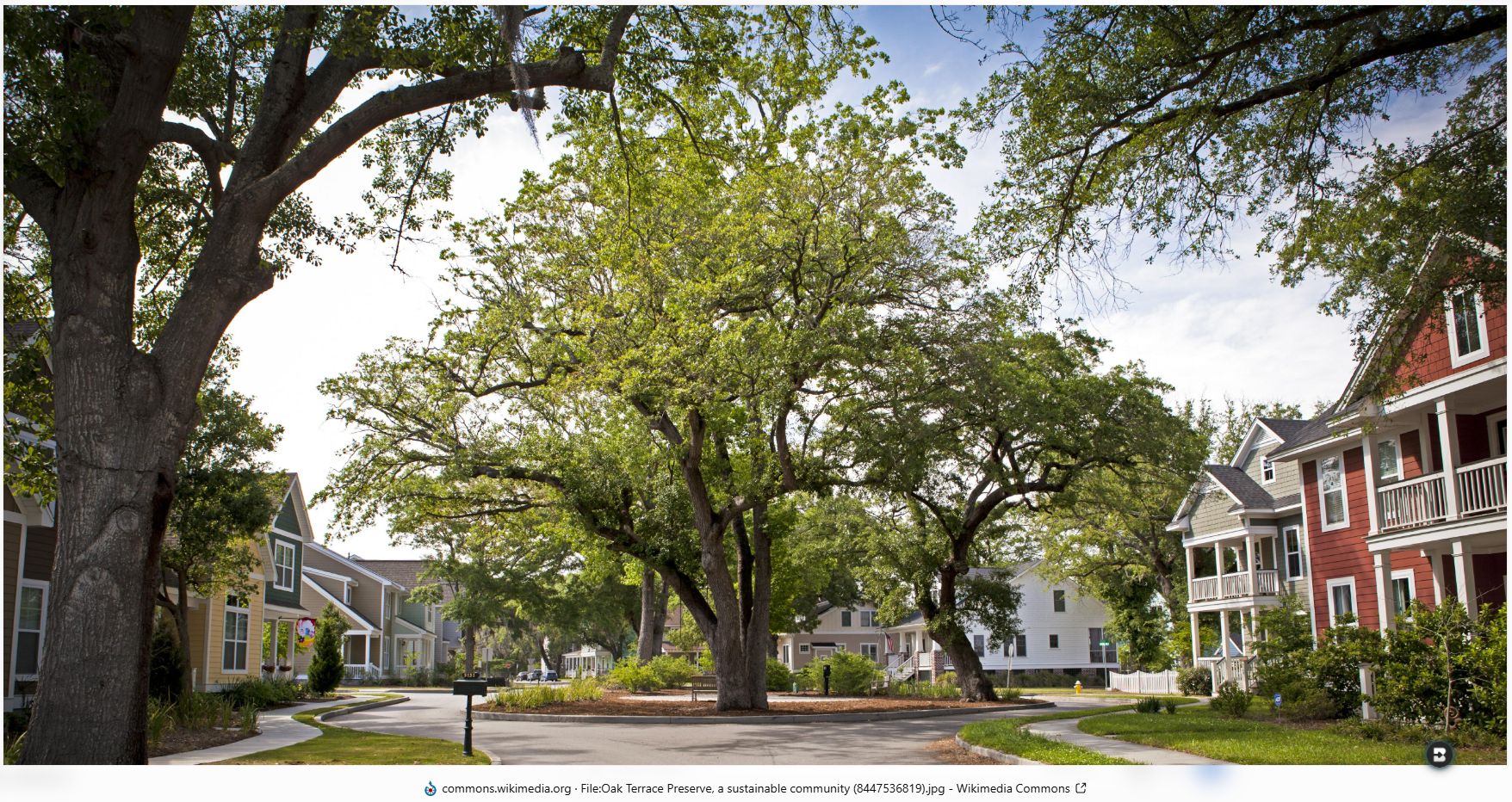
Photograph of a residential street with pastel-colored houses, front porches, a sidewalk, trees, and landscaped lawns. A large tree stands near the sidewalk, which extends along the homes. The image illustrates physical features of a neighborhood that may support walking and connections among residents.
Figure 6.1.1: Neighborhood Environments and Community Connections. A residential neighborhood with sidewalks, trees, and homes illustrates how the physical environment can influence opportunities for mobility, neighborhood interaction, and community participation. Walkable streets may help connect families to neighbors and community resources, although accessibility, safety, and available services also influence children's opportunities to participate. “Oak Terrace Preserve's Walkable Neighborhoods,” by North Charleston, licensed CC BY-SA 2.0.
Relational Communities
A relational community refers to people connected through shared relationships, interests, experiences, or identities, regardless of whether they live in the same location.
Examples include:
- A preschool classroom community.
- A group of families participating in a community organization.
- A cultural or language community.
- A neighborhood association.
- A youth recreation program.
- An online community organized around shared interests.
Children and families may participate in several communities simultaneously.
These communities can provide different forms of connection, knowledge, support, and opportunity.
Sense of Community and Belonging
Community involves more than the presence of people within a shared space.
An important consideration is whether individuals experience meaningful relationships, trust, participation, and belonging.
Sense of community describes people's feelings of belonging, connection, mutual influence, and shared commitment within a group.
McMillan and Chavis (1986) proposed four interconnected elements of sense of community.
Table 6.1.1: Four Elements of Sense of Community
| Element |
Meaning |
Example in Children's Experiences |
| Membership |
Feeling accepted, connected, and part of a group |
A child recognizes familiar people at a neighborhood recreation program and feels welcome participating |
| Influence |
Experiencing the ability to contribute to a group while also being influenced by it |
Children help decide which activities will be included in a community event |
| Integration and Fulfillment of Needs |
Receiving support, resources, or meaningful benefits through community participation |
Families share information and support one another in accessing community resources |
| Shared Emotional Connection |
Developing bonds through common experiences, relationships, history, and participation |
Children and families build relationships through repeated neighborhood gatherings or shared projects |
Based on McMillan and Chavis (1986).

Diagram presenting four elements of sense of community: membership, feeling accepted and included; influence, having a voice and contributing; fulfillment of needs, receiving and sharing support; and shared emotional connection, developing bonds through shared experiences.
Figure 6.1.2: Four Elements of Sense of Community. McMillan and Chavis (1986) identified four interconnected elements that contribute to people's experience of community: membership, influence, integration and fulfillment of needs, and shared emotional connection. Together, these elements help explain how individuals develop belonging, participate in group decisions, receive support, and build meaningful relationships through shared experiences. Conceptual illustration based on McMillan and Chavis (1986).
These elements demonstrate why a community cannot be defined only by geography or the number of organizations within it.
A neighborhood may have numerous public spaces but limited opportunities for some residents to participate meaningfully.
Conversely, a group with relatively few physical resources may develop strong relationships, mutual support, and shared participation.
Both social relationships and material conditions are important to understanding community experiences.
Community Relationships and Children's Development
Children learn through their interactions with people in their communities.
These interactions may involve neighbors, peers, educators, librarians, coaches, healthcare professionals, business owners, community organizers, and other adults.
Through community participation, children may develop:
Social development: Opportunities to communicate, cooperate, develop friendships, and participate in shared responsibilities.
Emotional development: Experiences of connection, recognition, encouragement, and belonging.
Cognitive development: Opportunities to investigate unfamiliar ideas, solve problems, observe community activities, and develop knowledge.
Physical development: Access to spaces and activities supporting movement, exploration, recreation, and play.
These developmental domains are interconnected.
For example, children participating in a community gardening activity may develop relationships, investigate plant growth, use mathematical reasoning, practice motor skills, and contribute to a shared goal.
The benefits of community participation depend not simply on the presence of an activity, but also on its accessibility, quality, safety, and meaning for the children involved.
Communities and Bronfenbrenner's Bioecological Theory
As discussed in Chapter 1, Bronfenbrenner's bioecological perspective helps us understand how children's development occurs within interconnected environments.
Community experiences may involve several ecological systems.
For example, a neighborhood recreation program may be part of a child's immediate experiences when they participate directly.
Relationships between caregivers and program staff may connect different settings in the child's life.
Local government decisions, employment conditions, transportation, and public funding may also influence the opportunities available to children.
Broader cultural beliefs, policies, and historical changes can affect how communities are organized and supported.
Rather than repeating the ecological systems model here, we will apply the broader idea that community relationships, institutions, and conditions interact to influence children's everyday experiences.
Community Support During Times of Change and Crisis
Communities may provide important support during emergencies, transitions, and other challenging circumstances.
For example, when wildfires, floods, or other disasters affect a community, residents and organizations may coordinate food, shelter, transportation, childcare, and other assistance.
The 2018 Camp Fire in Butte County, California, provides a historical example of a major disaster that affected families, schools, homes, and community relationships.
Following the fire, individuals and organizations contributed resources, assistance, and opportunities for recovery.
The experience demonstrates how communities may mobilize during difficult circumstances.
However, disasters can also reveal differences in access to transportation, housing, financial resources, and recovery services.
Community resilience should therefore be understood in relation to both the strengths of community relationships and the resources and institutional support available to residents.
Community Participation and Socialization
As children participate in community activities, they encounter expectations about cooperation, responsibility, communication, fairness, and relationships.
For example, a child visiting a library may learn how to share public materials, participate in group storytelling, ask for assistance, and interact with people outside their family.
A child participating in a neighborhood cleanup may develop an understanding of shared spaces and collective responsibility.
A child joining a recreation program may learn about teamwork, belonging, and participation in group decisions.
These experiences illustrate community socialization in everyday life.
Children are not simply passive observers. They also influence their communities through their interests, ideas, relationships, and participation.
Case Study: Building a Sense of Community
Meet Jordan
Jordan is a six-year-old child who recently moved with his family to a new neighborhood.
At first, Jordan knows few people nearby and spends most afternoons at home.
A neighbor tells Jordan's caregiver about a free community gardening program that welcomes children and families.
During the first visit, Jordan observes other children planting vegetables.
Over several weeks, he begins recognizing familiar participants, helping water plants, and sharing ideas about what the group might grow next.
He develops friendships and begins looking forward to the weekly gatherings.
Applying Sense-of-Community Theory
Membership: Jordan develops a feeling of belonging as he becomes familiar with the group.
Influence: Jordan contributes ideas and participates in decisions.
Integration and Fulfillment of Needs: The program provides opportunities for learning, recreation, and relationships.
Shared Emotional Connection: Repeated activities and shared accomplishments strengthen Jordan's connections with others.
This example demonstrates that community socialization occurs through meaningful participation and relationships.
Connecting Community to Professional Practice
Early childhood educators can support community connections by:
- Learning about children's community experiences and relationships.
- Recognizing both geographic and relational communities.
- Helping children identify meaningful people and places in their communities.
- Building collaborative relationships with local organizations.
- Creating opportunities for children to participate in shared projects.
- Recognizing that transportation, cost, accessibility, and safety influence participation.
- Avoiding assumptions about children based solely on where they live.
- Supporting children's sense of belonging in classrooms and community settings.
Educators should also recognize that families may define community differently.
For some, neighborhood relationships may be central. For others, extended family, cultural organizations, faith communities, or geographically distant relationships may be equally important.
Understanding these experiences helps educators develop respectful, inclusive learning environments.
Pause to Reflect!
- How do geographic and relational communities differ?
- Identify the four elements of sense of community proposed by McMillan and Chavis.
- How might community participation influence children's social, emotional, cognitive, and physical development?
- Describe a community that has influenced your own development. Which elements of sense of community were present?
- How did Jordan develop a sense of belonging through the gardening program?
- Why is the presence of community resources different from meaningful access to those resources?
- What could an educator do to help children recognize the communities to which they belong?
References
McMillan, D. W., & Chavis, D. M. (1986). Sense of community: A definition and theory. Journal of Community Psychology, 14(1), 6–23. https://doi.org/10.1002/1520-6629(198601)14:1%3C6::AID-JCOP2290140103%3E3.0.CO;2-I
Osterman, K. F. (2000). Students' need for belonging in the school community. Review of Educational Research, 70(3), 323–367. https://doi.org/10.3102/00346543070003323
Solomon, D., Watson, M., Battistich, V., Schaps, E., & Delucchi, K. (1996). Creating classrooms that students experience as communities. American Journal of Community Psychology, 24(6), 719–748.
Content Attribution
This section adapts and expands Rebecca Laff and Wendy Ruiz's original What Is Community?, in the supplied LibreTexts Chapter 6: Community, licensed under Creative Commons Attribution-NonCommercial-ShareAlike 4.0 International (CC BY-NC-SA 4.0).
The revised section retains the original focus on community as an agent of socialization, geographic and relational communities, belonging, community support, and children's development.
Revisions include expanding McMillan and Chavis's sense-of-community framework, reducing repetition of Bronfenbrenner's theory, creating new educational examples, and organizing the discussion around relationships, participation, and belonging.
Original source: Rebecca Laff and Wendy Ruiz, Community, Social Sci LibreTexts.