Community Institutions as Agents of Socialization
Children learn about the world through interactions with people and institutions beyond their families and schools.
Community organizations, businesses, healthcare providers, libraries, recreation programs, cultural organizations, and social-service agencies all contribute to children's experiences.
Some provide formal educational opportunities, while others support informal learning through everyday participation.
For example, a child may learn about community responsibilities while visiting a library, develop communication skills while ordering food at a restaurant, or build relationships through a recreation program.
These experiences illustrate how community institutions contribute to socialization.
Community resources also influence families' opportunities to access education, healthcare, childcare, nutrition, recreation, and other supports.
However, the presence of an organization does not guarantee that every family can use its services.
Cost, transportation, accessibility, eligibility requirements, language availability, operating hours, and awareness of programs all influence access.
Businesses as Community Learning Environments
Businesses provide opportunities for children to observe how people communicate, exchange goods and services, solve problems, and participate in community life.
For example, a visit to a grocery store may involve identifying foods, comparing quantities, observing transactions, and learning about occupations.
A visit to a neighborhood bakery may provide opportunities to investigate measurement, food preparation, employment, and cooperation.
Children may also observe how adults interact respectfully with employees, respond to questions, and navigate public environments.
These experiences connect community participation with language, mathematics, social studies, and social-emotional learning.
Educators can create meaningful partnerships with local businesses when experiences align with children's interests and developmental abilities.
However, classroom learning should not depend on families' ability to purchase goods or pay participation fees.
Libraries and Cultural Organizations
Public libraries are important community resources.
They provide access to books, information, technology, educational programs, and shared spaces.
Many libraries offer early literacy activities, storytelling, family programs, and opportunities for children to interact with others.
Libraries may also serve as gathering places where community members connect with information and services.
Museums, community arts centers, historical organizations, and cultural institutions can provide additional opportunities for exploration.
For example, a children's museum may offer hands-on scientific and artistic experiences, while a community arts program may introduce children to different forms of creative expression.
The value of these resources depends partly on whether children and families can access them.
Educators should investigate free admission days, transportation options, accessibility services, language supports, and alternative participation opportunities.
Recreation, Clubs, and Youth Programs
Recreation programs and community clubs provide opportunities for children to develop interests, relationships, and skills.
Examples include:
- Sports and movement programs.
- Art and music organizations.
- Theater and creative-expression programs.
- Gardening and environmental clubs.
- Youth leadership and mentoring programs.
- Community service organizations.
- Cultural and language enrichment activities.
Children may develop cooperation, confidence, persistence, communication, and leadership through these experiences.
However, participation often requires resources such as transportation, equipment, registration fees, or caregiver time.
Sociologist Annette Lareau (2011) examined how social class and family resources may influence children's opportunities to participate in organized activities.
Her research helps explain why unequal participation should not be interpreted simply as differences in family interest or motivation.
Faith-Based and Community Organizations
Faith-based organizations may provide social relationships, cultural activities, educational programs, childcare, food assistance, emergency shelter, and other resources.
Religious organizations can also serve as important sources of cultural identity and community connection for participating families.
Community organizations that are not religious may provide similar opportunities through cultural associations, neighborhood groups, mutual-aid networks, and nonprofit organizations.
During emergencies, these organizations may coordinate assistance for residents.
For example, following Hurricane Harvey in 2017, faith-based organizations, community volunteers, and other groups helped people affected by flooding.
This example illustrates how relationships and organizations can contribute to community resilience.
Educators should recognize the range of community supports available while respecting families' different religious, spiritual, and nonreligious identities.
Transportation and Community Access
Transportation influences families' opportunities to participate in community life.
Available options may include walking, bicycles, public buses, trains, accessible transportation, private vehicles, and other mobility services.
Transportation access is not simply a matter of distance.
A program may be geographically close but difficult to reach because of unsafe roads, inaccessible sidewalks, limited transit schedules, or the cost of transportation.
For example, a family may be interested in a free early literacy program but unable to attend because the nearest bus route does not operate during program hours.
Understanding community access requires educators to consider how transportation interacts with scheduling, cost, disability access, and family responsibilities.
Family and Community Support Services
Families may seek community services for a variety of purposes, including education, healthcare, nutrition, housing, developmental support, and childcare.
Services may be provided through public agencies, nonprofit organizations, community institutions, or private providers.
Table 6.3.1: Examples of Community Resources and Services
| Type of Resource |
Examples |
Potential Support |
| Early Childhood Education |
Head Start, Early Head Start, childcare programs, public preschool |
Early learning, family engagement, developmental support |
| Nutrition Assistance |
WIC, food banks, community meal programs |
Nutrition resources, education, and referrals |
| Healthcare |
Community clinics, pediatric practices, public health services |
Preventive care, health information, referrals |
| Developmental Services |
Early intervention, regional centers, disability-support organizations |
Assessment, service coordination, family support |
| Housing and Family Services |
Housing-assistance agencies, family resource centers |
Housing navigation, crisis support, connections to resources |
| Recreation and Culture |
Libraries, parks, museums, youth programs |
Learning, play, relationships, and community participation |
Eligibility, availability, funding, and services vary by program and location.
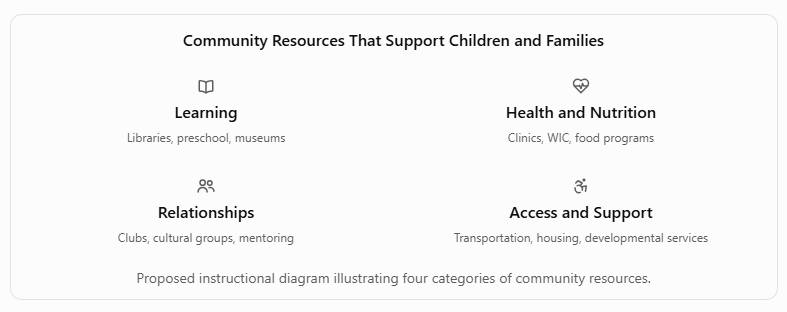
Diagram organizing community resources into four categories: Learning, including libraries, preschool, and museums; Health and Nutrition, including clinics, WIC, and food programs; Relationships, including clubs, cultural groups, and mentoring; and Access and Support, including transportation, housing, and developmental services.
Figure 6.3.1: Community Resources That Support Children and Families. Community institutions offer interconnected opportunities for education, health and nutrition, social relationships, and family support. Libraries, early childhood programs, healthcare providers, recreation organizations, transportation systems, and social-service agencies may contribute to children's socialization and development. Meaningful access depends on affordability, availability, accessibility, and families' individual circumstances. Original instructional diagram.
Head Start and Early Head Start
Head Start and Early Head Start are federally supported programs designed to promote young children's development and support families.
Programs may provide early education, health and developmental services, and family engagement opportunities.
Their specific services and eligibility requirements should be verified through the appropriate local program.
WIC
The Special Supplemental Nutrition Program for Women, Infants, and Children (WIC) provides nutrition support, education, and referrals to eligible participants.
The program serves eligible pregnant and postpartum individuals, infants, and children younger than five.
Eligibility depends on program criteria, and families should consult their local WIC agency for current information.
California Regional Centers
In California, regional centers are community-based nonprofit agencies that contract with the Department of Developmental Services.
They coordinate services and supports for eligible individuals with developmental disabilities and their families.
California's 21 regional centers provide functions including assessment, eligibility determination, service coordination, and case management.
Infants and toddlers may also qualify for Early Start services under applicable criteria.
Family Resource Centers and Other Agencies
Family resource centers may provide referrals, parent education, community connections, and assistance navigating services.
Other agencies may help families identify housing, childcare, transportation, healthcare, or nutrition resources.
The specific services available depend on the community.
Access, Opportunity, and Community Participation
A community may contain many organizations while some families experience substantial barriers to using them.
Consider a community museum that offers educational workshops.
Participation may depend on whether families can afford admission, arrange transportation, communicate with program staff, or attend during scheduled hours.
Similarly, a community organization may offer valuable services but remain difficult to navigate without language access or clear information.
Equitable access involves identifying and reducing barriers that prevent meaningful participation.
Educators can support families by learning about these barriers and identifying appropriate resources without assuming that every family needs the same services.
Connecting Families With Community Resources
Early childhood educators are not expected to become experts in every community program.
However, they can develop working knowledge of resources that may be useful to children and families.
A practical approach includes:
- Identifying community programs and agencies.
- Verifying current services, eligibility requirements, and contact information.
- Considering cost, transportation, language access, and accessibility.
- Sharing information respectfully and confidentially.
- Supporting families in making their own decisions.
- Updating resource information when programs change.
Educators should avoid assuming that a family needs assistance solely because of income, household structure, language, or other characteristics.
Resources should be offered through respectful collaboration rather than judgment.
Case Study: Connecting Learning With Community Resources
Meet Sofia and Her Family
Sofia is a four-year-old child who enjoys listening to stories and creating artwork.
Her teacher learns that Sofia's family is interested in additional learning opportunities outside preschool.
The teacher identifies several community resources, including a public library, a free neighborhood art program, and a children's museum.
After reviewing the options, the teacher realizes that the museum requires transportation and admission fees, while the library and art program are accessible through nearby public transit.
She shares the information with Sofia's family and invites them to select any opportunities that interest them.
Applying Community Resource Knowledge
The educator recognizes Sofia's interests while considering the family's available options.
She does not assume which activities the family should choose.
Instead, she provides information that supports informed family decision-making.
The example illustrates how educators can connect learning with community opportunities while respecting family autonomy.
Connecting Community Resources to Professional Practice
Educators can strengthen community partnerships by:
- Identifying resources that support children's interests and developmental needs.
- Considering barriers to participation.
- Developing relationships with local libraries, parks, and organizations.
- Offering families choices rather than prescribing one solution.
- Respecting confidentiality and family preferences.
- Recognizing community organizations as sources of knowledge, relationships, and support.
- Keeping resource information current and accurate.
Pause to Reflect!
- How do businesses and community organizations contribute to children's socialization?
- Why are public libraries especially valuable community institutions?
- How does Lareau's research help explain differences in access to organized activities?
- Identify three barriers that might prevent a family from using an available community resource.
- How could transportation influence opportunities for participation?
- What should educators verify before recommending a community service?
- In Sofia's case, how did the educator support family decision-making without making assumptions?
- Identify three resources in your community that could support children or families. Explain their services and possible access barriers.
Content Attribution
This section adapts and expands Rebecca Laff and Wendy Ruiz's Community Organizations and Services, in Chapter 6: Community, Social Sci LibreTexts, licensed CC BY-NC-SA 4.0.
It preserves the original discussion of businesses, libraries, cultural organizations, recreation programs, faith-based institutions, transportation, social services, and unequal opportunities for participation.
Revisions include reorganizing the resources by function, updating program descriptions, clarifying accessibility considerations, and developing family-centered educational applications.
Original source: Rebecca Laff and Wendy Ruiz, Community, Social Sci LibreTexts.