Opening the book…
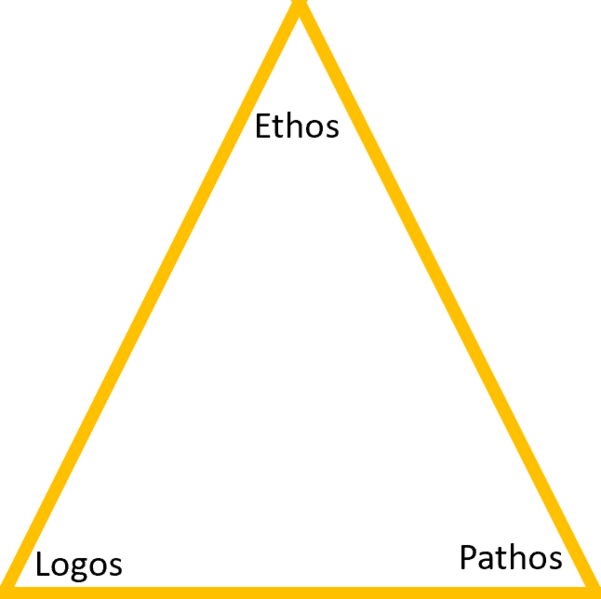 Over 2,300 years ago, the Greek philosopher Aristotle developed a three-pronged strategy for persuading others. He suggested that speakers employ a careful balance of all three vertices of his rhetorical triangle to achieve effective and successful persuasion. He labeled the three elements of that triangle as ethos, pathos, and logos, which students have probably encountered before in a writing class at some point. Looking at each concept individually will help demonstrate how each fits together with respect to persuasion in oral communication.
This page titled 11.4: Rhetorical Triangle was last modified on Mon, 06 May 2024 07:52:25 GMT and is shared under a CC BY license and was authored, remixed, and/or curated by Josh Misner and Geoff Carr via source content that was edited to the style and standards of the LibreTexts platform.
The book could not be loaded just now.