Opening the book…
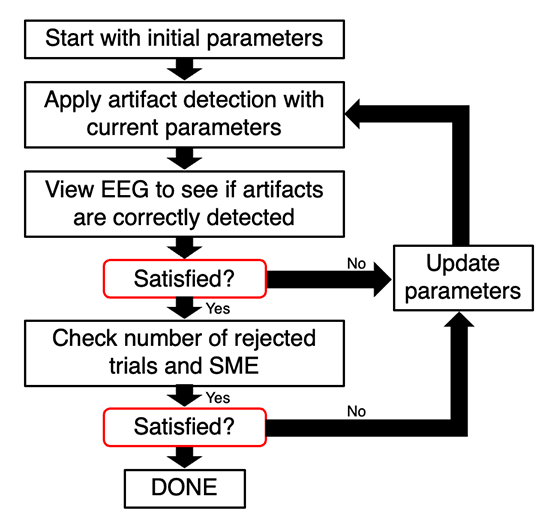
Many researchers use a preset artifact detection threshold for all participants, but this is not usually optimal. A threshold that works well for one participant might fail to flag all the blinks for another participant, and it might lead many non-blink epochs to be flagged in yet another participant. I therefore recommend the interactive and iterative approach shown below in Figure 8.1. It involves starting with an initial set of best-guess parameters, then seeing whether these parameters adequately flag the epochs that should be rejected, and then adjusting the parameters as necessary until you are satisfied. As will be described in the next section, it also involves using the standardized measurement error (SME) to help you determine which parameters lead to the best balance of eliminating noisy trials while still having enough trials to obtain a good averaged ERP waveform. We will see how to check the SME in the next section.
The threshold is not the only parameter you might adjust. For example, if you are using artifact correction to remove the artifactual voltages produced by blinks but you still want to reject blinks that occur at the time of a stimulus (which make it so that the participant can't see the stimulus), you can adjust the time window used to look for blinks. And as we will see in later sections, other artifact detection algorithms have additional parameters that control their operation. But the threshold is usually the main one you will adjust individually for each participant.
Make sure you keep a record of the parameters you choose for each participant. I recommend using a spreadsheet for this. The example script at the end of the chapter shows you how a script can read the artifact detection parameters from a spreadsheet and then perform the artifact detection with these parameters. That will keep you from having a meltdown when Reviewer 2 requests an analysis that requires performing artifact detection again. In fact, it’s a good idea to set the parameters manually and then immediately reprocess the data using a script with those parameters. Processing the data manually is important so that you see the data at each step of the process, which can alert you to problems in the data for a given participant that require special processing. However, it’s easy to make a mistake when you’re processing data by pointing and clicking in a GUI, and scripts are valuable because they avoid these point-and-click errors. You can get the best of both worlds if you start by manually processing the data in the eStudio GUI, manually determining the rejection parameters, saving those parameters in a spreadsheet, and then reanalyzing the data using a script that reads these parameters.I find this iterative approach is reasonably quick and effective for most kinds of experiments (5-10 minutes for most participants once you’ve become well practiced). However, other approaches may be better in certain cases.
For example, if you are doing a huge analysis with hundreds of datasets (e.g., datasets you obtained from online repositories), you might want to use one of the algorithms that automatically set the parameters for each participant (e.g., Jas et al., 2017; Nolan et al., 2010; Talsma, 2008). However, you should still do a quick visual verification for each participant to make sure that the parameters are reasonable.
Another case where a different approach is warranted arises when you have a small number of trials per participant (as in many infant studies) or a small number of highly valuable participants (as in some studies of lesion patients). In these cases, it is worth taking a manual approach to artifact detection because every epoch is important, and there aren't a lot of epochs to check. This was demonstrated in the preceding section.
Will this lead to bias?
You might be concerned that manually setting the artifact detection parameters might somehow bias the data. This can indeed be a legitimate concern. For example, if you set a more lenient threshold for participants in Group A than for participants in Group B, then more blinks may escape detection in Group A, and the voltages from these extra blinks in group A may create an artifactual difference in the ERPs between the two groups. There is a simple solution to this problem: The person who is setting the artifact detection parameters should be blind to group membership. This is what my lab does in our research comparing people with schizophrenia to matched control participants.
This potential for artifactual differences is mainly a problem in studies comparing different groups of participants (or different ages, etc.). In studies that solely examine within-participant effects in a single group of participants, it is unlikely that the results could be biased by the manual setting of artifact detection parameters. This is because the same parameters are used for all conditions. That is, if the rejection criterion is too lenient, this will be true for all the conditions of the experiment. I suppose that a truly devious researcher could play around with the threshold and try to find one that maximizes the difference between conditions in a given participant. But this would have to be a conscious decision to fudge the results. If someone wants to fudge the results, this would be a very difficult and time-consuming way to do it. So I don't worry that the manual setting of artifact detection parameters is going to bias the results in studies of within-participant effects.
This page titled 8.8: An Iterative Approach to Setting Parameters was last modified on Thu, 01 Oct 2026 18:52:48 GMT and is shared under a CC BY-NC 4.0 license and was authored, remixed, and/or curated by Steven J Luck directly on the LibreTexts platform.
The book could not be loaded just now.