Opening the book…
In Part 1 you sorted galaxies by shape. Now you will use the colors of their stars to find out whether each galaxy is still making new stars. The galaxy cards have the same numbers as in Part 1.
Blue Stars Are Young Stars
 Model
Model 1: Two star clusters. All the stars in a cluster formed at about the same time. Each dot is one star.
Before you start: On both diagrams, color the band hotter than 10,000 K blue, the band from 5,000 to 10,000 K yellow, and the band cooler than 5,000 K red. Color lightly so you can still see the dots.


| Color of star | Mass compared with the Sun | Time on the main sequence |
|---|---|---|
| Blue (hotter than 10,000 K) | more than about 3 times | a few million to a few hundred million years |
| Yellow (5,000 to 10,000 K) | about 1 to 3 times | about 1 billion to 10 billion years (the Sun: about 10 billion) |
| Red (cooler than 5,000 K) | less than the Sun | tens of billions of years or more, longer than the universe has existed (about 14 billion years) |
 Explore
- Which cluster still has main-sequence stars in the blue band?
- In Cluster B, the main sequence ends at the turnoff point. About what temperature is the turnoff, and which color band is it in? Answer space
- Use the table. What happened to the blue stars that Cluster B once had? Answer space
- Which cluster is older? Estimate the age of each cluster. Answer space
 Critical thinking & Concept Invention
- A classmate says Cluster A could be 5 billion years old. Use evidence from Model 1 to respond. Answer space
- Now think about a whole galaxy instead of one cluster. Suppose part of a galaxy glows blue because it has many hot blue stars. Write a rule: what does blue light tell you about when stars formed there? Answer space
- A galaxy shows only yellow and red light, with no blue. Does that mean it never formed any stars? Explain. Answer space
 Summary
- Complete the sentences. Blue stars are massive than the Sun and live lives. So blue light in a galaxy means stars .
 Apply
- Most large galaxies are about 10 billion years old or older. One such galaxy contains many blue stars. Are those blue stars as old as the galaxy? Explain. Answer space
Searching for Star Formation
Model
Model 2: Four galaxies up close. In these Hubble photos:
- Bright blue patches are clusters of young, hot stars.
- Glowing pink or red clouds are gas lit up by young stars. They also mark places where stars are forming.
- Smooth yellowish light comes mostly from older stars.
The colors are made by combining pictures taken through several filters, so they are close to, but not exactly, what your eye would see.


Explore
- On each of the four photos, circle every blue region you can find. Use a blue pencil if you have one.
- Fill in the table. Use Part 1 for the Hubble type, and look back at the cards on that page for any galaxy not shown above.
Card Hubble type Amount of blue (none, a little, a lot) Where is the blue? (arms, center, everywhere, nowhere) Color of the center 3 Answer space Answer space Answer space Answer space 1 Answer space Answer space Answer space Answer space 9 Answer space Answer space Answer space Answer space 10 Answer space Answer space Answer space Answer space 7 Answer space Answer space Answer space Answer space 4 Answer space Answer space Answer space Answer space 12 Answer space Answer space Answer space Answer space 11 Answer space Answer space Answer space Answer space
Critical thinking & Concept Invention
- Which types of galaxy have the most blue? Which have the least? Answer space
- Inside the spiral galaxies, where is the blue, and where is the yellow? What does this tell you about the ages of the stars in the arms compared with the stars in the central bulge? Answer space
- Compare card 10 (Hubble type a or b, large bulge) with card 3 (type c, small bulge). Which has more blue? Predict a pattern along the spiral scale from a to c. Answer space
- Use your rule from question 6. Which of the galaxies in your table are forming stars now? Which stopped forming stars long ago? Answer space
Summary
- Complete the sentences. Spiral, barred spiral, and irregular galaxies have , so they are . Elliptical galaxies have , so their stars are . In spirals, new stars form mainly in the .
Apply
- Card 18 is an irregular galaxy. Before you look at its colors, predict whether it is forming stars. Then check the card in Part 1. Were you right? Answer space
Fuel for New Stars
Model
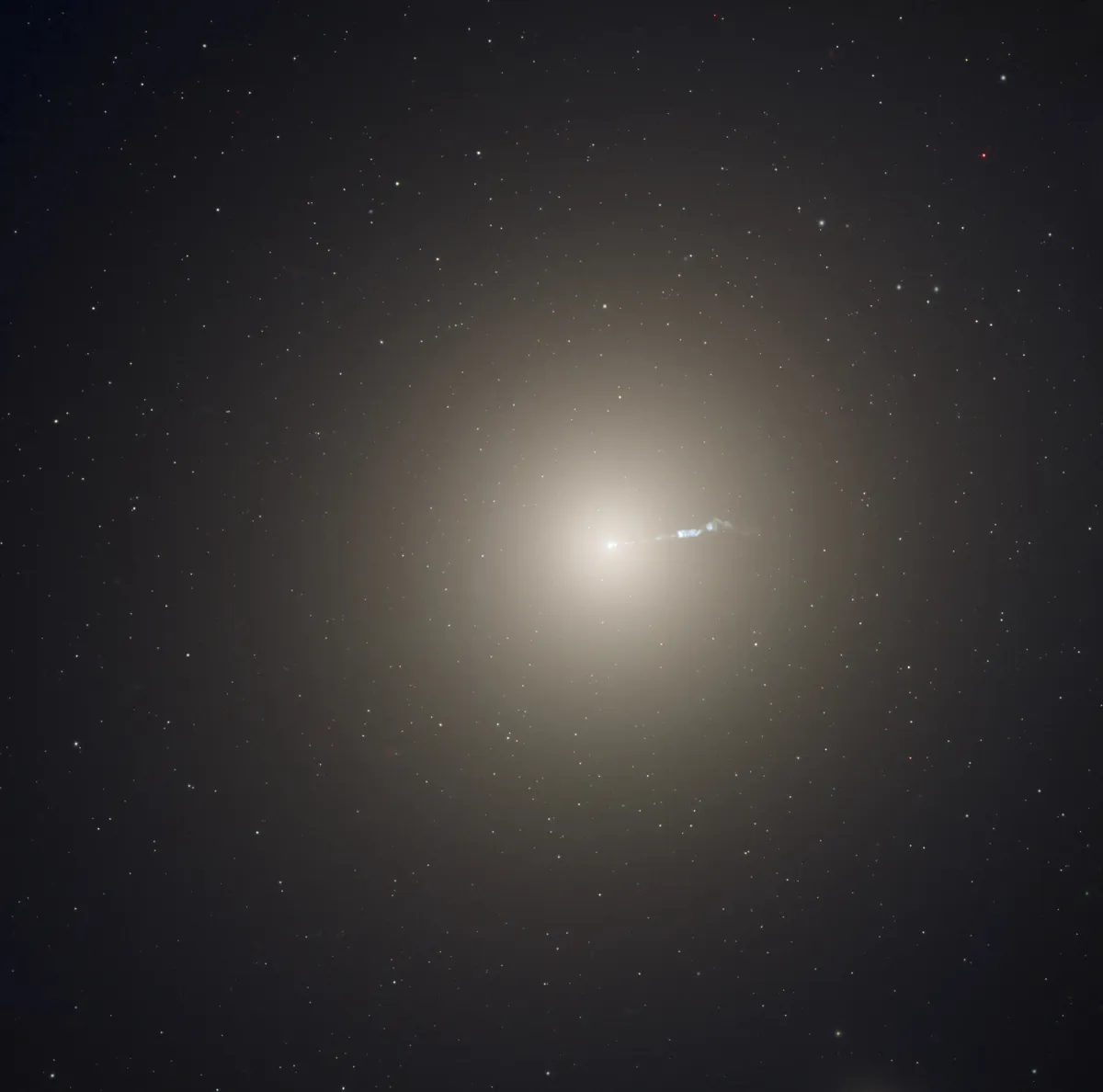
Model 3: Dust. Stars form inside cold clouds of gas mixed with dust. In photos, dust shows up as dark lanes or patches that block the light behind them. The thin bluish line near the center of card 2 is a jet of gas shot out from near a black hole. It is not made of stars.


Explore
- Fill in the table.
Card Is there dark dust? Where? Are there blue or pink regions? Where? 19 Answer space Answer space 16 Answer space Answer space 15 Answer space Answer space 2 Answer space Answer space
Critical thinking & Concept Invention
- What do the galaxies with blue regions have that the elliptical galaxies do not have? Answer space
- Explain why elliptical galaxies cannot form many new stars. Answer space
- Card 19 has a lot of dust but only a little blue. What does this suggest about the connection between dust and star formation? Answer space
Summary
- Complete the chain. Cold gas and dust, then , then , then after a few million years , unless .
Apply
- Card 14 is a lenticular (S0) galaxy with one thin dust lane. Predict whether it has a lot of star formation, a little, or none. What would you look for in the photo to check? Answer space
When Galaxies Collide
Model
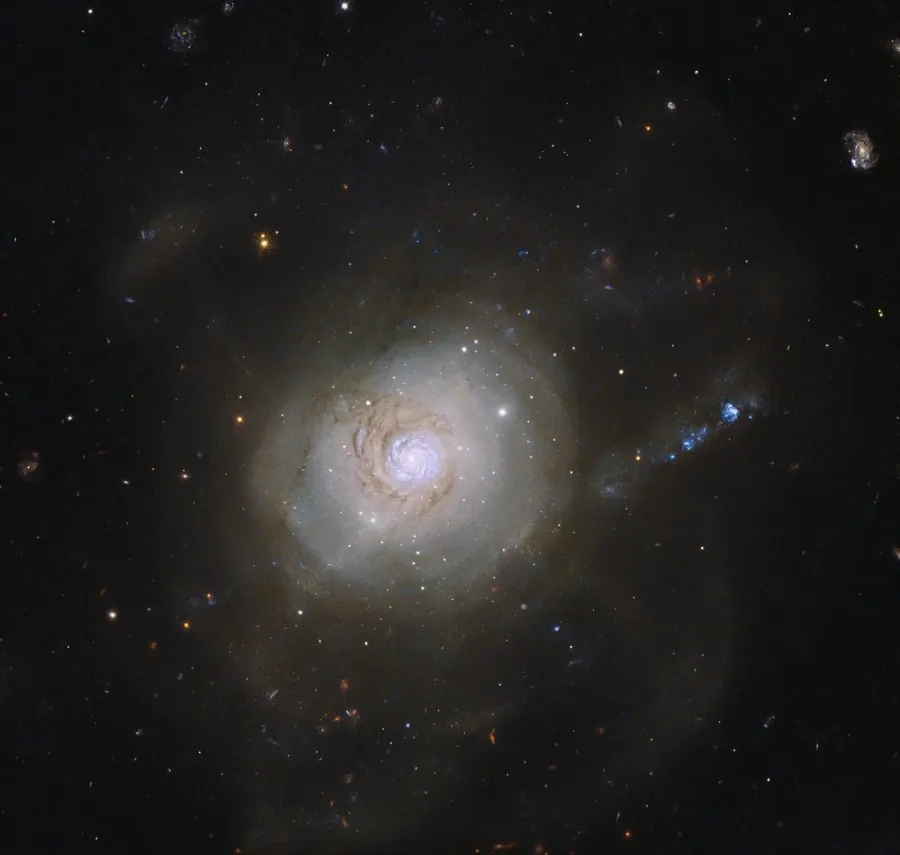
Model 4: Galaxies meeting. These four photos show galaxies at different stages of a collision. They are not in order.


Explore
- Put the four images in order from the earliest stage of a collision to the latest. Explain the clues you used. Answer space
- Which images show the most blue? Which show the least? Answer space
- What happens to the shapes of the spiral disks as a collision goes on? Answer space
Critical thinking & Concept Invention
- When galaxies collide, their gas clouds are squeezed together. Use your observations to explain why colliding galaxies have so much blue. Answer space
- Astronomers expect that in a few billion years, the galaxy in image P will look like an ordinary elliptical galaxy. Use the star lifetimes from Model 1 to explain why its blue regions will disappear. Answer space
- Elliptical galaxies contain only old stars and almost no gas. Could an elliptical galaxy turn into a spiral galaxy on its own? What would it need? Use evidence from this activity. Answer space
Summary
- Complete the sentences. When two spiral galaxies collide, their gas is and many stars form. Later the gas is , the blue stars , and the merged galaxy can look like an galaxy.
Apply
Classify like a citizen scientist. In the online project Galaxy Zoo, volunteers classify galaxy photos to help astronomers. Try it with two new images.

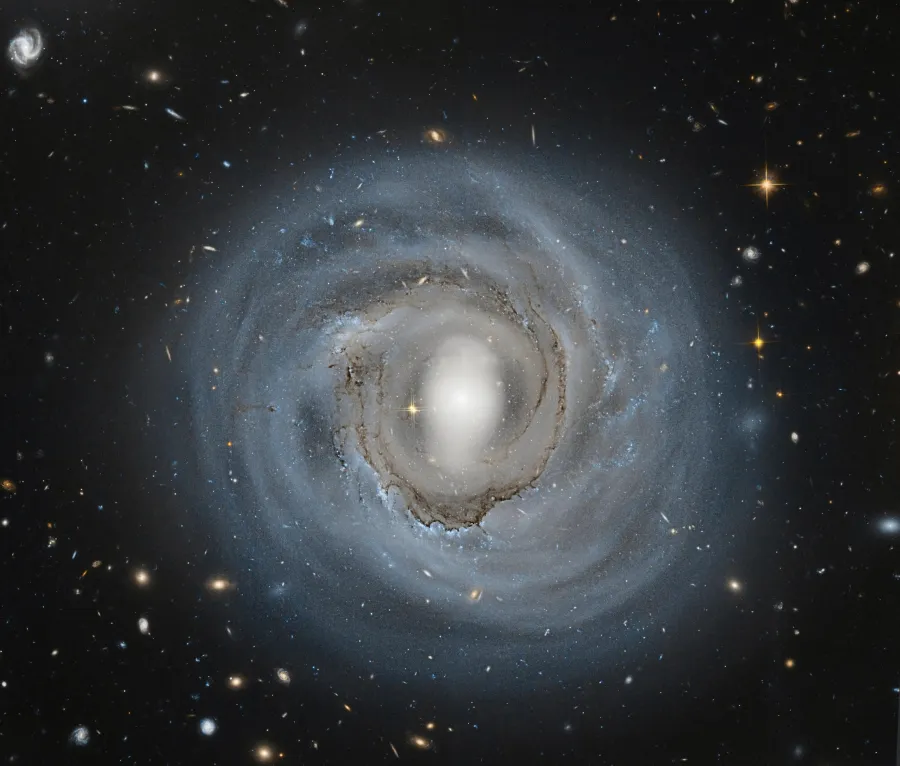
- Fill in the table. Image T contains two galaxies.
Galaxy Hubble type Amount of blue Forming many stars now? (yes or no) Image T, large galaxy Answer space Answer space Answer space Image T, small galaxy Answer space Answer space Answer space Image U Answer space Answer space Answer space - The galaxy in image U has a spiral shape but much less blue than most spirals. It lives in a crowded cluster of galaxies. Suggest what might have happened to it. Answer space
Image credits
Galaxy photos are from the Hubble Space Telescope. Diagrams are original to this workbook.
- Card 1: NGC 1300. Credit: NASA, ESA, and The Hubble Heritage Team (STScI/AURA); Acknowledgment: P. Knezek (WIYN). Source
- Card 2: Messier 87. Credit: NASA and The Hubble Heritage Team (STScI/AURA). Source
- Card 3: Messier 74. Credit: NASA, ESA, and the Hubble Heritage (STScI/AURA)-ESA/Hubble Collaboration; Acknowledgment: R. Chandar and J. Miller. Source
- Card 7: ESO 325-G004. Credit: NASA, ESA, and The Hubble Heritage Team (STScI/AURA); Acknowledgment: J. Blakeslee (Washington State University). Source
- Card 11: NGC 4449. Credit: NASA, ESA, A. Aloisi (STScI/ESA), and The Hubble Heritage (STScI/AURA)-ESA/Hubble Collaboration. Source
- Card 15: Messier 64. Credit: NASA, CSA, ESA, F. Belfiore, J. Lee, A. Leroy, and D. Thilker; Processing: Gladys Kober. Source
- Card 16: NGC 4217. Credit: ESA/Hubble & NASA, Acknowledgement: R. Schoofs (CC BY 4.0). Source
- Card 19: Messier 104 (Sombrero). Credit: NASA and The Hubble Heritage Team (STScI/AURA). Source
- Image P: NGC 7252 (center). Credit: NASA & ESA, Acknowledgements: Judy Schmidt (CC BY 4.0). Source
- Image Q: The Mice (NGC 4676). Credit: NASA, H. Ford (JHU), G. Illingworth (UCSC/LO), M. Clampin (STScI), G. Hartig (STScI), the ACS Science Team, and ESA. Source
- Image R: NGC 1132 (same galaxy as card 4). Credit: NASA, ESA, and the Hubble Heritage (STScI/AURA)-ESA/Hubble Collaboration; Acknowledgment: M. West (ESO, Chile). Source
- Image S: The Antennae (NGC 4038 and NGC 4039). Credit: NASA, ESA, and the Hubble Heritage Team (STScI/AURA)-ESA/Hubble Collaboration; Acknowledgment: B. Whitmore (STScI). Source
- Image T: Arp 116: Messier 60 (large) and NGC 4647 (small). Credit: NASA, ESA, and the Hubble Heritage (STScI/AURA)-ESA/Hubble Collaboration. Source
- Image U: NGC 4921. Credit: NASA, ESA, and K. Cook (Lawrence Livermore National Laboratory). Source
This page titled 5.2: What Galaxies Tell Us About Their Stars was last modified on Mon, 09 Nov 2026 19:01:01 GMT and is shared under a CC BY 4.0 license and was authored, remixed, and/or curated by Andrew Totah-McCarty.
The book could not be loaded just now.