Opening the book…
Standard practiced: K2 (vector kinematics equations), K3 (kinematics vectors, including trig components), and X1 (solving the equations). The week 2 quiz covers this activity and Projectiles.
In Kinematics Graphs, you saw that velocity is the derivative of position and that a change in position is an integral of velocity. In this activity, you will use calculus on polynomial functions to move between position, velocity, and acceleration. Then you will do the same thing in two dimensions, one row at a time, with column vectors. Keep unrounded values in your calculator during a problem, and round final answers to 2 decimal places.
Whiteboard first: in class, your group drafts its key work on the whiteboard. When the group agrees, everyone copies the final version into their notes.
Colors: use 3 or 4 colors to highlight. Using the same color for the same quantity in a diagram and in an equation shows where that quantity appears in each.
Before class: complete each Explore section on your own. Every Explore answer can be found in the Model above it.
The kinematics model: physical story, motion map, graphs, equations, and math solution. This activity adds functions grouped by powers of t to the equations, and column vectors for two dimensions.
1. From Position to Velocity
 Model
Physical story
This is the ball toss from Kinematics Graphs. You toss a ball straight up at 10 m/s from the edge of a cliff. Up is positive, and the ball starts at y = 0.

Position function
In one dimension, we write the component of each vector, like or . Its sign shows its direction. The ball's position, in meters, with t in seconds, is written grouped by powers of t:
Calculus tools
Derivatives from Kinematics Graphs:
Power rule for derivatives: . The derivative of a constant is 0.
| t (s) | y(t) (m) | v_y(t) (m/s) |
|---|---|---|
| 0 | ||
| 1 | ||
| 2 | ||
| 3 | ||
| 4 |
Position graph (to build)

 Explore
- Use the position function to complete the y(t) column of the table. Check each value with the motion map.
- What is the coefficient of each power of t in y(t)?Answer space
- Use the power rule to take the derivative of each term of y(t), one term at a time.Answer space
 Critical thinking & Concept Invention
Launch: Manager, have each person say one term of y(t) and its derivative.
- On your whiteboard, write grouped by powers of t. Use it to complete the column of the table, and check it with the velocity arrows on the motion map. Then take one more derivative to find . Finalize it on your whiteboard as a group, then copy it into your notes below.Answer space
- Each coefficient of y(t) matches a physical quantity of the ball at t = 0. Highlight the constant term, the t coefficient, and the t² coefficient in three colors. Highlight the matching quantity on the motion map, or in your answer to question 1, in the same color. On your whiteboard, write a rule for the meaning of each coefficient. Finalize it on your whiteboard as a group, then copy it into your notes below.Answer space
- Plot y(t) from the table on the position graph in the Model, and connect the points with a smooth curve. Draw the tangent line at t = 2 s, a straight line that touches the curve at only that point, and find its slope. Then draw a straight line from the 1 s point to the 3 s point and find its slope. On your whiteboard, explain what each slope represents. Then, connecting to calculus: is the slope of the tangent line a derivative or an integral, and of which quantity? Finalize it on your whiteboard as a group, then copy it into your notes below.Answer space
- A group member says the ball's acceleration is −5 m/s², because −5 is the coefficient of t². Write the Claim, Evidence, Reasoning template on your whiteboard and answer the question: do you agree? Finalize it on your whiteboard as a group, then copy it into your notes below.
Claim
Answer spaceEvidence
Answer spaceReasoning
Answer space
Check in: Reflector, check that everyone can explain what each coefficient of y(t) means. Set your cup.
2. From Acceleration to Position
Model
Physical story
A cart is pushed up a ramp and let go. Up the ramp is +x. At the clock reading t = 0, the cart is at x = 2 m and moving up the ramp at 3 m/s. The ramp gives the cart a constant acceleration of 0.6 m/s² down the ramp.
Given
Process
- Start from what is given.
- Integrate one term at a time.
- Find the constant of integration from the value at t = 0.
- Write the result grouped by powers of t.
Calculus tools
Power rule for integrals: . A constant c integrates to ct + C.
Worked step: velocity
At t = 0, , so C = 3 m/s. The velocity is
Position, grouped by powers of t
Explore
- Highlight each given quantity in the physical story and in the Given line in the same color. Which given quantity was used to find C in the worked step?Answer space
- Follow the process to integrate one term at a time. Use x(0) to find the constant, then fill in the boxes for x(t) in the Model.Answer space
- Use your functions to find the cart's velocity and position at t = 2 s.Answer space
Critical thinking & Concept Invention
Launch: Manager, have each person read one step of the process aloud and point to where it happens in the Model.
Compare: Check your x(t) with your group.
- Check your rule from Part 1 on x(t): is the constant the initial position, the t coefficient the initial velocity, and the t² coefficient half the acceleration? On your whiteboard, explain where the ½ comes from when you integrate. Finalize it on your whiteboard as a group, then copy it into your notes below.Answer space
- On your whiteboard, find when the cart stops for an instant and how far up the ramp it is then. Circle each unknown. Finalize it on your whiteboard as a group, then copy it into your notes below.Answer space
- A group member finds the cart's position at 5 s with x = 2 m + (3 m/s)(5 s) = 17 m. Write the Claim, Evidence, Reasoning template on your whiteboard and answer the question: is 17 m correct? Finalize it on your whiteboard as a group, then copy it into your notes below.
Claim
Answer spaceEvidence
Answer spaceReasoning
Answer space - A second cart has a motor that pushes harder and harder: (in m/s², with t in s). It starts from rest at x = 0. On your whiteboard, use the same process to find and , then find its velocity and position at 3 s. Could you use a rectangle plus a triangle on the velocity graph instead? Explain. Finalize it on your whiteboard as a group, then copy it into your notes below.Answer space
Check in: Reflector, check that everyone can say the four steps of the process. Set your cup.
3. Column Vectors
Model
Physical story
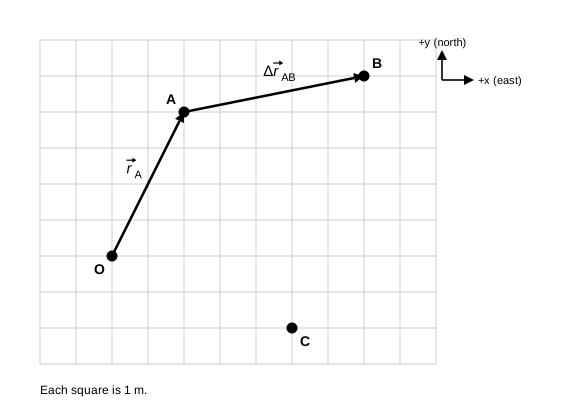
A robotic lawn mower moves around a yard. Point O is the origin. East is +x and north is +y.
Column vectors
A column vector lists the x component on top and the y component below. Each row is a one-dimensional component, and its sign shows its direction. The arrow from O to A is A's position:
Multiplying a column vector by a number multiplies each row:
The position update equation works one row at a time:
Explore
- Write the positions of B and C as column vectors, and draw their position arrows from O on the grid.
- Draw the displacement arrow from B to C on the grid. Count squares to write it as a column vector.
- Highlight the top row of each column vector in the Model's update equation in one color, and the bottom row in another. Write the top row as a one-dimensional update equation.Answer space
- The mower drives the displacement from A to B three times in a row. Write as a column vector.
Critical thinking & Concept Invention
Launch: Manager, have each person trace one arrow on the grid with a finger and say its column vector.
- On your whiteboard, write the position update equation from B to C with column vectors, and check each row. Then rearrange it to find from the positions of A and C, one row at a time. Check your answer by adding and tip to tail on the grid. Finalize it on your whiteboard as a group, then copy it into your notes below.Answer space
- A group member says that if the origin moved to point A, the displacement from B to C would change too. Write the Claim, Evidence, Reasoning template on your whiteboard and answer the question: do you agree? Finalize it on your whiteboard as a group, then copy it into your notes below.
Claim
Answer spaceEvidence
Answer spaceReasoning
Answer space - On your whiteboard, sketch with its x and y components as the sides of a right triangle. Find its magnitude (length) and its direction, as an angle measured from south. Finalize it on your whiteboard as a group, then copy it into your notes below.Answer space
Check in: Reflector, check that everyone can find a magnitude and angle from a column vector. Set your cup.
4. Velocity in Two Dimensions
Model
Physical story
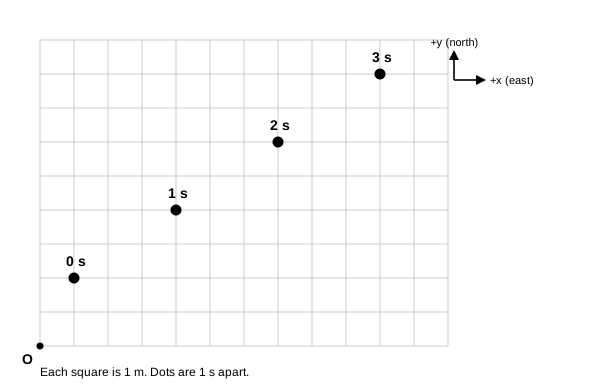
A delivery drone flies at a constant velocity over a field. A camera above the field takes a photo every second. East is +x and north is +y.
Position function, grouped by powers of t
You will build in the space under in Critical thinking question 1.
Positions are in meters, with t in seconds. To take a derivative or an integral of a column vector, do it one row at a time.
Explore
- Use the position function to find the drone's position at t = 2 s. Check it on the grid.
- Draw the displacement arrow from the 0 s dot to the 1 s dot, and write it as a column vector.
Critical thinking & Concept Invention
Launch: Manager, have each person point to one dot and read its position from the function.
- On your whiteboard, take the derivative of one row at a time to find , and write it under in the Model. Compare it with your displacement for 1 s. Then use your rule from Part 1 to explain what each column vector in means. Finalize it on your whiteboard as a group, then copy it into your notes below.Answer space
- Draw the drone's velocity arrow at each dot. On your whiteboard, find the drone's speed (the magnitude of its velocity) and its direction, as an angle from east. Finalize it on your whiteboard as a group, then copy it into your notes below.Answer space
- A group member says the drone's speed is 3 m/s + 2 m/s = 5 m/s. Write the Claim, Evidence, Reasoning template on your whiteboard and answer the question: do you agree? Finalize it on your whiteboard as a group, then copy it into your notes below.
Claim
Answer spaceEvidence
Answer spaceReasoning
Answer space - A second drone leaves O at t = 0, flying at a constant 5.0 m/s at 28° east of north. On your whiteboard, sketch its velocity with its components, write its velocity as a column vector, and write its position function grouped by powers of t. Finalize it on your whiteboard as a group, then copy it into your notes below.Answer space
Check in: Reflector, check that everyone can go from a magnitude and angle to a column vector and back. Set your cup.
 Summary
- For a polynomial, take derivatives and integrals one term at a time with the power rule. A derivative goes from position to velocity to acceleration. An integral goes back, with a constant you find from the value at t = 0.
- The process: start from what is given, integrate (or differentiate), find each constant from t = 0, and group by powers of t. It works for any polynomial, so there are no separate equations to memorize.
- When the acceleration is constant, the grouped position function has the form .
- A column vector lists the x component on top and the y component below. Update equations, sums, differences, multiplying by a number, derivatives, and integrals all work one row at a time.
- A vector's components form the sides of a right triangle. The magnitude is the hypotenuse, and right triangle trigonometry connects the components to the angle.
- Positions depend on the origin. Displacements, velocities, and accelerations do not.
 Apply
Build each piece on your whiteboard, finalize it as a group, then copy it into your notes before starting the next piece.
- An elevator's position is (in m, with t in s). Find and . When is the elevator at rest? What is its acceleration at t = 2 s?Answer space
- An object's velocity is given below, grouped by powers of t (in m/s, with t in s). It starts at m. Find and , each grouped by powers of t. Then find its speed and direction (angle from +x) at t = 1 s. Answer space
This page titled 1.3: Kinematics with Calculus and Vectors was last modified on Fri, 13 Nov 2026 14:48:13 GMT and is shared under a CC BY 4.0 license and was authored, remixed, and/or curated by Andrew Totah-McCarty.
The book could not be loaded just now.