Opening the book…
1 The First Law of Thermodynamics
3.4.1 Open Systems and First Law of Thermodynamics
Model

Explore
| Question | System A | System B | System C |
|---|---|---|---|
| What objects are in the system? | |||
| Is the interaction shown between objects an internal or external interaction? | |||
| What is the label on the interaction? | |||
| How many \(\Delta E\) terms (\(\Delta K\), \(\Delta U\), etc.) are inside the system boundary? | |||
| According to the energy equation, what does \(\Delta E_{system}\) equal? |
- Draw a line connecting the \(\Delta E\) terms in the system to the \(\Delta E\) terms in the energy equation.
Critical Thinking & Concept Invention
- Which system is open? Which is closed? How can you tell?
- How does your choice of system affect the \(\Delta E_{system}\) side of the equation (left side)?
- How does your choice of system affect the other side of the equation (right side)?
- Are both equations valid? How can that be possible if they are different?
Summary
Interactions are modeled differently when they are internal or external to our system.
- Internal interactions can result in changes in potential energies for the system.
- External interactions can do Work on the system.
Different choices of systems will result in different equations that are all equally valid. We can compare two system choices to discover potential energy equations from work or force equations from potential energies.
In order to interpret the validity of a First Law of Thermodynamics equation, it is essential that a system is chosen and explicitly stated.
1.1 Ball & Earth
Model
A ball at some height above the ground interacts with the Earth. This scenario is modeled with two different choices of systems. Both interaction lines are initially drawn as dashed. If you determine that a particular system is closed, you should then make the boundary solid.

Explore
- Examine the Object Interaction Diagrams: Tell a system story for each system. Be sure to include the following in each story:
- The number and names of the items in the system.
- The number and types of energy that could change in the system. Be clear on changes in energy for objects and changes in energy associated with interactions.
- Is the system an open or a closed system? How do you know?
- The number and names of external objects that interact with the system.
- The number of external interactions that do work on the system.
System A System B - Examine the Energy Equations: Draw a line from each change in energy label in the system to its corresponding term in the energy equation.
- Examine the Physical Scenario Diagram: What will \(\Delta \vec{s} \) equal if the ball falls straight down?
Critical Thinking & Concept Invention
- Which change in energy terms \( (\Delta K,\ \Delta U,\ \Delta E,\ W,\ \text{etc.}) \) are labeled in an object and which are labeled for interactions?
| Objects | Interactions |
|---|---|
- How does the label on the interaction change when it is an external interaction rather than an internal interaction?
| Internal | External |
|---|---|
- Compare the equations that result from different choices of system:
- Subtract the equation (System A equation − System B equation).
- Interpret the resulting equation: What does \(W\) equal? Why might that make sense?
- Replace \(W\) with \(F\Delta s\) and \(\Delta U\) for its potential energy equation. Solve for \(F\).
Summary
We can identify equations for the magnitude of forces that result in potential energies by comparing a system where that force is an internal interaction and where that force is an external interaction. Each system generates an accurate, but different equation for the dynamics of the system.
In cases where the two equations result in the relationship:
\[ W=-\Delta U \]
the interaction is called a conservative interaction. All conservative interactions are represented as potential energies when they are internal interactions.
From this process, we identified that the magnitude of the force of the Earth acting on an object is given by the equation:
\[ F_{\text{Earth on Object}}= \]
1.2 Pulling Up a Bucket
Model
The model below shows a person who pulls a bucket up a well using a rope that is attached to the bucket. We consider the timeline where the bucket begins and ends at rest.

Explore
- Describe the motion at the beginning and end of the timeline. Does this motion change?
- What object(s) change position? What is \( \Delta \vec{s} \)?
- Examine the Object Interaction Diagrams: Tell a system story for each system. Be sure to include the following in each story:
- The number and names of the items in the system.
- The number and types of energy that could change in the system. Be clear on changes in energy for objects and changes in energy associated with interactions.
- Is the system an open or a closed system? How do you know?
- The number and names of external objects that interact with the system.
- The number of external interactions that do work on the system.
| System A | System B |
|---|---|
Critical Thinking & Concept Invention
- What is the value of \( \Delta K_{\text{bucket}} \) for this timeline? How do you know?
\[ \Delta K_{\text{bucket}}= \]
because
- Identify and mark up the following on the Object Interaction Diagrams:
- If any objects do not have a change in Kinetic Energy, write \(\Delta K = 0\) inside the box for that object.
- Next to each external interaction that does work, put a (+) or (−) above the \(W\) to identify the sign of that work.
- Apply the First Law of Thermodynamics to explore the scenario from the perspective of each system:
- Create an energy equation for each system with appropriate (+) or (−) signs over each term.
- Substitute in \(\vec{F}\cdot\Delta\vec{s}\) with appropriate labels for each \(W\) in your equations.
- Identify the direction of each force and the parallel displacement of each force to evaluate the dot product.
- Solve for \(F_{\text{Person on Bucket}}\) in terms of \(F_{\text{Earth on Bucket}}\).
| System A | System B |
|---|---|
| \[ \Delta E_{sys}=W \] | \[ \Delta E_{sys}=W \] |
- Why does the \(F_{\text{Person on Bucket}}\) make sense?
- What can we say about the forces acting on an object when \[ \Delta K=0 \] ?
- Below is a diagram that shows the force of the Earth on the bucket. Draw an arrow to represent the force of the person on the bucket. Explain how you drew your arrow (length and direction).
Summary
When there are multiple external interactions, each one can do Work on the system. The \(W\) in the First Law of Thermodynamics equation \( \Delta E_{system}=Q+W \) is the net work on the system. This becomes a sum of each individual Work:
\[ \Delta E_{system}=Q+W \]
\[ \Delta E_1+\Delta E_2+\cdots+\Delta E_n = W_1+W_2+W_3+\cdots+W_n \]
When \( \Delta K=0 \) for an object and all of those forces are applied over the same displacement \( \Delta \vec{s}, \) the forces on that object are ____________________ and the motion of the object ____________________ change.
1.3 Pushing a Box up a Ramp
Model
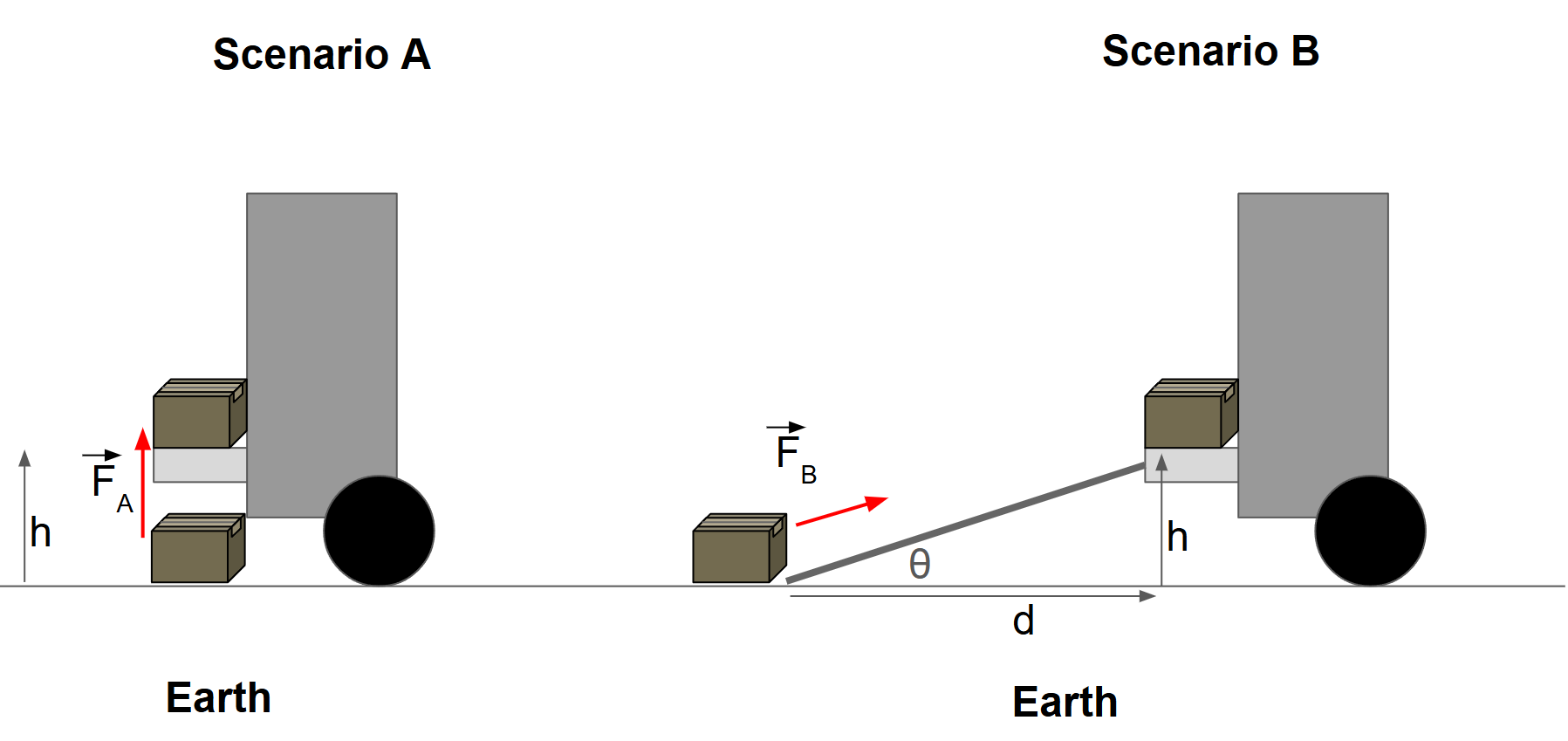
In this model, a person (Person A or Person B) lifts a box or pushes a box up a ramp to get the box to the bed of the truck. Assume you can model this scenario with only forces of the person (A or B) and gravity doing work on the box. That means there might be other forces, but they do not affect the energy dynamics so you can ignore them. The vectors shown for forces A and B represent average Force applied to the box over its displacement.
Explore
- In each case, what is the initial and final velocity of the box?
- Draw a vector to show \( \Delta \vec{s} \) of the box for each scenario. Remember that the displacement vector is drawn from where the box started to where the box ended. Identify the magnitude of \(\Delta \vec{s} \) in terms of variables in the scenario (\(h\), \(d\), \(\theta\)).
- Draw a vector to show the force of gravity on the box in each scenario.
For Scenario A
- Compare the direction of each force to the different position-based vectors:
| \(\Delta \vec{s}\) | \(\vec{h}\) | |
|---|---|---|
| \(\vec{F}_A\) | + / − / ⊥ / ∥ / neither | + / − / ⊥ / ∥ / neither |
| \(\vec{F}_g\) | + / − / ⊥ / ∥ / neither | + / − / ⊥ / ∥ / neither |
For Scenario B
- Compare the direction of each force to the different position-based vectors:
| \(\Delta \vec{s}\) | \(\vec{h}\) | \(\vec{d}\) | |
|---|---|---|---|
| \(\vec{F}_B\) | + / − / ⊥ / ∥ / neither | + / − / ⊥ / ∥ / neither | + / − / ⊥ / ∥ / neither |
| \(\vec{F}_g\) | + / − / ⊥ / ∥ / neither | + / − / ⊥ / ∥ / neither | + / − / ⊥ / ∥ / neither |
- How does the magnitude of \[ \Delta \vec{s}_B \] compare to \[ \Delta \vec{s}_A \] ?
Critical Thinking & Concept Invention
- Should \(W_g\) be + or −? Explain.
- Should \(W_A\) be + or −? Explain.
- Should \(W_B\) be + or −? Explain.
- Model each scenario using the First Law of Thermodynamics:
- Write an equation for the Work done to the box in each case. Put a (+) or (−) over the terms based on your responses above.
- Determine the Force from the person in each case. Your answer might be in terms of variables \(m\), \(g\), \(h\), and/or \(\theta\).
| System A | System B |
|---|---|
| \(\Delta E_{sys}=W\) | \(\Delta E_{sys}=W\) |
- Which method of putting the box on the truck requires less force from the person? Explain why this is the case.
1.4 Ramps
Model

Explore
- Examine the coordinate axes. What direction is:
- \(+\hat{x}\)?
- \(+\hat{y}\)?
- How many forces act on the block (do not count components of a force)? List them.
- What direction (\(+/-\hat{x}\) and/or \(+/-\hat{y}\); OR vertically up/down or horizontally left/right) do each of the following point?
| \(\Delta \vec{s}\) | \(\Delta \vec{h}\) | \(\vec{F}_g\) | \(F_{g,x}\) | \(F_{g,y}\) | \(\vec{F}_N\) |
|---|---|---|---|---|---|
Critical Thinking & Concept Invention
- How does \(\Delta \vec{h}\) relate to \(\Delta \vec{s}\)? Explain.
- Which is parallel (\(F_{\parallel}\)) to \(\Delta \vec{s}\)? Circle one.
- \(\vec{F}_g\)
- \(F_{g,x}\)
- \(F_{g,y}\)
- Write \(F_{\parallel}\Delta s\) as an equation.
- Which is parallel (\(\Delta s_{\parallel}\)) to \(\vec{F}_g\)? Circle one.
- \(\Delta \vec{s}\)
- \(\Delta \vec{h}\)
- Write \(F\Delta s_{\parallel}\) as an equation.
- What is \(\vec{F}_N \cdot \Delta \vec{s} \) ? Does the Normal force do work on the object?
- Construct an Energy Interaction Diagram for the object that models only the object as the system. From it, construct an energy equation and solve for the speed of the block at the bottom of the ramp. Assume no friction and no rotation.
\[ \Delta E_{sys}=W+Q \]
1.5 Atwood Machine
Model
Below is a model you have previously explored through the lens of a System A for energy. For this activity, focus only on System B. In this first activity, we will assume the pulley is massless instead of having a mass of \(6M\).

Explore
- Draw the interactions between the objects in the Object Interaction Diagram.
- Draw a \( \Delta \vec{s} \) vector on any object that you expect to move that shows the direction the object moves. Pay attention to how this direction relates to the forces on the objects (parallel, antiparallel, perpendicular, etc.).
- Tell a system story for System B. Be sure to include the following in each story:
- The number and names of the items in the system.
- The number and types of energy that could change in the system. Be clear on changes in energy for objects and changes in energy associated with interactions.
- Is the system an open or a closed system? How do you know?
- The number and names of external objects that interact with the system.
- The number of external interactions that do work on the system, including whether the work is positive or negative.
Critical Thinking & Concept Invention
- How should the Work on different objects in the system compare? Consider sign and magnitude.
- Apply the First Law of Thermodynamics to explore the scenario from the perspective of System B:
- Create an energy equation with appropriate (+) or (−) signs over each term.
- Substitute in \(\vec{F}\cdot\Delta\vec{s}\) with appropriate labels for each \(W\) in your equations.
- Identify the direction of each force and the parallel displacement of each force to evaluate the dot product.
- Solve the equation to determine the final speed of each mass after the more massive object has experienced the displacement of 2 meters below its initial position. Your solution will be in terms of the variables given in the problem, not a final number.
- Use the final speed you determined from modeling the dynamics of System B to determine the force of the pulley (string) on each individual mass. Do this by modeling two new systems:
- System L, which is just the Left Block.
- System R, which is just the Right Block.
Apply
- Model the energy changes for this Atwood machine setup (two masses on a string over a pulley) as the previous model, but this time assume the pulley has a mass of \(6M\) (as shown in the diagram) and a radius \(R\). The pulley rotates as the string moves so that the speed of the rim of the pulley matches the speed of the string. Identify the final speed of the string/masses for the same displacement as the previous model.
- Using Systems R and L, identify the force of the pulley (string) on each mass for the case where the pulley has a mass of \(6M\).
This page titled 3.4: First Law of Thermodynamics - A Systems Approach was last modified on Sat, 24 Oct 2026 22:22:56 GMT and is shared under a CC BY 4.0 license and was authored, remixed, and/or curated by Andrew Totah-McCarty.
The book could not be loaded just now.