Opening the book…
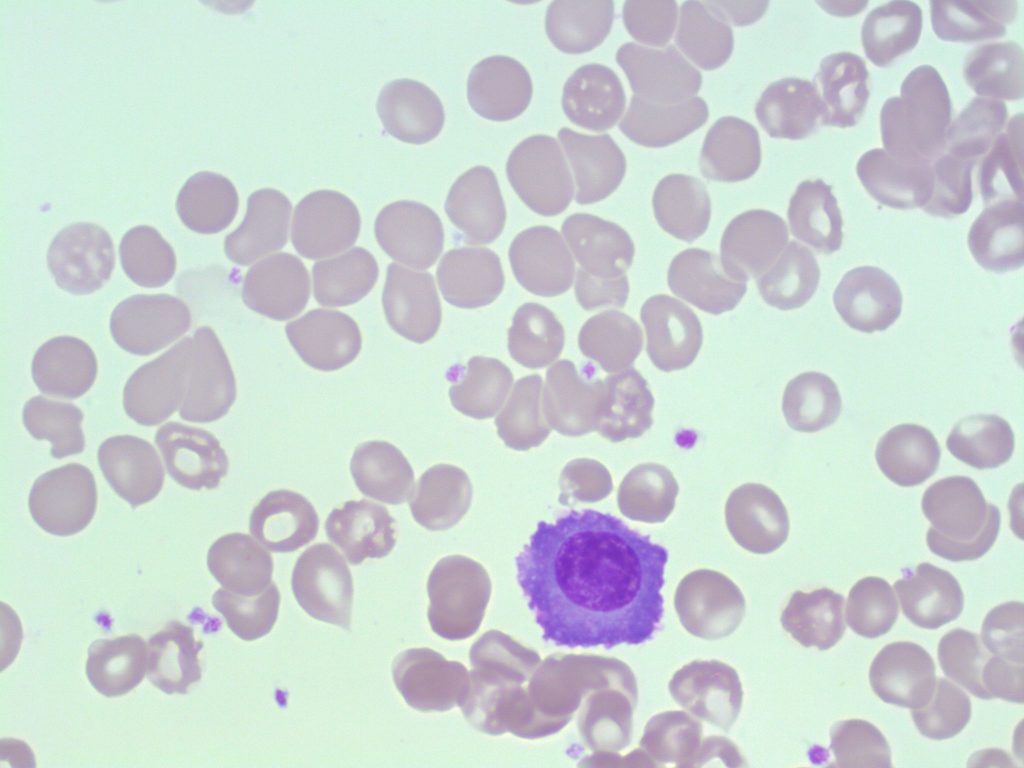
- An image from a bone marrow smear showing a plasma cell. Note the perinuclear clearing surrounding the nucleus. 100z oil immersion. From MLS Collection, University of Alberta, https://doi.org/10.7939/R30C4T111
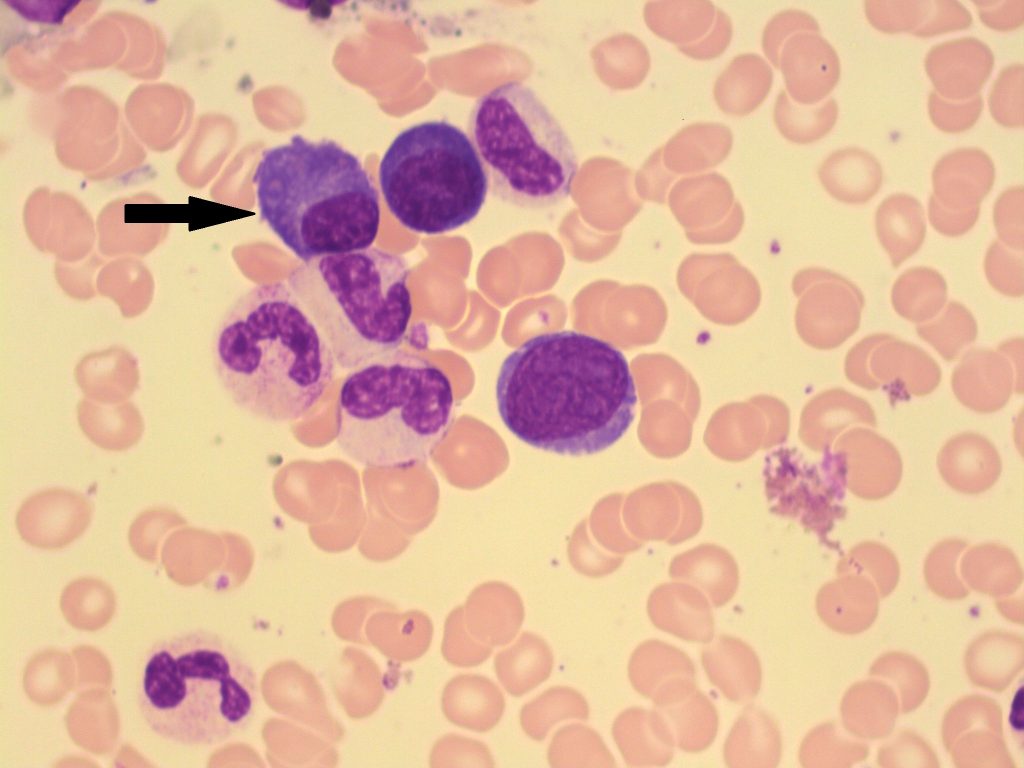
- An image from a bone marrow smear with a plasma cell (indicated by an arrow). 100x oil immersion. From MLS Collection, University of Alberta, https://doi.org/10.7939/R3JM23X5J
Notes: The maturation of a lymphocyte to a plasma cell marks the production of immunoglobulins. Lymphocytes that mature into plasma cells are of B lineage.1
Nucleus-to-Cytoplasm Ratio: 2:1 to 1:1 2
Nucleoli: None 1,2
Nucleus:1,2
Round or oval
Eccentrically located
Coarse, clumpy, dark purple staining chromatin
Cytoplasm:1,2
Abundant
Darkly basophilic
Perinuclear (clear) zone may be seen around the nucleus (Representing the golgi body)
Vacuoles may be present
Normal % in Bone Marrow: 0-1% 1,2
Normal % in Peripheral Blood: 0% 1,2
References:
1. Williams L, Finnegan K. Lymphocytes. In: Clinical laboratory hematology. 3rd ed. New Jersey: Pearson; 2015. p. 122-43.
2. Rodak BF, Carr JH. Lymphocyte maturation. In: Clinical hematology atlas. 5th ed. St. Louis, Missouri: Elsevier Inc.; 2017. p. 79-88.
This page titled 10.3: Plasma Cells was last modified on Sat, 02 Sep 2023 08:16:18 GMT and is shared under a CC BY-NC 4.0 license and was authored, remixed, and/or curated by Valentin Villatoro and Michelle To (Open Education Alberta) via source content that was edited to the style and standards of the LibreTexts platform.
The book could not be loaded just now.