Opening the book…
- Identify the general structure for an amide.
- Identify the functional group for an amide.
- Names amides with common names.
- Name amides according to the IUPAC system.
The amide functional group has an nitrogen atom attached to a carbonyl carbon atom. If the two remaining bonds on the nitrogen atom are attached to hydrogen atoms, the compound is a simple amide. If one or both of the two remaining bonds on the atom are attached to alkyl or aryl groups, the compound is a substituted amide.
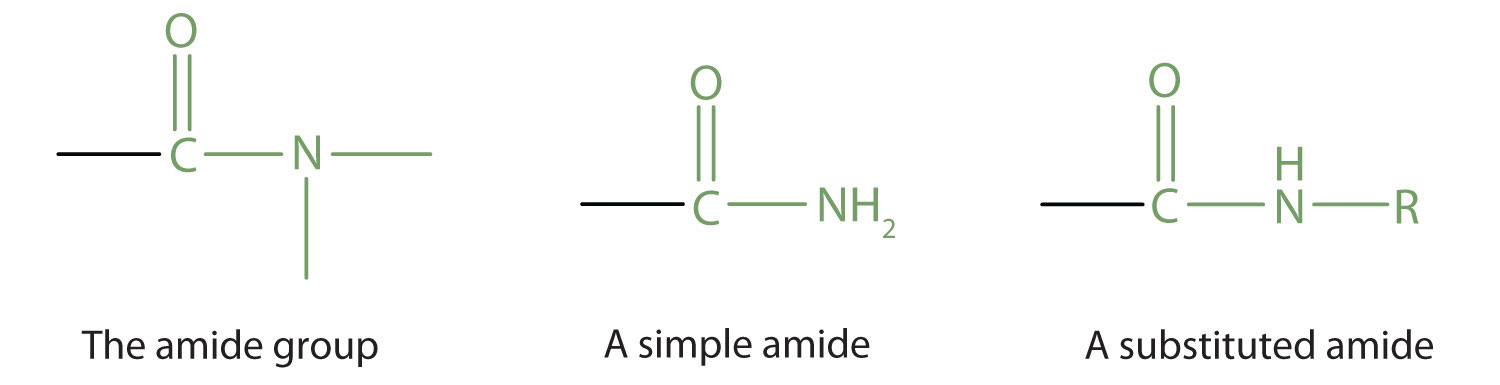
The carbonyl carbon-to-nitrogen bond is called an amide linkage. This bond is quite stable and is found in the repeating units of protein molecules, where it is called a peptide linkage.
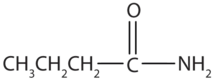
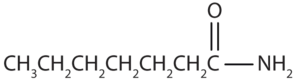
Simple amides are named as derivatives of carboxylic acids. The -ic ending of the common name or the -oic ending of the International Union of Pure and Applied Chemistry (IUPAC) name of the carboxylic acid is replaced with the suffix -amide.
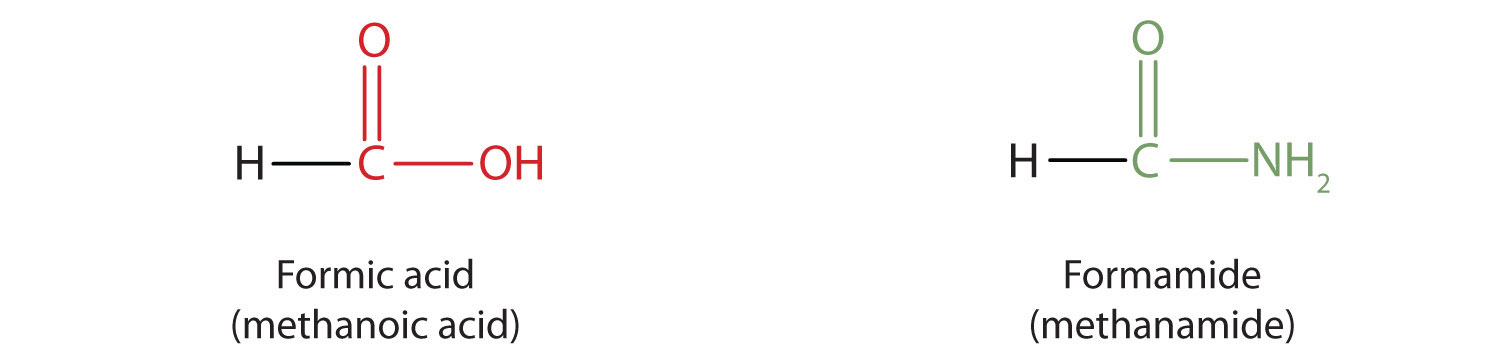
Name each compound with the common name, the IUPAC name, or both.
Solution
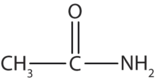
- This amide has two carbon atoms and is thus derived from acetic acid. The OH of acetic acid is replaced by an NH2 group. The -ic from acetic (or -oic from ethanoic) is dropped, and -amide is added to give acetamide (or ethanamide in the IUPAC system).
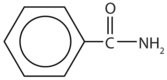
- This amide is derived from benzoic acid. The -oic is dropped, and -amide is added to give benzamide.
Name each compound with the common name, the IUPAC name, or both.
Key Takeaways
- Amides have a general structure in which a nitrogen atom is bonded to a carbonyl carbon atom.
- The functional group for an amide is as follows:

- In names for amides, the -ic acid of the common name or the -oic ending of the IUPAC for the corresponding carboxylic acid is replaced by -amide.
14.14: Amides- Structures and Names is shared under a CC BY-NC-SA 3.0 license and was authored, remixed, and/or curated by LibreTexts.
The book could not be loaded just now.