Opening the book…
The satellite cell is recognized among the two distinct types of glial cells evident within the PNS. These cells inhabit sensory and autonomic ganglia, enveloping the neuron cell bodies therein. The nomenclature attributed to these cells corresponds to their morphological characteristics. Satellite cells serve a supportive role akin to the functions assumed by astrocytes within the CNS, except for establishing the BBB.
Schwann cell is another subtype of glial cell that provides myelin insulation to axons within the PNS. They contrast with oligodendrocytes in that each Schwann cell wraps a solitary axon segment, whereas oligodendrocytes extend processes that span multiple axon segments. Myelin, a lipid-dominant envelope, encircles the axon, engendering a myelin sheath that expedites the conduction of electrical impulses along the axon. The nucleus and cytoplasm of the Schwann cell remain positioned at the periphery of the myelin sheath (Figure 7). The extension of myelin sheaths can span from one to two millimeters, contingent upon axon diameter. Axon diameters range from 1 to 20 micrometers. The length of a myelin sheath can potentially be 100–1000 times greater than the diameter of the axon. Figures 7 and 8 illustrate the encompassing of a myelin sheath around an axon segment, although not according to scale.
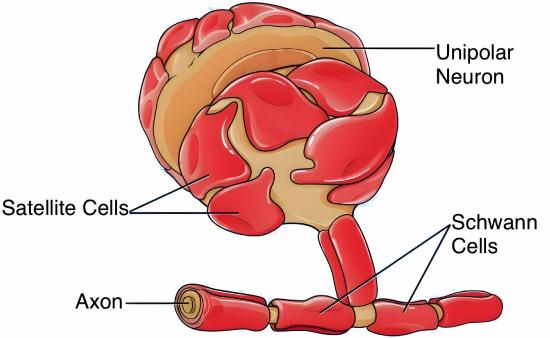

During development, the glial cell displays a provisional or incomplete enclosure around the axon (Figure 8). The peripheries of this provisional wrapping incline towards convergence, with one extremity folding beneath the other. The inner perimeter enwraps the axon, configuring multiple strata, while the opposing border envelops the external surface, thus culminating in the comprehensive encapsulation of the axon. Schwann cells continuously monitor and maintain the myelin sheath throughout the life of the axon11. Upon axonal transection, the proximal stub emits multiple regenerating sprouts. The sprout that successfully interfaces with an adjacent Schwann cell continues to elongate, eventually reinnervating the target cell.
This page titled 2.3.3: Glial Cells of the PNS was last modified on Sat, 22 Aug 2026 02:49:06 GMT and is shared under a CC BY-NC-SA 4.0 license and was authored, remixed, and/or curated by Chaya Gopalan (Consortium of Academic and Research Libraries in Illinois (CARLI)) .
The book could not be loaded just now.