Opening the book…
Purpose: To calculate a derivative with messy and incomplete data.
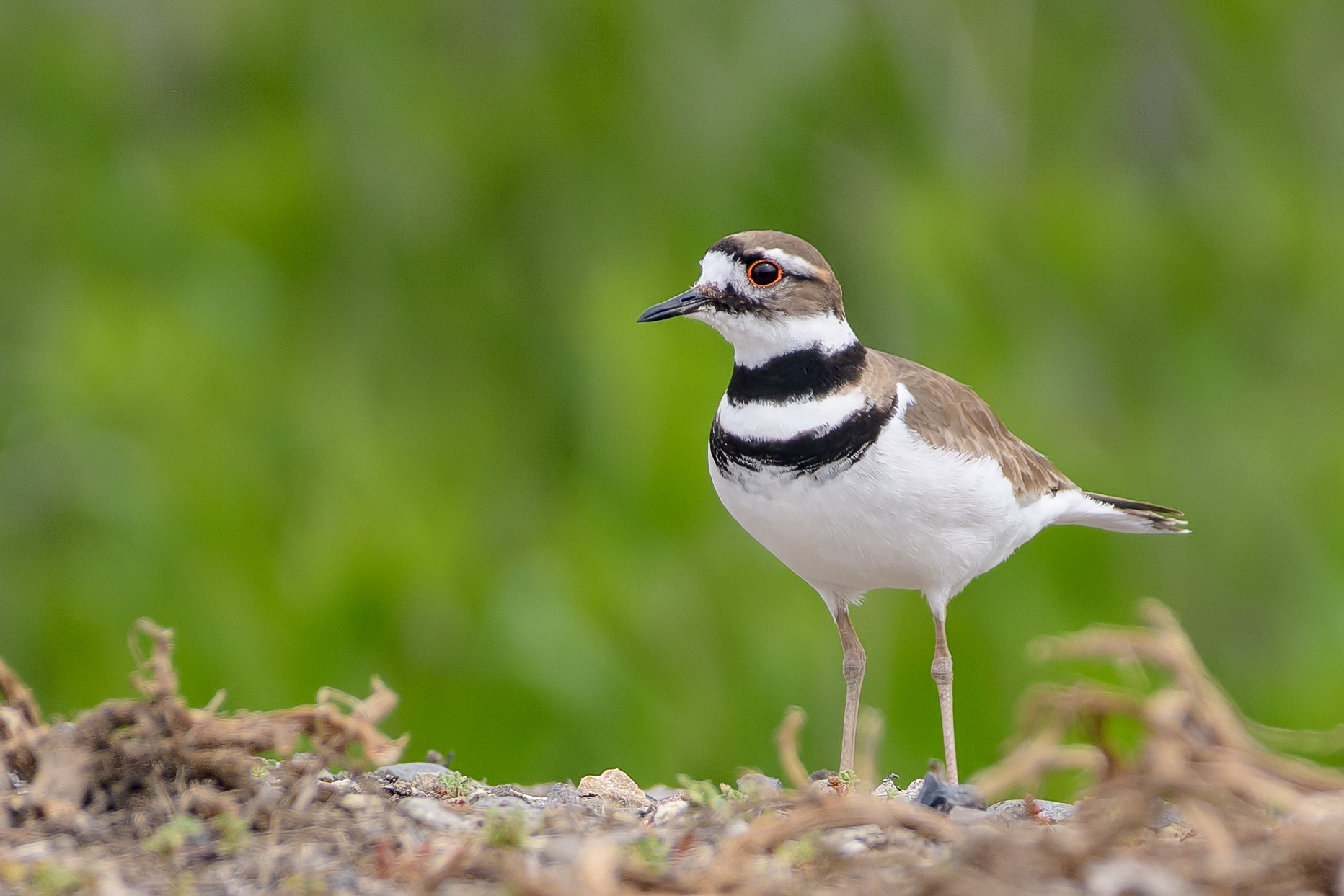
(image credit: Becky Matsubara)
Killdeer are small birds famous for their loud, squeaky call and defense behavior that includes feigning wing injuries. Their population is also mysteriously declining, so getting a handle on their numbers and migratory patterns is important. They are partially migratory, with some going from the southern US and Mexico up to the northern US and Canada, while some stay put. The main question here is to use messy data to get some sort of idea of how fast they are moving at any given time.
- \(\begin{array}{rcccccccc} \text{day} & 0 & 10 & 10 & 15 & 20 & 20 & 25 & 35 \\ \text{miles} & 0 & 10 & 45 & 165 & 75 & 200 & 105 & 200 \end{array}\)
\(\begin{array}{rccccccc} \text{day} & 40 & 50 & 50 & 65 & 70 & 80 & 80 \\ \text{miles} & 310 & 220 & 380 & 405 & 305 & 425 & 445 \end{array}\)
The goal is to fill out a new table with the velocity or derivative of the killdeer at any given time. Since you don’t really know which killdeer is which, this velocity will represent some sort of average or aggregate velocity for the three killdeer.
\(\begin{array}{rccc} \text{approximately day} & 20 & 40 & 60 \\ \frac{\text{miles}}{\text{day}} & & & \end{array}\)
What are some different ways you can do this? Talk about it as a group, and then work towards filling in the second table. Do the birds seem to be getting faster as time passes, or slower?
- Same type of question with a new setup. The goal is to figure out a rough speed of migration (just one number this time). There are three areas: Mexico, Oklahoma, and Montana, and you have rough esimates for the abundance in each of the three areas during both the non-breeding and breeding seasons. For simplicity, assume all the killdeer stay within these three areas (even though that is clearly false). How can you figure some sort of average velocity of the killdeer in this case?
\(\begin{array}{lr} \text{Mexico, $1500$ miles north of the equator} & \text{Abundance} \\ \text{Day 0 (non-breeding)} & 970 \\ \text{Day 150 (breeding)} & 260 \end{array}\)
\(\begin{array}{lr} \text{Oklahoma, $2500$ miles north of the equator} & \text{Abundance} \\ \text{Day 0 (non-breeding)} & 150 \\ \text{Day 150 (breeding)} & 420 \end{array}\)
\(\begin{array}{lr} \text{Montana, $3200$ miles north of the equator} & \text{Abundance} \\ \text{Day 0 (non-breeding)} & 0 \\ \text{Day 150 (breeding)} & 540 \end{array}\)
- Look at the excel spreadsheet entitled “Killdeer abundance data”, with data taken from the eBird data repository.
Click here for a cool visualization of this data.
Use the data in the spreadsheet to create a best guess average velocity during the time period starting with the non-breeding season and ending with the breeding season (roughly January through June). The final answer is just that one number, but there is a lot of data to sort through to get there!
Data source: Fink, D., T. Auer, A. Johnston, M. Strimas-Mackey, O. Robinson, S. Ligocki, B. Petersen, C. Wood, I. Davies, B. Sullivan, M. Iliff, S. Kelling. 2020. eBird Status and Trends, Data Version: 2018; Released: 2020. Cornell Lab of Ornithology, Ithaca, New York. doi.org/10.2173/ebirdst.2018
This page titled 2.16: Project- Killdeer Migration Speed was last modified on Tue, 19 Oct 2021 06:46:28 GMT and is shared under a CC BY 4.0 license and was authored, remixed, and/or curated by Tyler Seacrest via source content that was edited to the style and standards of the LibreTexts platform.
The book could not be loaded just now.