Opening the book…
Lesson
Let's use long division.
Exercise \(\PageIndex{1}\): Number Talk: Estimating Quotients
Estimate these quotients mentally.
\(500\div 7\)
\(1,394\div 9\)
Exercise \(\PageIndex{2}\): Lin Uses Long Division
Lin has a method of calculating quotients that is different from Elena’s method and Andre’s method. Here is how she found the quotient of \(657\div 3\):

- Discuss with your partner how Lin’s method is similar to and different from drawing base-ten diagrams or using the partial quotients method.
- Lin subtracted \(3\cdot 2\) then \(3\cdot 1\), and lastly \(3\cdot 9\). Earlier, Andre subtracted \(3\cdot 200\) then \(3\cdot 10\), and lastly \(3\cdot 9\). Why did they have the same quotient?
- In the third step, why do you think Lin wrote the 7 next to the remainder of 2 rather than adding 7 and 2 to get 9?
- Lin’s method is called long division. Use this method to find the following quotients. Check your answer by multiplying it by the divisor.
- \(846\div 3\)
- \(1,816\div 4\)
- \(768\div 12\)
Exercise \(\PageIndex{3}\): Dividing Whole Numbers
- Find each quoteint.
- \(633\div 3\)
- \(1001\div 7\)
- \(2996\div 14\)
- Here is Priya's calculation of \(906\div 3\)

- Priya wrote 320 for the value of \(906\div 3\). Check her answer by multiplying it by 3. What product do you get and what does it tell you about Priya’s answer?
- Describe Priya’s mistake, then show the correct calculation and answer.
Summary
Long division is another method for calculating quotients. It relies on place value to perform and record the division.
When we use long division, we work from left to right and with one digit at a time, starting with the leftmost digit of the dividend. We remove the largest group possible each time, using the placement of the digit to indicate the size of each group. Here is an example of how to find \(948\div 3\) using long division.

- We start by dividing 9 hundreds into 3 groups, which means 3 hundreds in each group. Instead of writing 300, we simply write 3 in the hundreds place, knowing that it means 3 hundreds.
- There are no remaining hundreds, so we work with the tens. We can make 3 groups of 1 ten in 4 tens, so we write 1 in the tens place above the 4 of 948. Subtracting 3 tens from 4 tens, we have a remainder of 1 ten.
- We know that 1 ten is 10 ones. Combining these with the 8 ones from 948, we have 18 ones. We can make 3 groups of 6, so we write 6 in the ones place.
In total, there are 3 groups of 3 hundreds, 1 ten, and 6 ones in 948, so \(948\div 3=316\).
Glossary Entries
Definition: Long Division
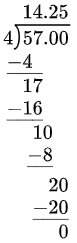
Long division is a way to show the steps for dividing numbers in decimal form. It finds the quotient one digit at a time, from left to right.
For example, here is the long division for \(57\div 4\).
Practice
Exercise \(\PageIndex{4}\)
Kiran is using long division to find \(696\div 12\).

He starts by dividing 69 by 12. In which decimal place should Kiran place the first digit of the quotient (5)?
- Hundreds
- Tens
- Ones
- Tenths
Exercise \(\PageIndex{5}\)
Here is a long-division calculation of \(917\div 7\).

- There is a 7 under the 9 of 917. What does this 7 represent?
- What does the subtraction of 7 from 9 mean?
- Why is a 1 written next to the 2 from \(9-7\)?
Exercise \(\PageIndex{6}\)
Han's calculation of \(972\div 9\) is shown here.

- Find \(180\cdot 9\).
- Use your calculation of \(180\cdot 9\) to explain how you know Han has made a mistake.
- Identify and correct Han’s mistake.
Exercise \(\PageIndex{7}\)
Find each quotient.

Exercise \(\PageIndex{8}\)
One ounce of a yogurt contains of \(1.2\) grams of sugar. How many grams of sugar are in \(14.25\) ounces of yogurt?
- \(0.171\) grams
- \(1.71\) grams
- \(17.1\) grams
- \(171\) grams
(From Unit 5.3.3)
Exercise \(\PageIndex{9}\)
The mass of one coin is 16.718 grams. The mass of a second coin is 27.22 grams. How much greater is the mass of the second coin than the first? Show your reasoning.
(From Unit 5.2.3)
29.2: Using Long Division is shared under a CC BY 4.0 license and was authored, remixed, and/or curated by LibreTexts.
The book could not be loaded just now.