Opening the book…
Lesson
Let's play with blocks and diagrams to think about division with fractions.
Exercise \(\PageIndex{1}\): Equal-Sized Groups
Write a multiplication equation and a division equation for each sentence or diagram.
- Eight $5 bills are worth $40.
- There are 9 thirds in 3 ones.

Exercise \(\PageIndex{2}\): Reasoning with Pattern Blocks
Use the pattern blocks in the applet to answer the questions. (If you need help aligning the pieces, you can turn on the grid.)
- If a hexagon represents 1 whole, what fraction do each of the following shapes represent? Be prepared to show or explain your reasoning.
- 1 triangle
- 1 rhombus
- 1 trapezoid
- 4 triangles
- 3 rhombuses
- 2 hexagons
- 1 hexagon and 1 trapezoid
- Here are Elena’s diagrams for \(2\cdot\frac{1}{2}=1\) and \(6\cdot\frac{1}{3}=2\). Do you think these diagrams represent the equations? Explain or show your reasoning.

- Use pattern blocks to represent each multiplication equation. Remember that a hexagon represents 1 whole.
- \(3\cdot\frac{1}{6}=\frac{1}{2}\)
- \(2\cdot\frac{3}{2}=3\)
- Answer the questions. If you get stuck, consider using pattern blocks.
- How many \(\frac{1}{2}\)s are in \(4\)?
- How many \(\frac{2}{3}\)s are in \(2\)?
- How many \(\frac{1}{6}\)s are in \(1\frac{1}{2}\)?
Summary
Some problems that involve equal-sized groups also involve fractions. Here is an example: “How many \(\frac{1}{6}\) are in \(2\)?” We can express this question with multiplication and division equations.
\(?\cdot\frac{1}{6}=2\)
\(2\div\frac{1}{6}=?\)
Pattern-block diagrams can help us make sense of such problems. Here is a set of pattern blocks.

If the hexagon represents 1 whole, then a triangle must represent \(\frac{1}{6}\), because 6 triangles make 1 hexagon. We can use the triangle to represent the \(\frac{1}{6}\) in the problem.
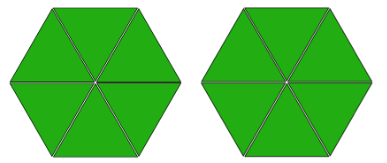
Twelve triangles make 2 hexagons, which means there are 12 groups of \(\frac{1}{6}\) in 2.
If we write the 12 in the place of the “?” in the original equations, we have:
\(12\cdot\frac{1}{6}=2\)
\(2\div\frac{1}{6}=12\)
Practice
Exercise \(\PageIndex{3}\)
Consider the problem: A shopper buys cat food in bags of 3 lbs. Her cat eats \(\frac{3}{4}\) lb each week. How many weeks does one bag last?
- Draw a diagram to represent the situation and label your diagram so it can be followed by others. Answer the question.
- Write a multiplication or division equation to represent the situation.
- Multiply your answer in the first question (the number of weeks) by \(\frac{3}{4}\). Did you get 3 as a result? If not, revise your previous work.
Exercise \(\PageIndex{4}\)
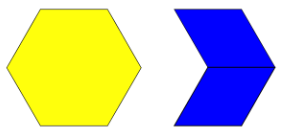
Use the diagram to answer the question: How many \(\frac{1}{3}\)s are in \(1\frac{2}{3}\)? The hexagon represents 1 whole. Explain or show your reasoning.
Exercise \(\PageIndex{5}\)
Which question can be represented by the equation \(?\cdot\frac{1}{8}=3\)?
- How many \(3\)s are in \(\frac{1}{8}\)?
- What is \(3\) groups of \(\frac{1}{8}\)?
- How many \(\frac{1}{8}\)s are in \(3\)?
- What is \(\frac{1}{8}\) of \(3\)?
Exercise \(\PageIndex{6}\)
Write two division equations for each multiplication equation.
- \(15\cdot\frac{2}{5}=6\)
- \(6\cdot\frac{4}{3}=8\)
- \(16\cdot\frac{7}{8}=14\)
Exercise \(\PageIndex{7}\)
Noah and his friends are going to an amusement park. The total cost of admission for 8 students is $100, and all students share the cost equally. Noah brought $13 for his ticket. Did he bring enough money to get into the park? Explain your reasoning.
(From Unit 4.1.2)
Exercise \(\PageIndex{8}\)
Write a division expression with a quotient that is:
- greater than \(8\div 0.001\)
- less than \(8\div 0.001\)
- between \(8\div 0.001\) and \(8\div\frac{1}{10}\)
(From Unit 4.1.1)
Exercise \(\PageIndex{9}\)
Find each unknown number.
- \(12\) is \(150\)% of what number?
- \(5\) is \(50\)% of what number?
- \(10\)% of what number is \(300\)?
- \(5\)% of what number is \(72\)?
- \(20\) is \(80\)% of what number?
(From Unit 3.4.5)
22.1: How Many Groups? (Part 1) is shared under a CC BY 4.0 license and was authored, remixed, and/or curated by LibreTexts.
The book could not be loaded just now.