Opening the book…
For exercises 1 - 5, examine the graphs. Identify where the vertical asymptotes are located.
1)
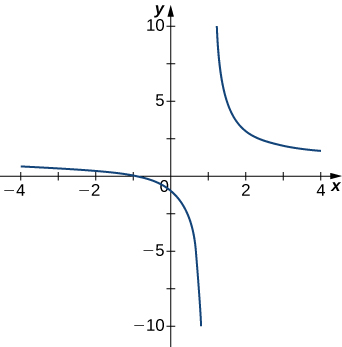
- Answer
- \(x=1\)
2)
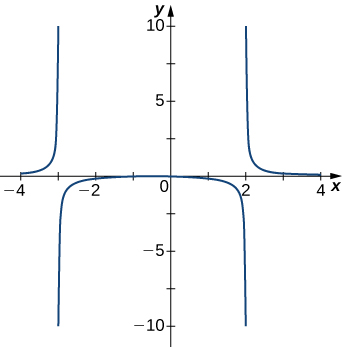
3)
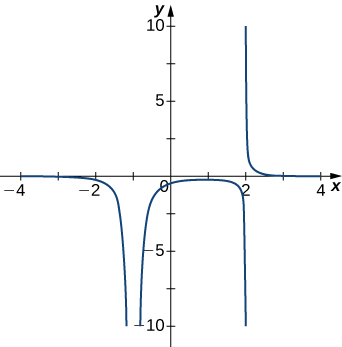
- Answer
- \(x=−1,\;x=2\)
4)
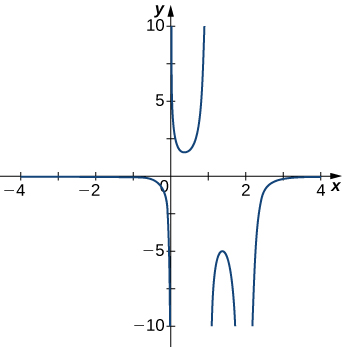
5)
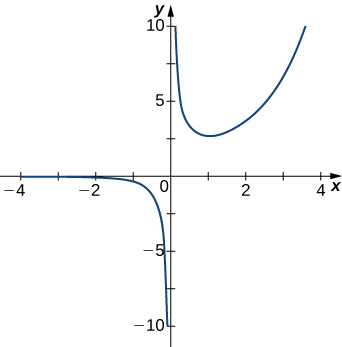
- Answer
- \(x=0\)
For the functions \(f(x)\) in exercises 6 - 10, determine whether there is an asymptote at \(x=a\). Justify your answer without graphing on a calculator.
6) \(f(x)=\dfrac{x+1}{x^2+5x+4},\quad a=−1\)
7) \(f(x)=\dfrac{x}{x−2},\quad a=2\)
- Answer
- Yes, there is a vertical asymptote at \(x = 2\).
8) \(f(x)=(x+2)^{3/2},\quad a=−2\)
9) \(f(x)=(x−1)^{−1/3},\quad a=1\)
- Answer
- Yes, there is vertical asymptote at \(x = 1\).
10) \(f(x)=1+x^{−2/5},\quad a=1\)
In exercises 11 - 20, evaluate the limit.
11) \(\displaystyle \lim_{x→∞}\frac{1}{3x+6}\)
- Answer
- \(\displaystyle \lim_{x→∞}\frac{1}{3x+6} = 0\)
12) \(\displaystyle \lim_{x→∞}\frac{2x−5}{4x}\)
13) \(\displaystyle \lim_{x→∞}\frac{x^2−2x+5}{x+2}\)
- Answer
- \(\displaystyle \lim_{x→∞}\frac{x^2−2x+5}{x+2} = ∞\)
14) \(\displaystyle \lim_{x→−∞}\frac{3x^3−2x}{x^2+2x+8}\)
15) \(\displaystyle \lim_{x→−∞}\frac{x^4−4x^3+1}{2−2x^2−7x^4}\)
- Answer
- \(\displaystyle \lim_{x→−∞}\frac{x^4−4x^3+1}{2−2x^2−7x^4} = −\frac{1}{7}\)
16) \(\displaystyle \lim_{x→∞}\frac{3x}{\sqrt{x^2+1}}\)
17) \(\displaystyle \lim_{x→−∞}\frac{\sqrt{4x^2−1}}{x+2}\)
- Answer
- \(\displaystyle \lim_{x→−∞}\frac{\sqrt{4x^2−1}}{x+2} = -2\)
18) \(\displaystyle \lim_{x→∞}\frac{4x}{\sqrt{x^2−1}}\)
19) \(\displaystyle \lim_{x→−∞}\frac{4x}{\sqrt{x^2−1}}\)
- Answer
- \(\displaystyle \lim_{x→−∞}\frac{4x}{\sqrt{x^2−1}} = -4\)
20) \(\displaystyle \lim_{x→∞}\frac{2\sqrt{x}}{x−\sqrt{x}+1}\)
For exercises 21 - 25, find the horizontal and vertical asymptotes.
21) \(f(x)=x−\dfrac{9}{x}\)
- Answer
- Horizontal: none,
Vertical: \(x=0\)
22) \(f(x)=\dfrac{1}{1−x^2}\)
23) \(f(x)=\dfrac{x^3}{4−x^2}\)
- Answer
- Horizontal: none,
Vertical: \(x=±2\)
24) \(f(x)=\dfrac{x^2+3}{x^2+1}\)
25) \(f(x)=\sin(x)\sin(2x)\)
- Answer
- Horizontal: none,
Vertical: none.
26) \(f(x)=\cos x+\cos(3x)+\cos(5x)\)
27) \(f(x)=\dfrac{x\sin(x)}{x^2−1}\)
- Answer
- Horizontal: \(y=0,\)
Vertical: \(x=±1\)
28) \(f(x)=\dfrac{x}{\sin(x)}\)
29) \(f(x)=\dfrac{1}{x^3+x^2}\)
- Answer
- Horizontal: \(y=0,\)
Vertical: \(x=0\) and \(x=−1\)
30) \(f(x)=\dfrac{1}{x−1}−2x\)
31) \(f(x)=\dfrac{x^3+1}{x^3−1}\)
- Answer
- Horizontal: \(y=1,\)
Vertical: \(x=1\)
32) \(f(x)=\dfrac{\sin x+\cos x}{\sin x−\cos x}\)
33) \(f(x)=x−\sin x\)
- Answer
- Horizontal: none,
Vertical: none
34) \(f(x)=\dfrac{1}{x}−\sqrt{x}\)
For exercises 35 - 38, construct a function \(f(x)\) that has the given asymptotes.
35) \(x=1\) and \(y=2\)
- Answer
- Answers will vary, for example: \(y=\dfrac{2x}{x−1}\)
36) \(x=1\) and \(y=0\)
37) \(y=4, \;x=−1\)
- Answer
- Answers will vary, for example: \(y=\dfrac{4x}{x+1}\)
38) \(x=0\)
In exercises 39 - 43, graph the function on a graphing calculator on the window \(x=[−5,5]\) and estimate the horizontal asymptote or limit. Then, calculate the actual horizontal asymptote or limit.
39) [T] \(f(x)=\dfrac{1}{x+10}\)
- Answer
- \(\displaystyle \lim_{x→∞}\frac{1}{x+10}=0\) so \(f\) has a horizontal asymptote of \(y=0\).
40) [T] \(f(x)=\dfrac{x+1}{x^2+7x+6}\)
41) [T] \(\displaystyle \lim_{x→−∞}x^2+10x+25\)
- Answer
- \(\displaystyle \lim_{x→−∞}x^2+10x+25 = ∞\)
42) [T] \(\displaystyle \lim_{x→−∞}\frac{x+2}{x^2+7x+6}\)
43) [T] \(\displaystyle \lim_{x→∞}\frac{3x+2}{x+5}\)
- Answer
- \(\displaystyle \lim_{x→∞}\frac{3x+2}{x+5}=3\) so this function has a horizontal asymptote of \(y=3\).
Contributors and Attributions
Gilbert Strang (MIT) and Edwin “Jed” Herman (Harvey Mudd) with many contributing authors. This content by OpenStax is licensed with a CC-BY-SA-NC 4.0 license. Download for free at http://cnx.org.
This page titled 2.6E: Exercises for Section 2.6 was last modified on Wed, 12 Aug 2026 18:59:31 GMT and is shared under a CC BY-NC-SA 4.0 license and was authored, remixed, and/or curated by Leonard Lamp, Kenn Huber, and Mohamad Youssef via source content that was edited to the style and standards of the LibreTexts platform.
The book could not be loaded just now.