Opening the book…
The circle in two dimensions is defined as a locus: a collection of points that follow a particular rule. The circle \((x-h)^2+(y-k)^2=r^2\) is the collection of points which are a distance of exactly \(r\) away from the center \((h,k)\). A natural extension of this type of equation is found in the equation of a sphere.
A sphere is the set of all points in space equidistant from a fixed point, the center of the sphere, just as the set of all points in a plane that are equidistant from the center represents a circle. In a sphere, as in a circle, the distance from the center to a point on the sphere is called the radius.
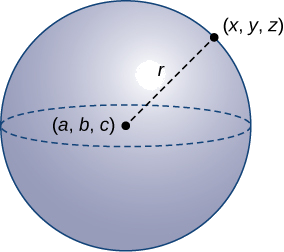
The equation of a sphere is therefore based on the three-dimensional formula for distance:
The sphere with center \((a,b,c)\) and radius \(r\) can be represented by the equation
\[(x−a)^2+(y−b)^2+(z−c)^2=r^2 \nonumber \]
This equation is known as the standard equation of a sphere.
Find the standard equation of the sphere with center \((10,7,4)\) passing through the point \((−1,3,−2)\).

Solution
Use the distance formula to find the radius \(r\) of the sphere:
\[\begin{align*} r &=\sqrt{(−1−10)^2+(3−7)^2+(−2−4)^2} \\[4pt] &=\sqrt{(−11)^2+(−4)^2+(−6)^2} \\[4pt] &=\sqrt{173} \end{align*} \nonumber \]
The standard equation of the sphere is
\[\boxed{(x−10)^2+(y−7)^2+(z−4)^2=173} \nonumber \]
Let \(P=(−5,2,3)\) and \(Q=(3,4,−1)\), and suppose line segment \(\overline{PQ}\) forms the diameter of a sphere. Find the equation of the sphere.
Solution:
Since \(\overline{PQ}\) is a diameter of the sphere, we know the center of the sphere is the midpoint of \(\overline{PQ}\). Then,
\[C=\left(\dfrac{−5+3}{2},\dfrac{2+4}{2},\dfrac{3+(−1)}{2}\right)=(−1,3,1) \nonumber \]
Furthermore, we know the radius of the sphere is half the length of the diameter. This gives
\[\begin{align*} r &=\dfrac{1}{2}\sqrt{(−5−3)^2+(2−4)^2+(3−(−1))^2} \\[4pt] &=\dfrac{1}{2}\sqrt{64+4+16} \\[4pt] &=\sqrt{21} \end{align*}\]
Then, the equation of the sphere is \(\boxed{(x+1)^2+(y−3)^2+(z−1)^2=21}\)
Instead of finding the set of points equidistant from one point, what happens if we want the collection of points which are equidistant from two points? We start our investigation in \(\mathbb{R}^2\).
Find the relationship which defines the points which are equidistant from the points \((0,1)\) and \((4,3)\).
Solution:
We begin by finding the distance from a general point \((x,y)\) to each of \(P_1=(0,1)\) and \(P_2=(4,3)\):
\[ d_1=\sqrt{(x-0)^2+(y-1)^2} =\sqrt{x^2+y^2-2y+1} \nonumber \]
\[d_2=\sqrt{(x-4)^2+(y-3)^2} =\sqrt{x^2-8x+y^2-6y+25} \nonumber \]
Now we set these two distances equal to each other and solve:
\[\begin{align*} d_1=d_2 & \longrightarrow \sqrt{x^2+y^2-2y+1}=\sqrt{x^2-8x+y^2-6y+25} \\[4pt] & \longrightarrow x^2+y^2-2y+1=x^2-8x+y^2-6y+25 \\[4pt] & \longrightarrow -2y+1=-8x-6y+25 \\[4pt] & \longrightarrow 4y=-8x+24 \\[4pt] & \longrightarrow y=-2x+6 \end{align*}\]
Therefore the relationship defined here is the line \(\boxed{y=-2x+6}\). This is consistent with the graph below:

Now we try the same type of question in three dimensional space:
Find the relationship which defines the points which are equidistant from \((0,2,-1)\) and \((4,0,3)\).
Solution:
We begin by finding the distance from a general point \((x,y,z)\) to each of \(P_1=(0,2,-1)\) and \(P_2=(4,0,3)\):
\[ d_1=\sqrt{(x-0)^2+(y-2)^2+(z+1)^2} =\sqrt{x^2+y^2-4y+z^2+2z+5} \nonumber \]
\[d_2=\sqrt{(x-4)^2+(y-0)^2+(z-3)^2} =\sqrt{x^2-8x+y^2+z^2-6z+25} \nonumber \]
Now we set these two distances equal to each other and solve:
\[\begin{align*} d_1=d_2 & \longrightarrow \sqrt{x^2+y^2-4y+z^2+2z+5}=\sqrt{x^2-8x+y^2+z^2-6z+25} \\[4pt] & \longrightarrow x^2+y^2-4y+z^2+2z+5=x^2-8x+y^2+z^2-6z+25 \\[4pt] & \longrightarrow -4y+2z+5=-8x-6z+25 \\[4pt] & \longrightarrow 8x-4y+8z=20 \\[4pt] & \longrightarrow \boxed{2x-y+2z=5} \end{align*}\]
This relationship defines a plane in \(\mathbb{R}^3\), which we will discuss later in this chapter.
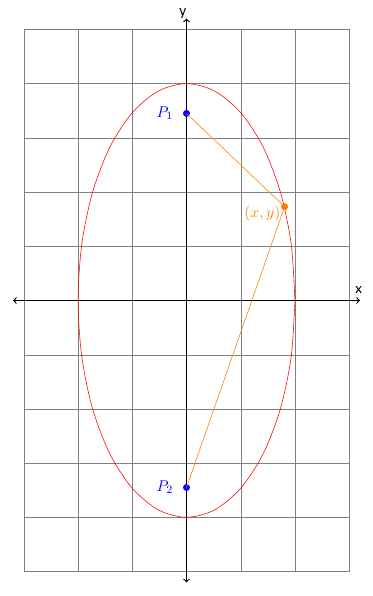
Many famous shapes in the Cartesian plane are defined in terms of distances. For example, we know an ellipse is the collection of points for which the sum of the distances from \((x,y)\) to two separate points is always constant.
We will find the relationship which defines the points for which the sum of the distances to \((0,c)\) and \((0,-c)\) is always \(2D\) (where \(D>c\)).
We begin by finding the distance from a general point \((x,y)\) to each of \(P_1=(0,c)\) and \(P_2=(0,-c)\):
\[ d_1=\sqrt{(x-0)^2+(y-c)^2} =\sqrt{x^2+y^2-2cy+c^2} \nonumber \]
\[d_2=\sqrt{(x-0)^2+(y+c)^2} =\sqrt{x^2+y^2+2cy+c^2} \nonumber \]
Now we set the sum of these distances equal to \(2D\) and solve:
\[\begin{align*} d_1+d_2=2D & \longrightarrow \sqrt{x^2+y^2-2cy+c^2}+\sqrt{x^2+y^2+2cy+c^2}=2D \\[4pt] & \longrightarrow \left( \sqrt{x^2+y^2-2cy+c^2}+\sqrt{x^2+y^2+2cy+c^2}\right)^2=4D^2 \\[4pt] & \longrightarrow x^2+y^2-2cy+c^2+2\sqrt{(x^2+y^2-2cy+c^2)(x^2+y^2+2cy+c^2)}+x^2+y^2+2cy+c^2=4D^2 \\[4pt] & \longrightarrow 2x^2+2y^2+2c^2-4D^2 = -2\sqrt{(x^2+y^2-2cy+c^2)(x^2+y^2+2cy+c^2)} \\[4pt] & \longrightarrow x^2+y^2+c^2-2D^2 = -\sqrt{(x^2+y^2+c^2-2cy)(x^2+y^2+c^2+2cy)} \\[4pt] & \longrightarrow (x^2+y^2+c^2-2D^2)^2 = \left(-\sqrt{(x^2+y^2+c^2-2cy)(x^2+y^2+c^2+2cy)}\right)^2 \\[4pt] & \longrightarrow (x^2+y^2+c^2)^2-4D^2(x^2+y^2+c^2)+4D^4 = (x^2+y^2+c^2)^2-4c^2y^2 \\[4pt] & \longrightarrow D^2(x^2+y^2+c^2)-D^4 = c^2y^2 \\[4pt] & \longrightarrow D^2x^2+(D^2-c^2)y^2=D^4-D^2c^2 \\[4pt] & \longrightarrow \dfrac{x^2}{D^2-c^2}+\dfrac{y^2}{D^2}=1 \end{align*}\]
This matches the standard form of an ellipse \(\dfrac{x^2}{A^2}+\dfrac{y^2}{B^2}=1\) where \(A^2=D^2-c^2\) and \(B^2=D^2\).
Sketch the graph of each shape below in \(\mathbb{R}^2\).
(a) \( x^2+4y^2=1\)
(b) \( x^2+4y^2=4\)
(c) \( x^2+4y^2=16\)
Solution:
(a) In general form this becomes \(\dfrac{x^2}{1^2}+\dfrac{y^2}{\left(\frac{1}{2}\right)^2}=1\), so its graph is:

(b) In general form this becomes \(\dfrac{x^2}{2^2}+\dfrac{y^2}{1^2}=1\), so its graph is:
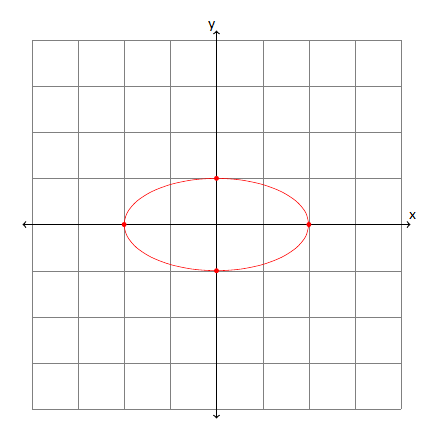
(c) In general form this becomes \(\dfrac{x^2}{4^2}+\dfrac{y^2}{2^2}=1\), so its graph is:

Another common conic section is the set of points for which the difference of the distances to two points is constant: \(\|d_1-d_2\|=2D\).
It is possible (but not pleasant) to show that this leads to the general forms for hyperbola: \(\dfrac{x^2}{A^2}-\dfrac{y^2}{B^2}=1\) or \(\dfrac{y^2}{A^2}-\dfrac{x^2}{B^2}=1\)These shapes will occur frequently in this chapter, so students are expected to be comfortable with their graphs.
Sketch the graph of each shape below in \(\mathbb{R}^2\).
(a) \( 4x^2-y^2=4\)
(b) \( 4x^2-y^2=1\)
(c) \( 4x^2-y^2=-4\)
Solution:
(a) In general form this becomes \(\dfrac{x^2}{1^2}-\dfrac{y^2}{2^2}=1\), so its graph is:

(b) In general form this becomes \(\dfrac{x^2}{\left(\frac{1}{2}\right)^2}-\dfrac{y^2}{1^2}=1\), so its graph is:

(c) In general form this becomes \(\dfrac{y^2}{2^2}-\dfrac{x^2}{1^2}=1\), so its graph is:

This page titled 1.1: Distance Based Objects was last modified on Tue, 12 May 2026 22:26:28 GMT and is shared under a CC BY-NC 4.0 license and was authored, remixed, and/or curated by Kenn Huber.
The book could not be loaded just now.