Opening the book…
Use Stokes' Theorem to evaluate \(\displaystyle{ \iint_S \text{curl}(\vecs{F})\cdot d\vecs{S}}\) for \(\vecs{F}=\left\langle 2x,2xy ,e^z \right\rangle\) and \(S=\left\{ (x,y,z) \, : \, z=x^2+y^2, \, 0\le z\le 4 \right\}\) oriented upward
- Answer
-
The surface \(S\) is a paraboloid, and its boundary the circle \(x^2+y^2=4\) at height \(z=4\):

We can parameterize this boundary curve \(C=\partial S\) by \(\vecs{r}(t)=\left\langle 2\cos(t), 2\sin(t), 4 \right\rangle\) over \(0\le t\le2\pi\)
Therefore by Stokes' Theorem we have:
\[ \begin{align*} \iint_S \text{curl}(\vecs{F})\cdot d\vecs{S} &= \int_C \vecs{F}(\vecs{r}(t))\cdot \vecs{r}'(t)
\\[4pt] &= \int_0^{2\pi} \left\langle 2(2\cos(t)), 2(2\cos(t))(2\sin(t)), e^{4} \right\rangle \cdot \left\langle -2\sin(t), 2\cos(t), 0\right\rangle \, dt
\\[4pt] &= \int_0^{2\pi} \left( -8\cos(t)\sin(t) +16\cos^2(t)\sin(t) \right) \, dt
\\[4pt] &= \left[ 4\cos^2(t) -\dfrac{16}{3}\cos^3(t) \right]\Bigg|_0^{2\pi}
\\[4pt] &= 0 \end{align*} \]
Use Stokes' Theorem to evaluate \(\displaystyle{ \iint_S \text{curl}(\vecs{F})\cdot d\vecs{S}}\) for \(\vecs{F}=\left\langle y,y^2,z^2 \right\rangle\) and \(S=\left\{ (x,y,z) \, : \, z=x^2-y^2, \, x^2+y^2\le 100 \right\}\) oriented upward
- Answer
-
The surface \(S\) is a hyperbolic paraboloid, and its boundary is the circle \(x^2+y^2=100\) at height \(z=x^2-y^2\):

We can parameterize this boundary curve \(C=\partial S\) by \(\vecs{r}(t)=\left\langle 10\cos(t), 10\sin(t), 100\cos^2(t)-100\sin^2(t) \right\rangle\) over \(0\le t\le2\pi\)
Therefore by Stokes' Theorem we have:
\[ \begin{align*} \iint_S \text{curl}(\vecs{F})\cdot d\vecs{S} &= \int_C \vecs{F}(\vecs{r}(t))\cdot \vecs{r}'(t)\,dt
\\[4pt] &= \int_0^{2\pi} \left\langle 10\sin(t), (10\sin(t))^2, (100\cos^2(t)-100\sin^2(t))^2\right\rangle \cdot \left\langle -10\sin(t), 10\cos(t), -400\cos(t)\sin(t)\right\rangle \, dt
\\[4pt] &= \int_0^{2\pi} \left( -100\sin^2(t) +1000\sin^2(t)\cos(t)-4000000(\cos^5(t)\sin(t)-2\cos^3(t)\sin^3(t)+\sin^5(t)\cos(t)) \right) \, dt
\\[4pt] &= \left[ -50t+25\sin(2t) +\dfrac{1000}{3}\sin^3(t) +\dfrac{1000000}{3} \cos^3(2t) \right]\Bigg|_0^{2\pi}
\\[4pt] &= -100\pi \end{align*} \]
Use Stokes' Theorem to evaluate \(\displaystyle{ \iint_S \text{curl}(\vecs{F})\cdot d\vecs{S}}\) for \(\vecs{F}=\left\langle yz,-xz,x^3y^3z^2 \right\rangle\) and \(S=\left\{ (x,y,z) \, : \, x^2+y^2+z^2=4, \, x^2+y^2\le 1, \, z\ge 0 \right\}\) oriented upward
- Answer
-
The surface \(S\) is a small part of a sphere, and its boundary is the circle \(x^2+y^2=1\) at height \(z= \sqrt{3}\):

We can parameterize this boundary curve \(C=\partial S\) by \(\vecs{r}(t)=\left\langle \cos(t), \sin(t), \sqrt{3} \right\rangle\) over \(0\le t\le2\pi\)
Therefore by Stokes' Theorem we have:
\[ \begin{align*} \iint_S \text{curl}(\vecs{F})\cdot d\vecs{S} &= \int_C \vecs{F}(\vecs{r}(t))\cdot \vecs{r}'(t)
\\[4pt] &= \int_0^{2\pi} \left\langle (\sin(t))(\sqrt{3}), -(\cos(t))(\sqrt{3}),(\cos(t))^3(\sin(t))^3(\sqrt{3})^2\right\rangle \cdot \left\langle -\sin(t), \cos(t), 0\right\rangle \, dt
\\[4pt] &= \int_0^{2\pi} \left( -\sin^2(t)\sqrt{3}- \cos^2(t)\sqrt{3} \right) \, dt
\\[4pt] &= \int_0^{2\pi} \ -\sqrt{3}\, dt
\\[4pt] &= -\sqrt{3}\, t \Big|_0^{2\pi}
\\[4pt] &= -2\pi\sqrt{3} \end{align*} \]
Use Stokes' Theorem to evaluate \(\displaystyle{ \iint_S \text{curl}(\vecs{F})\cdot d\vecs{S}}\) for \(\vecs{F}=\left\langle -x^2y,xy^2, \sqrt{z} \right\rangle\) and \(S=\left\{ (x,y,z) \, : \, z=1-x^2-y^2, \, z\ge 0 \right\}\) oriented upward
- Answer
-
The surface \(S\) is a paraboloid, and its boundary is the circle \(x^2+y^2=1\) at height \(z=0\):

We can parameterize this boundary curve \(C=\partial S\) by \(\vecs{r}(t)=\left\langle \cos(t), \sin(t), 0 \right\rangle\) over \(0\le t\le2\pi\)
Therefore by Stokes' Theorem we have:
\[ \begin{align*} \iint_S \text{curl}(\vecs{F})\cdot d\vecs{S} &= \int_C \vecs{F}(\vecs{r}(t))\cdot \vecs{r}'(t)
\\[4pt] &= \int_0^{2\pi} \left\langle -(\cos(t))^2(\sin(t)), (\cos(t))(\sin(t))^2,\sqrt{ 0}\right\rangle \cdot \left\langle -\sin(t), \cos(t), 0\right\rangle \, dt
\\[4pt] &= \int_0^{2\pi} \left( 2\cos^2(t)\sin^2(t)\right) \, dt
\\[4pt] &= \int_0^{2\pi} \left( \dfrac{1}{4}-\dfrac{1}{4}\cos(4t)\right) \, dt
\\[4pt] &= \left[ \dfrac{1}{4}t -\dfrac{1}{16}\sin(4t) \right]\Bigg|_0^{2\pi}
\\[4pt] &= \dfrac{\pi}{2} \end{align*} \]
Use Stokes' Theorem to evaluate \(\displaystyle{ \iint_S \text{curl}(\vecs{F})\cdot d\vecs{S}}\) for \(\vecs{F}=\left\langle z,x,y \right\rangle\) and \(S=\left\{ (x,y,z) \, : \, z=2x+16y-13, \, x^2+4y^2\le z \right\}\) oriented upward
- Answer
-
This surface is an elliptical cut-out of a plane. The boundary can be found by substituting \(z=2x+16y-13\) into \(z=x^2+4y^2\):
\(x^2+4y^2=2x+16y-13 \longleftrightarrow (x-1)^2+4(y-2)^2=4 \longleftrightarrow \dfrac{(x-1)^2}{4}+(y-2)^2=1\)

We can parameterize this boundary curve \(C=\partial S\) by \(\vecs{r}(t)=\left\langle 1+2\cos(t), 2+\sin(t), 2(1+2\cos(t))+16(2+\sin(t))-13 \right\rangle=\left\langle 1+2\cos(t), 2+\sin(t), 21+4\cos(t)+16\sin(t) \right\rangle\) over \(0\le t\le2\pi\)
Therefore by Stokes' Theorem we have:
\[ \begin{align*} \iint_S \text{curl}(\vecs{F})\cdot d\vecs{S} &= \int_C \vecs{F}(\vecs{r}(t))\cdot \vecs{r}'(t)
\\[4pt] &= \int_0^{2\pi} \left\langle (21+4\cos(t))+16\sin(t)) ,(1+2\cos(t)), (2+\sin(t))\right\rangle \cdot \left\langle -2\sin(t), \cos(t), -4\sin(t)+16\cos(t) \right\rangle \, dt
\\[4pt] &= \int_0^{2\pi} \left( -50\sin(t)-32\sin^2(t)+2\cos^2(t)+33\cos(t)-4\sin^2(t)+8\cos(t)\sin(t)\right) \, dt
\\[4pt] &= \int_0^{2\pi} \left( -50\sin(t)-17+19\cos(2t)+33\cos(t)+8\cos(t)\sin(t)\right) \, dt
\\[4pt] &= \left[ 50\cos(t)-17t+\dfrac{19}{2}\sin(2t)+33\sin(t)+4\sin^2(t) \right]\Big|_0^{2\pi}
\\[4pt] &= -34\pi \end{align*} \]
Use Stokes' Theorem to evaluate \(\displaystyle{ \iint_S \text{curl}(\vecs{F})\cdot d\vecs{S}}\) for \(\vecs{F}=\left\langle x,\sin(x-z^2),2 \right\rangle\) and \(S=\left\{ (x,y,z) \, : \, y=e^x-e^z, \, z^2 \le x \le z \right\}\) oriented toward the negative \(y\)-axis
- Answer
-
This surface is a function \(y=f(x,z)\) over a domain between a line and parabola:

The boundary of this domain connects the points \((0,0,0)\) and \((1,0,1)\) along two separate curves.
For this to look counterclockwise from the negative \(y\)-axis, we need the arrows to point in the directions they do in the picture above.
We let \(C_1\) be the path from \((0,0,0)\) to \((1,0,1)\) along the straight line \(z=x\)
We parameterize this using \(\vecs{r}(t)=\left\langle t,0,t\right\rangle\) over \(0\le t\le 1\)
The line integral of \(\vecs{F}\) on this path is given by:
\[ \begin{align*} \int_{C_1} \vecs{F}(\vecs{r}(t))\cdot \vecs{r}'(t) &= \int_0^1 \left\langle t,\sin(t-t^2),2 \right\rangle \cdot \left\langle 1,0, 1\right\rangle \, dt
\\[4pt] &= \int_0^1 \left( t+2\right) \, dt
\\[4pt] &= \left[ \dfrac{1}{2}t^2+2t \right]\Bigg|_0^1
\\[4pt] &= \dfrac{5}{2} \end{align*} \]We let \(C_2\) be the path back from \((1,0,1)\) to \((0,0,0)\) along \(x=z^2\)
We parameterize this using \(\vecs{r}(t)=\left\langle (1-t)^2,e^{(1-t)^2}-e^{1-t},1-t\right\rangle\) over \(0\le t\le 1\)
The line integral of \(\vecs{F}\) on this path is given by:
\[ \begin{align*} \int_{C_2} \vecs{F}(\vecs{r}(t))\cdot \vecs{r}'(t) &= \int_0^1 \left\langle (1-t)^2,\sin(0),2 \right\rangle \cdot \left\langle -2(1-t),-2(1-t)e^{(1-t)^2}+e^{1-t}, -1\right\rangle \, dt
\\[4pt] &= \int_0^1 \left(-2(1-t)^3-2\right) \, dt
\\[4pt] &= \dfrac{1}{2}(1-t)^4-2t \Bigg|_0^1
\\[4pt] &= -\dfrac{5}{2} \end{align*} \]Finally by Stokes' Theorem we know that
\[ \iint_S \text{curl}(\vecs{F})\cdot d\vecs{S} = \int_{C_1\, \cup \, C_2} \vecs{F}\cdot d\vecs{r} =\int_{C_1} \vecs{F}\cdot d\vecs{r}+\int_{C_2} \vecs{F}\cdot d\vecs{r}=\dfrac{5}{2}-\dfrac{5}{2}=0 \nonumber \]
Use Stokes' Theorem to evaluate \(\displaystyle{ \iint_S \text{curl}(\vecs{F})\cdot d\vecs{S}}\) for \(\vecs{F}=\left\langle -y,x,\ln(z) \right\rangle\) and \(S=\left\{ (x,y,z) \, : \, z=e^{x^2+y^2}, \, 1 \le x^2+y^2 \le 4 \right\}\) oriented upward
- Answer
-
The surface \(S\) is defined by a function \(z=f(x,y)\) over an annulus domain:

The boundary of this surface is also in two pieces, the outer circle \(x^2+y^2=4\) (which we must traverse counterclockwise) and the inner circle \(x^2+y^2=1\) (which we want to traverse clockwise).
Let \(C_1\) be the outer boundary, which we can parameterize using \(\vecs{r}(t)=\langle 2\cos(t),2\sin(t),e^4\rangle\) over \(0\le t\le 2\pi\)
The line integral of \(\vecs{F}\) on this path is given by:
\[ \begin{align*} \int_{C_1} \vecs{F}(\vecs{r}(t))\cdot \vecs{r}'(t) &= \int_0^{2\pi} \left\langle -2\sin(t),2\cos(t),4 \right\rangle \cdot \left\langle -2\sin(t),2\cos(t), 0\right\rangle \, dt
\\[4pt] &= \int_0^{2\pi} 4 \, dt
\\[4pt] &= 4t \Big|_0^{2\pi}
\\[4pt] &= 8\pi \end{align*} \]Let \(C_2\) be the inner boundary, which we can parameterize using \(\vecs{r}(t)=\langle \sin(t),\cos(t),e^1 \rangle \) over \(0\le t\le 2\pi\)
The line integral of \(\vecs{F}\) on this path is given by:
\[ \begin{align*} \int_{C_2} \vecs{F}(\vecs{r}(t))\cdot \vecs{r}'(t) &= \int_0^{2\pi} \left\langle -\cos(t),\sin(t),1 \right\rangle \cdot \left\langle \cos(t),-\sin(t), 0\right\rangle \, dt
\\[4pt] &= \int_0^{2\pi} -1 \, dt
\\[4pt] &= -t \Big|_0^{2\pi}
\\[4pt] &= -2\pi \end{align*} \]Finally by Stokes' Theorem we know that
\[ \iint_S \text{curl}(\vecs{F})\cdot d\vecs{S} = \int_{C_1\, \cup \, C_2} \vecs{F}\cdot d\vecs{r} =\iint_{C_1} \vecs{F}\cdot d\vecs{r}+\iint_{C_2} \vecs{F}\cdot d\vecs{r}=8\pi+(-2\pi)=6\pi \nonumber \]
Use Stokes' Theorem to evaluate \( \displaystyle{ \int_C y\,dx+(x+z)\,dy+z^2\,dz}\) for \(C\) the intersection of the unit sphere and the plane \(z=\dfrac{1}{2}y\) in the counterclockwise direction when viewed from above.
- Answer
-
The line integral is \(\displaystyle \int_C \vecs{F} \cdot d\vecs{r}\) for \(\vecs{F}=\left\langle y,x+z, z^2\right\rangle \)
This vector field has curl \(\text{curl}(\vecs{F})=\left\langle -1,0,0 \right\rangle \)
The line \(C\) is the intersection of the unit sphere and the plane \(z=\dfrac{1}{2}y\) in the counterclockwise direction when viewed from above:

One surface with this boundary is \(S=\left\{ (x,y,z)\, : \, x^2+5z^2\le 1, \, y=2z\right\}\)
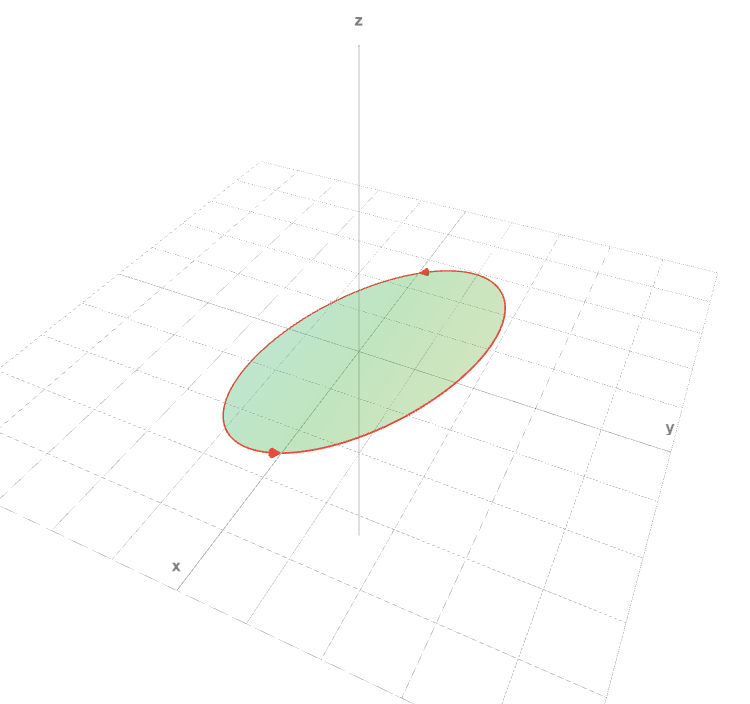
We can parameterize this surface using \(\vecs{r}(u,v)=\left\langle u\cos(v), \dfrac{2}{\sqrt{5}}u\sin(v), \dfrac{1}{\sqrt{5}}u\sin(v)\right\rangle\) over \(D=\left\{ (u,v)\, : \, 0 \le u \le 1,\, 0\le v\le 2\pi\right\}\)
We calculate \(\vecs{r}_u=\left\langle \cos(v), \dfrac{2}{\sqrt{5}}\sin(v), \dfrac{1}{\sqrt{5}}\sin(v) \right\rangle\), \(\vecs{r}_v=\left\langle -u\sin(v) , \dfrac{2}{\sqrt{5}}u\cos(v), \dfrac{1}{\sqrt{5}}u\cos(v) \right\rangle\), and \(\vecs{r}_u\times \vecs{r}_v= \left\langle 0,-\dfrac{1}{\sqrt{5}}u,\dfrac{2}{\sqrt{5}}u \right\rangle\)
This is clearly oriented upward, since the \(z\) component is positive. This matches the orientation of \(C\) in regards to Stokes' Theorem.
Therefore, we can calculate the line integral as:
\[ \begin{align*} \int_{C} \vecs{F} \cdot d\vecs{r} &= \iint_S \text{curl}(\vecs{F})\cdot d\vecs{S}
\\[4pt] &= \iint_D \left\langle -1,0,0\right\rangle \cdot \left\langle 0,-\dfrac{1}{\sqrt{5}}u,\dfrac{2}{\sqrt{5}} u\right\rangle \, dA
\\[4pt] &= \iint_D 0 \, dA
\\[4pt] &= 0 \end{align*} \]
Use Stokes' Theorem to evaluate \(\displaystyle{ \int_C z^2\, dx+y^2\, dy+xy\, dz }\) for \(C\) the curve connecting \((1,0,0)\) to \((0,2,0)\) to \((0,0,2)\) to \((1,0,0)\) with straight lines.
- Answer
-
The line integral is \(\displaystyle \int_C \vecs{F} \cdot d\vecs{r}\) for \(\vecs{F}=\left\langle z^2,y^2, xy\right\rangle \)
This vector field has curl \(\text{curl}(\vecs{F})=\left\langle x,2z-y,0 \right\rangle \)
The curve \(C\) traces a triangle in some plane which moves along its edge in the counterclockwise direction when viewed from above:

The equation of the plane containing this curve can easily be calculated to be \(2x+y+z=2\), so one surface with this as its boundary is \(S=\left\{(x,y,z)\, : \, 0\le x\le 1, \, 0\le y\le 2-2x, \, z=2-2x-y\right\}\)

We can parameterize this surface using \(\vecs{r}(u,v)=\left\langle u, v, 2-2u-v\right\rangle\) over \(D=\left\{ (u,v)\, : \, 0 \le u \le 1,\, 0\le v\le 2-2u\right\}\)
We calculate \(\vecs{r}_u=\left\langle 1,0,-2 \right\rangle\), \(\vecs{r}_v=\left\langle 0,1,-1\right\rangle\), and \(\vecs{r}_u\times \vecs{r}_v= \left\langle 2,1,1 \right\rangle\)
This is clearly oriented upward, since the \(z\) component is positive. This matches the orientation of \(C\) in regards to Stokes' Theorem.
Therefore, we can calculate the line integral as:
\[ \begin{align*} \int_{C} \vecs{F} \cdot d\vecs{r} &= \iint_S \text{curl}(\vecs{F})\cdot d\vecs{S}
\\[4pt] &= \iint_D \left\langle u,2(2-2u-v)-v,0 \right\rangle \cdot \left\langle 2,1,1 \right\rangle \, dA
\\[4pt] &= \int_0^1 \int_0^{2-2u} (4-2u-3v) \, dv \, du
\\[4pt] &= \int_0^1 \left[ 4v-2uv-\dfrac{3}{2}v^2\right]\Bigg|_0^{2-2u} \, du
\\[4pt] &= \int_0^1 \left( 2-2u^2\right) \, du
\\[4pt] &= \left[ 2u-\dfrac{2}{3}u^3\right]\Bigg|_0^1
\\[4pt] &= \dfrac{4}{3} \end{align*} \]
Use Stokes' Theorem to evaluate \(\displaystyle{ \int_C x^2\, dx+(2xy+x) \, dy+z \, dz }\) for \(C\) parameterized by \(\vecs{r}(t)=\langle \sin(\pi t),\cos(\pi t),0\rangle \) over \(0\le t\le 2\)
- Answer
-
The line integral is \(\displaystyle \int_C \vecs{F} \cdot d\vecs{r}\) for \(\vecs{F}=\left\langle x^2,2xy+x, z\right\rangle \)
This vector field has curl \(\text{curl}(\vecs{F})=\left\langle 0,0,2y+1 \right\rangle \)
The curve \(C\) traces a circle in the \(z=0\) plane which moves along its edge in the clockwise direction when viewed from above:

One surface with this as its boundary is \(S=\left\{(x,y,z)\, : \, x^2+y^2\le 1 \right\}\)

We can parameterize this surface using \(\vecs{r}(u,v)=\left\langle u\cos(v), u\sin(v),0\right\rangle\) over \(D=\left\{ (u,v)\, : \, 0 \le u \le 1,\, 0\le v\le 2\pi \right\}\)
We calculate \(\vecs{r}_u=\left\langle \cos(v),\sin(v),0 \right\rangle\), \(\vecs{r}_v=\left\langle -u\sin(v),u\cos(v),0\right\rangle\), and \(\vecs{r}_u\times \vecs{r}_v= \left\langle 0,0,u \right\rangle\)
This is clearly oriented upward, since the \(z\) component is positive. This does not match the orientation of \(C\) in regards to Stokes' Theorem, so we multiply the flux integral by a negative sign to compensate.
We can calculate the line integral as:
\[ \begin{align*} \int_{C} \vecs{F} \cdot d\vecs{r} &= -\iint_S \text{curl}(\vecs{F})\cdot d\vecs{S}
\\[4pt] &= -\iint_D \left\langle 0,0,2u\sin(v)+1 \right\rangle \cdot \left\langle 0,0,u \right\rangle \, dA
\\[4pt] &= \int_0^1 \int_0^{2\pi} (-2u^2\sin(v)-u) \, dv \, du
\\[4pt] &= \int_0^1 \left[ 2u^2\cos(v)-uv \right] \Big|_0^{2\pi} \, du
\\[4pt] &= \int_0^1 -2\pi u \, du
\\[4pt] &= -\pi u^2 \Big|_0^1
\\[4pt] &= -\pi \end{align*} \]
Use Stokes' Theorem to evaluate \(\displaystyle{ \int_C y^2\, dx+2x\, dy-4z^2\, dz }\) for \(C\) the intersection of \(y+z=12\) and \(x^2+y^2=25\) going counterclockwise when viewed from above.
- Answer
-
The line integral is \(\displaystyle \int_C \vecs{F} \cdot d\vecs{r}\) for \(\vecs{F}=\left\langle y^2,2x, -4z^2\right\rangle \)
This vector field has curl \(\text{curl}(\vecs{F})=\left\langle 0,0,2-2y \right\rangle \)
The curve \(C\) is the intersection of the plane \(y+z=12\) and cylinder \(x^2+y^2=25\) going counterclockwise when viewed from above.

One surface with this as its boundary is \(S=\left\{(x,y,z)\, : \, x^2+y^2\le 25, \, z=12-y \right\}\)

We can parameterize this surface using \(\vecs{r}(u,v)=\left\langle u\cos(v), u\sin(v), 12-u\sin(v) \right\rangle\) over \(D=\left\{ (u,v)\, : \, 0 \le u \le 5,\, 0\le v\le 2\pi \right\}\)
We calculate \(\vecs{r}_u=\left\langle \cos(v),\sin(v),-\sin(v) \right\rangle\), \(\vecs{r}_v=\left\langle -u\sin(v), u\cos(v),-u\cos(v)\right\rangle\), and \(\vecs{r}_u\times \vecs{r}_v= \left\langle 0,u,u \right\rangle\)
This is clearly oriented upward, since the \(z\) component is positive. This matches the orientation of \(C\) in regards to Stokes' Theorem.
Therefore, we can calculate the line integral as:
\[ \begin{align*} \int_{C} \vecs{F} \cdot d\vecs{r} &= \iint_S \text{curl}(\vecs{F})\cdot d\vecs{S}
\\[4pt] &= \iint_D \left\langle 0,0,2-2u\sin(v) \right\rangle \cdot \left\langle 0,u,u \right\rangle \, dA
\\[4pt] &= \int_0^5 \int_0^{2\pi } (2u-2u^2\sin(v)) \, dv \, du
\\[4pt] &= \int_0^5 \left[ 2uv+2u^2\cos(v)\right] \Big|_0^{2\pi} \, du
\\[4pt] &= \int_0^5 4\pi u \, du
\\[4pt] &= 2\pi u^2 \Big|_0^5
\\[4pt] &= 50\pi \end{align*} \]
Use Stokes' Theorem to evaluate \(\displaystyle{ \int_C \cos(x^2)\, dx+ e^{|y|} \, dy+\left(x-\ln(z^4+1)\right)\, dz }\) for \(C\) parameterized by \(\vecs{r}(t)=\langle \cos( t),2\sin(t),\cos^2(t)+4\sin(t) \rangle \) over \(0\le t\le 2\pi \)
- Answer
-
This line integral is \(\displaystyle \int_C \vecs{F} \cdot d\vecs{r}\) for \(\vecs{F}=\left\langle \cos(x^2),e^{|y|}, x-\ln(z^4+1) \right\rangle \)
This vector field has curl \(\text{curl}(\vecs{F})=\left\langle 0,-1,0 \right\rangle \)
The curve \(C\) traces an ellipse \(x^2+\dfrac{y^2}{4}=1\) while \(z=x^2+2y\)

One surface with this as its boundary is \(S=\left\{(x,y,z)\, : \, x^2+\dfrac{y^2}{4} \le 1, \, z=x^2+2y \right\}\)

We can parameterize this surface using \(\vecs{r}(u,v)=\left\langle u\cos(v), 2u\sin(v), u^2\cos^2(v)+4u\sin(v) \right\rangle\) over \(D=\left\{ (u,v)\, : \, 0 \le u \le 1,\, 0\le v\le 2\pi \right\}\)
We calculate \(\vecs{r}_u=\left\langle \cos(v),2\sin(v), 2u\cos^2(v)+4\sin(v) \right\rangle\), \(\vecs{r}_v=\left\langle -u\sin(v), 2u\cos(v),-2u^2\cos(v)\sin(v)+4u\cos(v) \right\rangle\), and \(\vecs{r}_u\times \vecs{r}_v= \left\langle -4u^2\cos^2(v),-4u,2u \right\rangle\)
This is clearly oriented upward, since the \(z\) component is positive. This matches the orientation of \(C\) in regards to Stokes' Theorem.
Therefore, we can calculate the line integral as:
\[ \begin{align*} \int_{C} \vecs{F} \cdot d\vecs{r} &= \iint_S \text{curl}(\vecs{F})\cdot d\vecs{S}
\\[4pt] &= \iint_D \left\langle 0,-1,0 \right\rangle \cdot \left\langle -4u^2\cos^2(v)-2u^2\sin^2(v),-4u-u^2\cos(v)\sin(v),2u \right\rangle \, dA
\\[4pt] &= \int_0^1 \int_0^{2\pi } (4u+u^2\cos(v)\sin(v)) \, dv \, du
\\[4pt] &= \int_0^1 \left[ 4uv+\dfrac{1}{2}u^2\sin^2(v)\right]\Bigg|_0^{2\pi} \, du
\\[4pt] &= \int_0^1 8\pi u \, du
\\[4pt] &= 4\pi u^2 \Big|_0^1
\\[4pt] &= 4\pi \end{align*} \]
Use Stokes' Theorem to evaluate \(\displaystyle{ \int_C e^y \, dx + e^{\sin(\pi z)} \, dy+ \sqrt[4]{z} \, dz }\) where \(C\) is the curve connecting \((5,0,4)\) to \((4,1,1)\) to \((1,0,4)\) using straight lines.
- Answer
-
The desired line integral is \(\displaystyle \int_C \vecs{F} \cdot d\vecs{r}\) for \(\vecs{F}=\left\langle e^y, e^{\sin(\pi z)},\sqrt[4]{z} \right\rangle \)
Notice that this path \(C\) is not closed, so we need to close it to use Stokes' Theorem.

We will add on a return path \(\tilde{C}\), which is easiest as a straight line back to \((5,0,4)\)
We can parameterize this path using \(\vecs{s}(t)=\langle 1+4t,0,4\rangle\) for \(0\le t\le 1\)

We calculate the return line integral:
\[ \begin{align*} \int_{\tilde{C}} \vecs{F} \cdot d\vecs{r} &= \int_0^1 \left( e^0 \cdot 4 + e^0 \cdot 0 + \sqrt[4]{4} \cdot 0 \right) \, dt
\\[4pt] &= \int_0^1 4 \,dt
\\[4pt] &= 4t \Big|_0^1
\\[4pt] &= 4 \end{align*} \]It is easy to find these points (and lines) all lie within the same plane, which is \(3y+z=4\)
One surface with this as its boundary is thus \(S=\left\{(x,y,z)\,: \, 0\le y \le 1, \, 3y+1 \le x\le 5-y, \, z=4-3y\right\}\)

We can parameterize this surface using \(\vecs{r}(u,v)=\left\langle u,v,4-3v \right\rangle\) over \(D=\left\{ (u,v)\, : \, 0 \le v \le 1,\, 3v+1\le u\le 5-v \right\}\)
We calculate \(\vecs{r}_u=\left\langle 1,0,0 \right\rangle\), \(\vecs{r}_v=\left\langle 0,1,-3 \right\rangle \), and \(\vecs{r}_u\times \vecs{r}_v= \left\langle 0,3,1 \right\rangle\)
This is clearly oriented upward, since the \(z\) component is positive. This matches the orientation of \(C\) in regards to Stokes' Theorem, since the curve travels around the boundary of \(S\) counterclockwise when viewed from above.
This vector field has \(\text{curl}(\vecs{F})=\left\langle -\pi \cos(\pi z) e^{\sin(\pi z)},0,-e^y\right\rangle \)
Therefore, we can calculate the surface integral as:
\[ \begin{align*} \iint_S \text{curl}(\vecs{F})\cdot d\vecs{S} & = \iint_D \left\langle -\pi \cos( \pi(4-3v))e^{\sin(\pi(4-3v))}, 0, -e^v \right\rangle \cdot \left\langle 0,3,1 \right\rangle \, dA
\\[4pt] &= \int_0^1 \int_{3v+1}^{5-v} -e^v \, du \, dv
\\[4pt] &= \int_0^1 -ue^v \Big|_{3v+1}^{5-v} \, dv
\\[4pt] &= \int_0^1 (4v-4)e^v \,dv
\\[4pt] &= 4(v-2)e^v \Big|_0^1
\\[4pt] &= 8-4e \end{align*} \]Stokes' Theorem says that \( \displaystyle \int_{C} \vecs{F}\cdot d\vecs{r}+ \int_{\tilde{C}} \vecs{F}\cdot d\vecs{r} = \iint_S \text{curl}(\vecs{F})\cdot d\vecs{S} \)
Therefore, our final answer is \( \displaystyle \int_{C} \vecs{F}\cdot d\vecs{r} =4-4e \)
Use Stokes' Theorem to evaluate \(\displaystyle{ \int_C \left(2x^{17}+3x^2+yz\right) \, dx- y^8 \, dy+ \left(xy+(1+z)^z\right) \, dz }\) where \(C\) is the path parameterized by \(\vecs{r}(t)=\langle 2\cos(\pi t), 4\cos^2(\pi t), \sin(\pi t)\rangle\) for \(0\le t\le 1\)
- Answer
-
The desired line integral is \(\displaystyle \int_C \vecs{F} \cdot d\vecs{r}\) for \(\vecs{F}=\left\langle 2x^{17}+3x^2+yz, -y^8 ,xy+(1+z)^z \right\rangle \)
Notice that this path \(C\) traces a half-ellipse \(\dfrac{x^2}{4}+z^2=1\) while \(y=x^2\) and is not closed, so we need to close it to use Stokes' Theorem.

We will add on a return path \(\tilde{C}\), which is easiest along the cylinder \(y=x^2\) with \(z=0\)
We can parameterize this path using \(\vecs{s}(t)=\langle t,t^2,0\rangle\) for \(-2\le t\le 2\)

We calculate the return line integral:
\[ \begin{align*} \int_{\tilde{C}} \vecs{F} \cdot d\vecs{s} &= \int_{-2}^2 \left( \left(2t^{17}+3t^2+t^2\cdot 0\right)\cdot 1 + \left(-(t^2)^8\right)\cdot 2t + \left(t\cdot t^2+(1+0)^0\right)\cdot 0 \right) \, dt
\\[4pt] &= \int_{-2}^2 3t^2 \,dt
\\[4pt] &= t^3 \Big|_{-2}^2
\\[4pt] &= 16 \end{align*} \]One surface with this as its boundary is \(S=\left\{(x,y,z)\, : \, \dfrac{x^2}{4}+z^2 \le 1, \, z\ge 0, \, y=x^2 \right\}\)

We can parameterize this surface using \(\vecs{r}(u,v)=\left\langle 2u\cos(v), 4u^2\cos^2(v), u\sin(v) \right\rangle\) over \(D=\left\{ (u,v)\, : \, 0 \le u \le 1,\, 0\le v\le \pi \right\}\)
We calculate \(\vecs{r}_u=\left\langle 2\cos(v),8u\cos^2(v), \sin(v) \right\rangle\), \(\vecs{r}_v=\left\langle -2u\sin(v), -8u\cos(v)\sin(v), u\cos(v) \right\rangle\), and \(\vecs{r}_u\times \vecs{r}_v= \left\langle 8u^2\cos(v),-2u,0 \right\rangle\)
This is clearly oriented toward the negative \(y\)-axis, since the \(y\) component is negative. This matches the orientation of \(C\) in regards to Stokes' Theorem, since the curve travels around the boundary of \(S\) counterclockwise when viewed from the negative \(y\)-axis.
This vector field has \(\text{curl}(\vecs{F})=\left\langle x,0,-z\right\rangle \)
Therefore, we can calculate the surface integral as:
\[ \begin{align*} \iint_S \text{curl}(\vecs{F})\cdot d\vecs{S} & = \iint_D \left\langle 2u\cos(v),0,-u\sin(v) \right\rangle \cdot \left\langle 8u^2\cos(v),-2u,0 \right\rangle \, dA
\\[4pt] &= \int_0^1 \int_0^\pi 16u^3\cos^2(v) \, dv \, du
\\[4pt] &= \left( \int_0^1 16u^3 \, du \right) \left( \int_0^\pi \cos^2(v) \, dv \right)
\\[4pt] &= \left( 4u^4 \Big|_0^1\right) \cdot \left[ \dfrac{1}{2}v+\dfrac{1}{4}\sin(2v) \right]\Bigg|_0^\pi
\\[4pt] &= 4 \cdot \dfrac{\pi}{2}
\\[4pt] &= 2\pi \end{align*} \]Stokes' Theorem says that \( \displaystyle \int_{C} \vecs{F}\cdot d\vecs{r}+ \int_{\tilde{C}} \vecs{F}\cdot d\vecs{s} = \iint_S \text{curl}(\vecs{F})\cdot d\vecs{S}\)
Therefore, our final answer is \( \int_{C} \vecs{F}\cdot d\vecs{r} = 2\pi -16\)
This page titled 4.3: Practice Set was last modified on Thu, 16 Apr 2026 19:57:13 GMT and is shared under a CC BY-NC 4.0 license and was authored, remixed, and/or curated by Kenn Huber.
The book could not be loaded just now.