Opening the book…
Quadratic functions are those of the form \(f(x)=ax^2+bx+c\) for some real numbers \(a,b,c\)
When \(a=0\), this simplifies down to a line (which we have already studied fully), so assume \(a\ne 0\)
We start with the graph of the standard parabola \(y=x^2\)
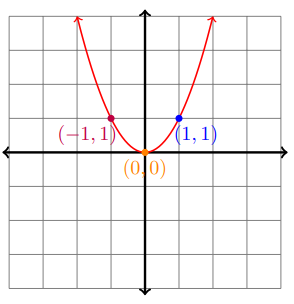
(We say the point \(\textcolor{orange}{ (0,0) }\) is the vertex of the parabola.)
A parabola is in vertex form when written \(y=a(x-h)^2+k\)
For \(g(x)=x^2\), this graph is just a transformation of \(g(x)\): \(y=ag(x-h)+k\)
\(y_{new}=a\cdot y_{old}+k\) and \(x_{old}=x_{new}-h\)
| \(x_{old}\) | \(y_{old}\) | \(x_{new}\) | \(y_{new}\) |
| -1 | 1 | h-1 | k+a |
| 0 | 0 | h | k |
| 1 | 1 | h+1 | k+a |
So when graph \(y=a(x-h)^2+k\), we can always plot three simple points:
The vertex: \((h,k)\), and the two points \((h\pm 1, k+a)\)

If you are given a quadratic, you can put it into vertex form by completing the square.
(Remember that \( (x+h)^2=x^2+2hx+h^2\) and \((x-h)^2=x^2-2hx+h^2\) )
So if we start off with \(x^2+bx+c\), then \(b\) should be doing the job of \(2h\):
\(b=2h \longleftrightarrow \displaystyle{h=\frac{b}{2}}\)
Therefore we should add and subtract \(\displaystyle{\left( \frac{b}{2}\right)^2}\) (which is the same as \(h^2\)) to our expression giving
\(\displaystyle{x^2+bx+c=\left(x+\frac{b}{2}\right)^2+k}\) for some \(k\)
Write the following quadratics in vertex form and find the vertex \((h,k)\):
(a) \(y=x^2+6x\) (b) \(y=x^2-2x+4\)
Solution
(a) Since \(b=6 \rightarrow h= 3\) we know \( h^2=\textcolor{red}{9}\)
So we add and subtract it: \(y=(x^2+6x+ \textcolor{red}{9})- \textcolor{red}{9}\)
And group up the first three as a perfect square to get \(y=(x+3)^2-9\)
This is vertex form, and we can clearly see our vertex is at the point \((-3,-9)\)
(b) Since \(b=-2\rightarrow h=-1\) we know \(h^2=\textcolor{purple}{1}\)
So we add and subtract it: \(y=(x^2-2x+\textcolor{purple}{1})-\textcolor{purple}{1}+4\)
And group up the first three as a perfect square to get \(y=(x-1)^2+3\)
This is vertex form, and we see our vertex is the point \((1,3)\)
If the leading term is \(ax^2\) instead of \(x^2\), your first step should be to factor out \(a\) from both \(x\) terms, then repeat the process above. (Just dont forget to distribute \(a\) when adding and subtracting \(h^2\))
Write the following quadratics in vertex form and find the vertex \((h,k)\):
(a) \(y=2x^2-8x+5\) (b) \(y=-\dfrac{1}{2}x^2-6x-4\)
Solution
(a) First we factor out the \(\textcolor{green}{2}\) from the \(x\) terms: \(y=\textcolor{green}{2}(x^2-4x)+5\)
Since \(b=-4 \rightarrow h= -2\) we know \( h^2=\textcolor{orange}{4}\)
So we add and subtract it: \(y=\textcolor{green}{2}(x^2-4x+ \textcolor{orange}{4})- \textcolor{orange}{4}\cdot \textcolor{green}{2}+5\)
Inside the parenthesis is a perfect square, so we write \(y=2(x-2)^2-3\)
This is vertex form, and we can clearly see our vertex is at the point \((2,-3)\)
(b) First we factor out the \(\textcolor{green}{-\dfrac{1}{2}}\) from the \(x\) terms: \(y=\textcolor{green}{-\dfrac{1}{2}}(x^2+12x)-4\)
Since \(b=12\rightarrow h=6\) we know \(h^2=\textcolor{blue}{36}\)
So we add and subtract it: \(y=\textcolor{green}{-\dfrac{1}{2}}(x^2+12x+\textcolor{blue}{36})-\textcolor{blue}{36}\cdot \left( \textcolor{green}{-\dfrac{1}{2}}\right)-4\)
Inside the parenthesis is a perfect square, so we write \(y=-\dfrac{1}{2}(x+6)^2+14\)
This is vertex form, and we see our vertex is the point \((-6,14)\)
As we can see, completing the square is a great tool we can use to help turn quadratic functions from their general form \(f(x)=ax^2+bx+c\) into vertex form \(f(x)=a(x-h)^2+k\)
This is definitely useful if you ever want to draw a parabola!
Sketch the graph of the function \(y=-2x^2+12x-14\)
Solution
First we put it into vertex form, so we factor out the \(-2\) from the \(x\) terms to get \(y=-2(x^2-6x)-14\)
Then since \(b=-6\), we get \(h=-3\) so \(h^2=9\)
We add and subtract it: \(y= {-2}(x^2-6x+ {9})- {9} \cdot \left( {-2} \right) -14\)
Which simplifies into vertex form: \(y=-2(x-3)^2+4\)
We have a vertex at \((3,4)\) and can sketch using the nearby points \((2,2)\) and \((4,2)\)

This page titled 1.8: Parabolas was last modified on Thu, 13 Mar 2025 20:04:47 GMT and is shared under a CC BY-NC-SA 4.0 license and was authored, remixed, and/or curated by Kenn Huber.
The book could not be loaded just now.