Opening the book…
Find the matrix for the linear transformation which rotates every vector in \(\mathbb{R}^2\) through an angle of \(\frac{\pi}{3} \).
- Answer
-
\(\left[\begin{array}{cc}\cos\left(\frac{\pi}{3}\right)&-\sin\left(\frac{\pi}{3}\right) \\ \sin\left(\frac{\pi}{3}\right)&\cos\left(\frac{\pi}{3}\right)\end{array}\right]=\left[\begin{array}{cc}\frac{1}{2}&-\frac{1}{2}\sqrt{3} \\ \frac{1}{2}\sqrt{3}&\frac{1}{2}\end{array}\right]\)
Find the matrix for the linear transformation which rotates every vector in \(\mathbb{R}^2\) through an angle of \(\frac{\pi}{4} \).
- Answer
-
\(\left[\begin{array}{cc}\cos\left(\frac{\pi}{4}\right)&-\sin\left(\frac{\pi}{4}\right) \\ \sin\left(\frac{\pi}{4}\right)&\cos\left(\frac{\pi}{4}\right)\end{array}\right]=\left[\begin{array}{cc}\frac{1}{2}\sqrt{2}&-\frac{1}{2}\sqrt{2} \\ \frac{1}{2}\sqrt{2}&\frac{1}{2}\sqrt{2}\end{array}\right]\)
Find the matrix for the linear transformation which rotates every vector in \(\mathbb{R}^2\) through an angle of \(\frac{-\pi}{3} \).
- Answer
-
\(\left[\begin{array}{cc}\cos\left(-\frac{\pi}{3}\right)&-\sin\left(-\frac{\pi}{3}\right) \\ \sin\left(-\frac{\pi}{3}\right)&\cos\left(-\frac{\pi}{3}\right)\end{array}\right]=\left[\begin{array}{cc}\frac{1}{2}&\frac{1}{2}\sqrt{3} \\ -\frac{1}{2}\sqrt{3}&\frac{1}{2}\end{array}\right]\)
Find the matrix for the linear transformation which rotates every vector in \(\mathbb{R}^2\) through an angle of \(\frac{2\pi}{3} \).
- Answer
-
\(\left[\begin{array}{cc}\cos\left(\frac{2\pi}{3}\right)&-\sin\left(\frac{2\pi}{3}\right) \\ \sin\left(\frac{2\pi}{3}\right)&\cos\left(\frac{2\pi}{3}\right)\end{array}\right]=\left[\begin{array}{cc}-\frac{1}{2}&-\frac{1}{2}\sqrt{3} \\ \frac{1}{2}\sqrt{3}&-\frac{1}{2}\end{array}\right]\)
Find the matrix for the linear transformation which rotates every vector in \(\mathbb{R}^2\) through an angle of \(\frac{\pi}{12} \).
Hint: \(\frac{\pi}{12} \) = \(\frac{\pi}{3} \) - \(\frac{\pi}{4} \)
- Answer
-
\[\begin{aligned}&\left[\begin{array}{cc}\cos\left(\frac{\pi}{3}\right)&-\sin\left(\frac{\pi}{3}\right) \\ \sin\left(\frac{\pi}{3}\right)&\cos\left(\frac{\pi}{3}\right)\end{array}\right]\left[\begin{array}{cc}\cos\left(-\frac{\pi}{4}\right)&-\sin\left(-\frac{\pi}{4}\right) \\ \sin\left(-\frac{\pi}{4}\right)&\cos\left(-\frac{\pi}{4}\right)\end{array}\right] \\ =&\left[\begin{array}{cc}\frac{1}{4}\sqrt{2}\sqrt{3}+\frac{1}{4}\sqrt{2}&\frac{1}{4}\sqrt{2}-\frac{1}{4}\sqrt{2}\sqrt{3} \\ \frac{1}{4}\sqrt{2}\sqrt{3}-\frac{1}{4}\sqrt{2}&\frac{1}{4}\sqrt{2}\sqrt{3}+\frac{1}{4}\sqrt{2}\end{array}\right]\end{aligned}\]
Find the matrix for the linear transformation which rotates every vector in \(\mathbb{R}^2\) through an angle of \(\frac{2\pi}{3} \) and then reflects across the \(x\) axis.
- Answer
-
\[\left[\begin{array}{cc}1&0\\0&-1\end{array}\right]\left[\begin{array}{cc}\cos\left(\frac{2\pi}{3}\right)&-\sin\left(\frac{2\pi}{3}\right) \\ \sin\left(\frac{2\pi}{3}\right)&\cos\left(\frac{2\pi}{3}\right)\end{array}\right]=\left[\begin{array}{cc}-\frac{1}{2}&-\frac{1}{2}\sqrt{3}\\-\frac{1}{2}\sqrt{3}&\frac{1}{2}\end{array}\right]\nonumber\]
Find the matrix for the linear transformation which rotates every vector in \(\mathbb{R}^2\) through an angle of \(\frac{\pi}{3} \) and then reflects across the \(x\) axis.
- Answer
-
\[\left[\begin{array}{cc}1&0\\0&-1\end{array}\right]\left[\begin{array}{cc}\cos\left(\frac{\pi}{3}\right)&-\sin\left(\frac{\pi}{3}\right) \\ \sin\left(\frac{\pi}{3}\right)&\cos\left(\frac{\pi}{3}\right)\end{array}\right]=\left[\begin{array}{cc}\frac{1}{2}&-\frac{1}{2}\sqrt{3}\\-\frac{1}{2}\sqrt{3}&-\frac{1}{2}\end{array}\right]\nonumber\]
Find the matrix for the linear transformation which rotates every vector in \(\mathbb{R}^2\) through an angle of \(\frac{\pi}{4} \) and then reflects across the \(x\) axis.
- Answer
-
\[\left[\begin{array}{cc}1&0\\0&-1\end{array}\right]\left[\begin{array}{cc}\cos\left(\frac{\pi}{4}\right)&-\sin\left(\frac{\pi}{4}\right) \\ \sin\left(\frac{\pi}{4}\right)&\cos\left(\frac{\pi}{4}\right)\end{array}\right]=\left[\begin{array}{cc}\frac{1}{2}\sqrt{2}&-\frac{1}{2}\sqrt{2}\\-\frac{1}{2}\sqrt{2}&-\frac{1}{2}\sqrt{2}\end{array}\right]\nonumber\]
Find the matrix for the linear transformation which rotates every vector in \(\mathbb{R}^2\) through an angle of \(\frac{\pi}{6} \) and then reflects across the \(x\) axis followed by a reflection across the \(y\) axis.
- Answer
-
\[\left[\begin{array}{cc}-1&0\\0&1\end{array}\right]\left[\begin{array}{cc}\cos\left(\frac{\pi}{6}\right)&-\sin\left(\frac{\pi}{6}\right) \\ \sin\left(\frac{\pi}{6}\right)&\cos\left(\frac{\pi}{6}\right)\end{array}\right]=\left[\begin{array}{cc}-\frac{1}{2}\sqrt{3}&\frac{1}{2}\\ \frac{1}{2}&\frac{1}{2}\sqrt{3}\end{array}\right]\nonumber\]
Find the matrix for the linear transformation which rotates every vector in \(\mathbb{R}^2\) across the \(x\) axis and then rotates every vector through an angle of \(\frac{\pi}{4} \).
- Answer
-
\[\left[\begin{array}{cc}\cos\left(\frac{\pi}{4}\right)&-\sin\left(\frac{\pi}{4}\right) \\ \sin\left(\frac{\pi}{4}\right)&\cos\left(\frac{\pi}{4}\right)\end{array}\right]\left[\begin{array}{cc}1&0\\0&-1\end{array}\right]=\left[\begin{array}{cc}\frac{1}{2}\sqrt{2}&\frac{1}{2}\sqrt{2} \\ \frac{1}{2}\sqrt{2}&-\frac{1}{2}\sqrt{2}\end{array}\right]\nonumber\]
Find the matrix for the linear transformation which rotates every vector in \(\mathbb{R}^2\) across the \(y\) axis and then rotates every vector through an angle of \(\frac{\pi}{4} \).
- Answer
-
\[\left[\begin{array}{cc}\cos\left(\frac{\pi}{4}\right)&-\sin\left(\frac{\pi}{4}\right) \\ \sin\left(\frac{\pi}{4}\right)&\cos\left(\frac{\pi}{4}\right)\end{array}\right]\left[\begin{array}{cc}-1&0\\0&1\end{array}\right]=\left[\begin{array}{cc}-\frac{1}{2}\sqrt{2}&-\frac{1}{2}\sqrt{2} \\ -\frac{1}{2}\sqrt{2}&\frac{1}{2}\sqrt{2}\end{array}\right]\nonumber\]
Find the matrix for the linear transformation which rotates every vector in \(\mathbb{R}^2\) across the \(x\) axis and then rotates every vector through an angle of \(\frac{\pi}{6} \).
- Answer
-
\[\left[\begin{array}{cc}\cos\left(\frac{\pi}{6}\right)&-\sin\left(\frac{\pi}{6}\right) \\ \sin\left(\frac{\pi}{6}\right)&\cos\left(\frac{\pi}{6}\right)\end{array}\right]\left[\begin{array}{cc}1&0\\0&-1\end{array}\right]=\left[\begin{array}{cc}\frac{1}{2}\sqrt{3}&\frac{1}{2} \\ \frac{1}{2}&-\frac{1}{2}\sqrt{3}\end{array}\right]\nonumber\]
Find the matrix for the linear transformation which rotates every vector in \(\mathbb{R}^2\) across the \(y\) axis and then rotates every vector through an angle of \(\frac{\pi}{6} \).
- Answer
-
\[\left[\begin{array}{cc}\cos\left(\frac{\pi}{6}\right)&-\sin\left(\frac{\pi}{6}\right) \\ \sin\left(\frac{\pi}{6}\right)&\cos\left(\frac{\pi}{6}\right)\end{array}\right]\left[\begin{array}{cc}-1&0\\0&1\end{array}\right]=\left[\begin{array}{cc}-\frac{1}{2}\sqrt{3}&-\frac{1}{2} \\ -\frac{1}{2}&\frac{1}{2}\sqrt{3}\end{array}\right]\nonumber\]
Find the matrix for the linear transformation which rotates every vector in \(\mathbb{R}^2\) through an angle of \(\frac{5\pi}{12} \).
Answer
-
\[\left[\begin{array}{cc}\cos\left(\frac{2\pi}{3}\right)&-\sin\left(\frac{2\pi}{3}\right) \\ \sin\left(\frac{2\pi}{3}\right)&\cos\left(\frac{2\pi}{3}\right)\end{array}\right]\left[\begin{array}{cc}\cos\left(-\frac{\pi}{4}\right)&-\sin\left(-\frac{\pi}{4}\right) \\ \sin\left(-\frac{\pi}{4}\right)&\cos\left(-\frac{\pi}{4}\right)\end{array}\right]=\nonumber\] \[\left[\begin{array}{cc}\frac{1}{4}\sqrt{2}\sqrt{3}-\frac{1}{4}\sqrt{2}&-\frac{1}{4}\sqrt{2}\sqrt{3}-\frac{1}{4}\sqrt{2} \\ \frac{1}{4}\sqrt{2}\sqrt{3}+\frac{1}{4}\sqrt{2}&\frac{1}{4}\sqrt{2}\sqrt{3}-\frac{1}{4}\sqrt{2}\end{array}\right]\nonumber\] Note that it doesn't matter about the order in this case.
Find the matrix of the linear transformation which rotates every vector in \(\mathbb{R}^3\) counter clockwise about the \(z\) axis when viewed from the positive \(z\) axis through an angle of \(30^◦\) and then reflects through the \(xy\) plane.
- Answer
-
\[\left[\begin{array}{ccc}1&0&0\\0&1&0\\0&0&-1\end{array}\right]\left[\begin{array}{ccc}\cos\left(\frac{\pi}{6}\right)&-\sin\left(\frac{\pi}{6}\right)&0 \\ \sin\left(\frac{\pi}{6}\right)&\cos\left(\frac{\pi}{6}\right)&0 \\ 0&0&1\end{array}\right]=\left[\begin{array}{ccc}\frac{1}{2}\sqrt{3}&-\frac{1}{2}&0\\ \frac{1}{2}&\frac{1}{2}\sqrt{3}&0\\0&0&-1\end{array}\right]\nonumber\]
Let \(\vec{u}=\left[\begin{array}{c}a\\b\end{array}\right]\) be a unit vector in \(\mathbb{R}^2\). Find the matrix which reflects all vectors across this vector, as shown in the following picture.
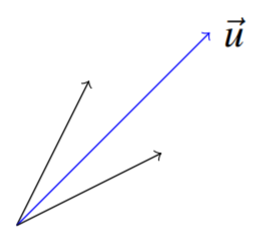
Hint: Notice that \(\left[\begin{array}{c}a\\b\end{array}\right]=\left[\begin{array}{c}\cos\theta \\ \sin\theta\end{array}\right]\) for some \(\theta\). First rotate through \(-\theta\). Next reflect through the \(x\) axis. Finally rotate through \(\theta\).
- Answer
-
\[\begin{aligned} &\left[\begin{array}{cc}\cos (\theta )&-\sin(\theta) \\ \sin(\theta)&\cos(\theta)\end{array}\right]\left[\begin{array}{cc}1&0\\0&-1\end{array}\right]\left[\begin{array}{cc}\cos(-\theta)&-\sin(\theta) \\ \sin(-\theta)&\cos(-\theta)\end{array}\right] \\ =&\left[\begin{array}{cc}\cos^2\theta-\sin^2\theta &2\cos\theta\sin\theta \\ 2\cos\theta\sin\theta&\sin^2\theta-\cos^2\theta\end{array}\right]\end{aligned}\] Now to write in terms of \((a,b)\), note that \(a/\sqrt{a^2+b^2}=\cos\theta\), \(b/\sqrt{a^2+b^2}=\sin\theta\). Now plug this in to the above. The result is \[\left[\begin{array}{cc}\frac{a^2-b^2}{a^2+b^2}&2\frac{ab}{a^2+b^2} \\ 2\frac{ab}{a^2+b^2}&\frac{b^2-a^2}{a^2+b^2}\end{array}\right]=\frac{1}{a^2+b^2}\left[\begin{array}{cc}a^2-b^2&2ab \\ 2ab&b^2-a^2\end{array}\right]\nonumber\] Since this is a unit vector, \(a^2+b^2=1\) and so you get \[\left[\begin{array}{cc}a^2-b^2&2ab \\ 2ab&b^2-a^2\end{array}\right]\nonumber\]
Find the matrix for \(T (\vec{w}) = proj_{\vec{v}}(\vec{w})\) where \(\vec{v}=\left[\begin{array}{ccc}1&-2&3\end{array}\right]^T\).
- Answer
-
Recall that \(proj_{\vec{u}}(\vec{v})=\frac{\vec{v}\bullet\vec{u}}{||\vec{u}||^2}\vec{u}\) and so the desired matrix has \(i\)th column equal to \(proj_{\vec{u}}(\vec{e}_i)\). Therefore, the matrix desired is \[\frac{1}{14}\left[\begin{array}{ccc}1&-2&3\\-2&4&-6\\3&-6&9\end{array}\right]\nonumber\]
Find the matrix for \(T (\vec{w}) = proj_{\vec{v}}(\vec{w})\) where \(\vec{v}=\left[\begin{array}{ccc}1&5&3\end{array}\right]^T\).
- Answer
-
\[\frac{1}{35}\left[\begin{array}{ccc}1&5&3\\5&25&15\\3&15&9\end{array}\right]\nonumber\]
Find the matrix for \(T (\vec{w}) = proj_{\vec{v}}(\vec{w})\) where \(\vec{v}=\left[\begin{array}{ccc}1&0&3\end{array}\right]^T\).
- Answer
-
\[\frac{1}{10}\left[\begin{array}{ccc}1&0&3\\0&0&0\\3&0&9\end{array}\right]\nonumber\]
Find the transformation matrix that reflects a vector across the \(x\)-axis, then applies a horizontal shear with factor \(k\), and finally rotates the vector by \(90^\circ\) clockwise.
- Answer
-
\( M = \begin{bmatrix} 0 & 1 \\ 1 & k \end{bmatrix} \)
Find the transformation matrix that first projects a vector onto the line \(y=x\), then dilates the result by a factor of \(2\), and finally applies a vertical shear with factor \(m\).
- Answer
-
\( M = \begin{bmatrix} 1 & 1 \\ m+1 & m+1 \end{bmatrix} \)
Find the transformation matrix that rotates a vector by the \(45^{\circ}\), then compresse it along the \(x\)-axis by a factor of \(k\) with \(0<k<1\), and finally reflects it across the \(y\)-axis.
- Answer
-
\( M = \frac{1}{\sqrt{2}} \begin{bmatrix} -k & k \\ 1 & 1 \end{bmatrix} \)
Find the transformation matrix that first contracts a vector by a factor \(c\) (\(0 < c < 1\)), then projects the result onto the \(x\)-axis, and finally rotates it by \(180^{\circ}\).
- Answer
-
\( M = \begin{bmatrix} -c & 0 \\ 0 & 0 \end{bmatrix} \)
This page titled 5.4E: Exercises for Section 5.4 was last modified on Thu, 10 Apr 2025 05:36:20 GMT and is shared under a CC BY 4.0 license and was authored, remixed, and/or curated by Doli Bambhania, Fatemeh Yarahmadi, and Bill Wilson.
The book could not be loaded just now.