Opening the book…
Tangrams are a seven-piece geometric puzzle that dates back at least to the Song Dynasty in China (about 1100 AD). Below[1] you will find the seven puzzle pieces. Make a careful copy (a photocopy or printout is best), cut out the puzzle pieces, and then use them to solve the problems in this section.
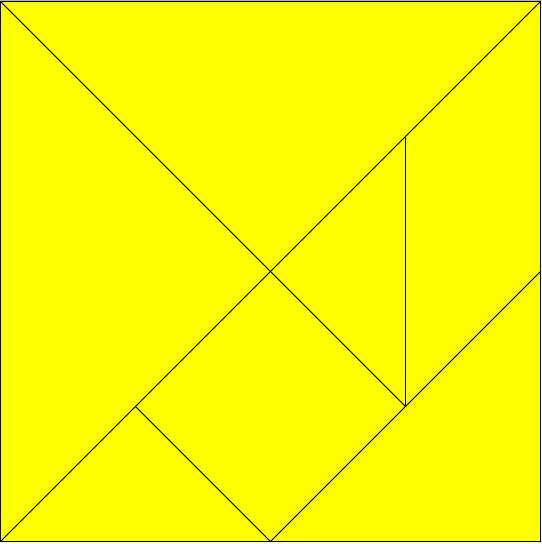
Whenever you solve a tangram puzzle, your job is to use all seven pieces to form the shape. They should fit together like puzzle pieces, sitting flat on the table; no overlapping of the pieces is allowed.
You can trace around your solutions to remember what you have done and to have a record of your work.
Use your tangram pieces to build the following designs[2]. How many can you make?

(These are all separate challenges. Each one requires all seven pieces. Once you solve one, trace your solution. Then try to solve another one.)
Use your tangram pieces to build the following designs[3]. How many can you make?
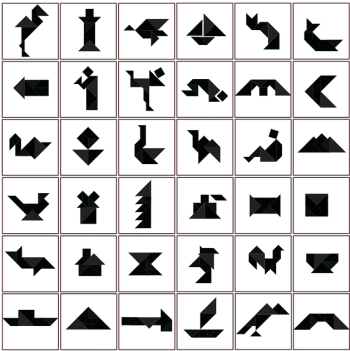
(These are all separate challenges. Each one requires all seven pieces. Once you solve one, trace your solution. Then try to solve another one.)
- Which tangram problems were easier and which were harder: making “real life” objects like cats and people, or purely mathematical objects like the rectangle?
- What do you think made one kind of problem easier or harder?
- Image of tangram puzzle from Wikimedia Commons, public domain. ↵
- Tangram puzzles from Wikimedia Commons, public domain. ↵
- Tangram puzzles from pixababy.com,CC0 Creative Commons. ↵
This page titled 11.2: Tangrams was last modified on Sun, 07 Jul 2024 21:03:51 GMT and is shared under a CC BY-SA 4.0 license and was authored, remixed, and/or curated by Michelle Manes via source content that was edited to the style and standards of the LibreTexts platform.
The book could not be loaded just now.