Opening the book…
- Note to the Instructor (click to expand)
- You have arrived at a decision point. While this material is technically not optional, you need to weigh whether or not squeezing it into a short period of time is worth it. If you have roughly 2 or more hours of instructional time remaining, you can easily cover this and the next (and final) section—it is worth it because of the beauty of the material. If you have less than 2 hours of instructional time remaining, review the course; squeezing this material into a rapid-fire session is not going to be worth it.
- (click to expand)
-
- Solving Equations
The following is a list of learning objectives for this section.
- Learning Objectives (click to expand)
-
- Express the square root of a negative number as an imaginary number.
- Add and subtract complex numbers.
- Simplify powers of \(i\).
- Multiply and divide complex numbers.
- Graph complex numbers.
- Use the Fundamental Theorem of Algebra to find all complex-valued zeros of a polynomial.
So far, most of your work in Mathematics has been done using the set of real numbers. We often represent the real numbers by a number line because they can be matched up one-for-one with the points on the line. Every real number is either rational or irrational. It can be expressed as a decimal number, although irrational numbers are non-repeating non-terminating decimals. However, the real numbers are a subset of a more extensive set of numbers called the complex numbers.
You may have first encountered complex numbers as solutions to certain quadratic equations. For example, the graph of\[f(x)=x^2-2 x+2\nonumber\]has no \(x\)-intercepts (as shown in Figure \(\PageIndex{1}\)), because the equation \(x^2-2 x+2=0\) has no real-valued solutions.
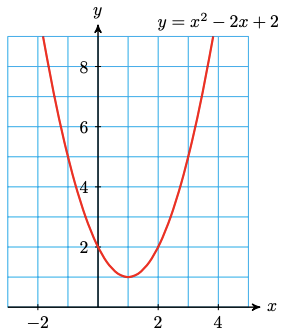
Applying the Quadratic Formula, we find\[x=\dfrac{-(-2) \pm \sqrt{(-2)^2-4(1)(2)}}{2}=\dfrac{2 \pm \sqrt{-4}}{2}.\nonumber\]The solutions of the equation are \(\frac{2+\sqrt{-4}}{2}\) and \(\frac{2-\sqrt{-4}}{2}\), but they are not real numbers. Because \(\sqrt{-4}\) is not a real number, the equation \(x^2-2 x+2=0\) has no real solutions.
Imaginary Numbers
Although square roots of negative numbers such as \(\sqrt{-4}\) are not real numbers, they occur often in Mathematics and its applications. Mathematicians began working with square roots of negative numbers in the sixteenth century in their attempts to solve quadratic and cubic equations. René Descartes gave them the name imaginary numbers, which reflected the mistrust with which mathematicians regarded them at the time. Today, however, such numbers are well understood and used routinely by scientists and engineers.
We begin by defining a new number, called \(i\), whose square is \(-1\).
The letter \(i\) used in this way is not a variable; it is the name of a specific number and hence is a constant. We have seen this sort of designation before—\(\pi\) represents the approximation \(3.14159\ldots\) and \(e\) represents the approximation \(2.71828\ldots\).
The square root of any negative number can be written as the product of a real number and \(i\). For example,\[\begin{array}{rcl} \sqrt{-4} & = & \sqrt{-1 \cdot 4} \\[6pt] & = & \sqrt{-1} \sqrt{4} \\[6pt] & = & i \cdot 2 \\[6pt] & = & 2i \\[6pt] \end{array}\nonumber\]Any number that is the product of \(i\) and a real number is called an imaginary number.
Examples of imaginary numbers are \(3 i\), \(\frac{7}{8} i\), \(-38 i\), and \(i \sqrt{5}\).
Write each radical as an imaginary number.
- \(\sqrt{-25}\)
- \(2 \sqrt{-3}\)
- Solutions
-
- \(\sqrt{-25}=\sqrt{-1} \sqrt{25}=i \sqrt{25}=5 i\)
- \(2 \sqrt{-3}=\sqrt{-1} \sqrt{3}=2 i \sqrt{3}\)
Write each radical as an imaginary number.
- \(\sqrt{-18}\)
- \(-6 \sqrt{-5}\)
- Answers
-
- \(3 i \sqrt{2}\)
- \(-6 i \sqrt{5}\)
Just as each positive number has two real-valued square roots, every negative number has two imaginary square roots. For example, the two square roots of \(-9\) are \(3 i\) and \(-3 i\).
Complex Numbers
Consider the quadratic equation\[x^2-2 x+5=0.\nonumber\]Using the Quadratic Formula to solve the equation, we find\[x=\dfrac{-(-2) \pm \sqrt{(-2)^2-4(1)(5)}}{2}=\dfrac{2 \pm \sqrt{-16}}{2}.\nonumber\]If we now replace \(\sqrt{-16}\) by \(4 i\), we have\[x=\dfrac{2 \pm 4 i}{2}=1 \pm 2 i.\nonumber\]The two solutions are \(1+2 i\) and \(1-2 i\). These are examples of complex numbers.
Examples of complex numbers are\[3-5 i, \quad 2+\sqrt{7} i, \quad \dfrac{4-i}{3}, \quad 6 i, \text{ and} \quad -9.\nonumber\]The real and imaginary parts of a complex number cannot be combined. Thus, two complex numbers \(z_1\) and \(z_2\) are equal if and only if their real parts are equal and their imaginary parts are equal.
The solutions of the equation \(x^2-2 x+2=0\) are \(\frac{2 \pm \sqrt{-4}}{2}\). Write these solutions as complex numbers and simplify.
- Solution
-
Because \(\sqrt{-4}=\sqrt{-1} \sqrt{4}=2 i\), we have \(\frac{2 \pm \sqrt{-4}}{2}=\frac{2 \pm 2 i}{2}\), or \(1 \pm i\). The solutions are \(1+i\) and \(1-i\).
Use Extraction of Roots to solve \((2 x+1)^2+9=0\). Write your answers as complex numbers.
- Answer
-
\(x=\dfrac{-1}{2} \pm \dfrac{3}{2} i\)
Arithmetic of Complex Numbers
We add and subtract complex numbers by combining their real and imaginary parts separately. For example,\[\begin{array}{rcl} (4+5 i)+(2-3 i) & = & (4+2)+(5-3) i \\[6pt] & = & 6+2 i \\[6pt] \end{array}\nonumber\]The algebraic form of this rule can be stated as follows.
Subtract: \((8-6 i)-(5+2 i)\).
- Solution
-
Combine the real and imaginary parts.\[\begin{array}{rcl} (8-6 i)-(5+2 i) & = & (8-5)+(-6-2) i \\[6pt] & = & 3+(-8) i=3-8 i \\[6pt] \end{array}\nonumber\]
Subtract: \((-3+2 i)-(-3-2 i)\)
- Answer
-
\(4i\)
Products of Complex Numbers
We use the following theorem to help us find the product of two imaginary numbers.
For example,\[\begin{array}{rcl} (3 i)(4 i) & = & 3 \cdot 4 i^2 \\[6pt] & = & 12(-1) \\[6pt] & = & -12 \\[6pt] \end{array}\nonumber\]To find the product of two complex numbers, we use the Distributive Law as if the numbers were binomials.
Multiply \((2+3 i)(3-5 i)\).
- Solution
-
We multiply each term of the first complex number by each term of the second one.\[(2+3 i)(3-5 i)=6-10 i+9 i-15 i^2.\nonumber\]Because \(i^2=-1\), the last term, \(-15 i^2\), can be replaced by \(-15(-1)\), or \(15\), to obtain\[6-10 i+9 i+15.\nonumber\]Finally, we combine the real parts and imaginary parts to obtain\[(6+15)+(-10 i+9 i)=21-i.\nonumber\]
Multiply \((-3+2 i)(-3-2 i)\).
- Answer
-
13
One property of real numbers that is not true of complex numbers is \(\sqrt{a b}=\sqrt{a} \sqrt{b}\). This identity fails when \(a\) and \(b\) are negative. For example, if \(a=b=-2\), we have\[\sqrt{a b}=\sqrt{(-2)(-2)}=\sqrt{4}=2,\nonumber\]but\[\begin{array}{rcl} \sqrt{a} \cdot \sqrt{b} & = & \sqrt{(-2)} \cdot \sqrt{(-2)} \\[6pt] & = & \sqrt{(-1 \cdot 2)} \cdot \sqrt{(-1 \cdot 2)} \\[6pt] & = & i \sqrt{2} \cdot i \sqrt{2} \\[6pt] & = & i^2(\sqrt{2})^2 \\[6pt] & = & -2 \\[6pt] \end{array}\nonumber\]so \(\sqrt{a b} \neq \sqrt{a} \sqrt{b}\). We can avoid possible errors by writing the square roots of negative numbers as imaginary numbers before attempting any calculations.
Quotients of Complex Numbers
To find the quotient of two complex numbers, we use the technique of rationalizing the denominator. First, consider division by a pure imaginary number.
Divide \(\dfrac{3+4 i}{2 i}\).
- Solution
-
Because \(i\) is a radical (remember that \(i=\sqrt{-1}\)), we multiply the numerator and denominator of the quotient by \(i\) to obtain\[\begin{array}{rclcl} \dfrac{(3+4 i) \cdot i}{2 i \cdot i} & = & \dfrac{3 i+4 i^2}{2 i^2} & \quad & \left( \text{multiplying numerator and denominator by }i \right) \\[6pt] & = & \dfrac{3 i-4}{-2} & \quad & \left( \text{distributing (in the numerator) and recalling that }i^2 = -1 \right) \\[6pt] \end{array}\nonumber\]To write the quotient in the form \(a+b i\), we divide \(-2\) into each term of the numerator.\[\dfrac{3 i}{-2}-\dfrac{4}{-2}=\dfrac{-3}{2} i+2.\nonumber\]The quotient is \(2-\dfrac{3}{2} i\).
Divide \(\dfrac{8+9 i}{3 i}\).
- Answer
-
\(3-\dfrac{8}{3} i\)
Perhaps you recall that to rationalize a binomial denominator, we multiply by its conjugate. For example, to rationalize the denominator of \(\frac{5}{2+\sqrt{3}}\), we multiply numerator and denominator by \(2-\sqrt{3}\). A similar technique works for dividing complex numbers. We first define the conjugate of a complex number.
The conjugate of a complex number has several useful properties. In particular, the product of a nonzero complex number and its conjugate is always a positive real number.
Now that we have an idea of what a complex conjugate is, and what the product of a complex number and its conjugate become, we are ready to define division of complex numbers.
To illustrate, we calculate the quotient \(\frac{5}{2+3 i}\). We multiply the numerator and denominator by the complex conjugate of the denominator, \(2-3 i\), to obtain\[\dfrac{5}{2+3 i} \cdot \dfrac{2-3 i}{2-3 i}.\nonumber\]The denominator is then a real number, because\[(2+3 i)(2-3 i)=4-6 i+6 i-9 i^2=4+9=13\nonumber\]and the quotient is\[\dfrac{5}{2+3 i} \cdot \dfrac{2-3 i}{2-3 i}=\dfrac{10-15 i}{13}=\dfrac{10}{13}-\dfrac{15}{13} i.\nonumber\]
Divide \(\dfrac{2+3 i}{4-2 i}\).
- Solution
-
We multiply the numerator and denominator by \(4+2 i\), the complex conjugate of the denominator.\[\begin{array}{rclcl} \dfrac{2+3 i}{4-2 i} & = & \dfrac{(2+3 i)(4+2 i)}{(4-2 i)(4+2 i)} & \quad & \left( \text{multiplying both numerator and denominator by the complex conjugate }4 + 2i \right) \\[6pt] & = & \dfrac{8+4 i+12 i+6 i^2}{16+8 i-8 i-4 i^2} & \quad & \left( \text{distributing} \right) \\[6pt] & = & \dfrac{8+16 i-6}{16-(-4)} & \quad & \left( \text{combining like terms in the numerator and using }i^2 = -1\text{ in the denominator} \right) \\[6pt] & = & \dfrac{2+16 i}{20} & \quad & \left( \text{combining like terms} \right) \\[6pt] & = & \dfrac{2}{20}+\dfrac{16 i}{20} & \quad & \left( \text{splitting the fraction} \right) \\[6pt] & = & \dfrac{1}{10}+\dfrac{4}{5} i & \quad & \left( \text{simplifying fractions} \right) \\[6pt] \end{array}\nonumber\]
Write the quotient \(\frac{4-2 i}{1+i}\) in the form \(a+b i\).
- Answer
-
\(1-3 i\)
Graphing Complex Numbers
Real numbers can be plotted on a number line, but we use the complex plane to graph a complex number.
To plot a complex number \(a+b i\), we move \(a\) units from the origin in the horizontal direction and \(b\) units in the vertical direction.
Plot the numbers \(z=2+3 i\) and \(\bar{z}=2-3 i\) in the complex plane.
- Solution
-
To plot \(z=2+3 i\), we move from the origin 2 units to the right and 3 units up. To plot \(\bar{z}=2-3 i\), we move from the origin 2 units to the right and 3 units down. The numbers \(2+3 i\) and \(2-3 i\) are plotted in the figure below.

Figure \(\PageIndex{2}\)
Plot \(z=-3+5 i\) and its conjugate in the complex plane.
- Answer
-

Figure \(\PageIndex{3}\)
You are used to plotting ordered pairs \((x, y)\) in the Cartesian plane so that one point represents two real numbers given by its coordinates. However, in the complex plane, one point represents a single complex number \(z=a+b i\), and the coordinates of the point are the real and imaginary parts of \(z\). For example, the point \((2,-6)\) in the real plane represents the pair of real numbers \(x=2\) and \(y=-6\), but the point \((2,-6)\) in the complex plane represents the complex number \(z=2-6 i\).
The modulus, or length, of a complex number is its distance from the origin in the complex plane. The modulus of a complex number is analogous to the absolute value of a real number. It is similarly denoted by \(|z|\). If \(z=a+b i\), we can use the Pythagorean Theorem to compute its modulus.
For example, the modulus of \(z=2+3 i\) is\[|z|=\sqrt{2^2+3^2}=\sqrt{13}.\nonumber\]
Plot all points in the complex plane that satisfy the equation \(|z|=4\).
- Solution
-
The points that satisfy \(|z|=4\) all lie 4 units from the origin. In other words, they lie on a circle of radius 4 centered at the origin, as shown below.

Figure \(\PageIndex{4}\)
Write an equation for the circle of radius 1 centered at the origin in the complex plane.
- Answer
-
\(|z|=1\)
We can think of the graph of a complex number \(z=a+b i\) as the vector that starts at the origin and ends at the point \((a, b)\) in the complex plane, as shown in Figure \(\PageIndex{5a}\).

Then, the sum of two complex numbers corresponds to the sum of the two vectors representing them. Figure \(\PageIndex{5b}\) illustrates the sum of two complex numbers, \(z_1\) and \(z_2\), by vector addition using the parallelogram law: we form a parallelogram with the vectors \(z_1\) and \(z_2\) as adjacent sides. Their sum is the vector that forms the diagonal of the parallelogram, starting at the origin.
Illustrate the sum of \(z_1=5-i\) and \(z_2=-7+4 i\) by vector addition.
- Solution
-
Draw a vector starting at the origin and ending at the point \((5,-1)\) in the complex plane to represent \(z_1\), and another vector ending at \((-7,4)\) to represent \(z_2\). Now sketch the opposite sides of a parallelogram and draw the diagonal starting at the origin, as shown below.

Figure \(\PageIndex{6}\) This vector represents the sum \(z_1+z_2\). You can check that the vector ends at the point\[z_1+z_2=(5-7)+(-1+4) i=-2+3 i.\nonumber\]
To visualize subtraction, we add the opposite of the second vector because\[z_1-z_2=z_1+\left(-z_2\right).\nonumber\]Recall that the opposite of a vector has the same length, but it points in the opposite direction.
Illustrate \(z_1-z_2\), for \(z_1=3-2 i\) and \(z_2=-4+5 i\).
- Answer
-

Figure \(\PageIndex{7}\)
Zeros of Polynomials
A polynomial with real-number coefficients may or may not have real-valued zeros. For example, the polynomial \(x^4+4\) has no real-valued zeros. But a polynomial always has a zero if we allow complex numbers as inputs. Because we can add, subtract, and multiply any two complex numbers, we can evaluate a polynomial function at a complex number. Thus, we can extend the domain of any polynomial to include all complex numbers.
Evaluate the polynomial \(f(x)=x^2-2 x+2\) for \(x=1+i\), and simplify.
- Solution
-
We substitute \(x=1+i\), to find\[\begin{array}{rcl} f(1+i) & = & (1+i)^2-2(1+i)+2 \\[6pt] & = & 1^2+2 i+i^2-2-2 i+2 \\[6pt] & = & 1+2 i+(-1)-2-2 i+2 \\[6pt] \end{array}\nonumber\]Thus, \(f(1+i)=0\), so \(1+i\) is a zero of the polynomial.
If \(f(x)=x^2-6 x+13\), evaluate \(f(3+2 i)\).
- Answer
-
0
The zeros of a quadratic polynomial \(a x^2+b x+c\), of course, are the solutions of the quadratic equation \(a x^2+b x+c=0\), and those solutions are given by the Quadratic Formula,\[x=\dfrac{-b}{2 a}+\dfrac{\sqrt{b^2-4 a c}}{2 a} \text{ and } x=\dfrac{-b}{2 a}-\dfrac{\sqrt{b^2-4 a c}}{2 a}.\nonumber\]If the discriminant \(D=b^2-4 a c\) is negative, the two solutions are complex conjugates. For example, the solutions of the equation \(x^2-4 x+5=0\) are\[\dfrac{-(-4) \pm \sqrt{(-4)^2-4(1)(5)}}{2(1)}=\dfrac{4 \pm \sqrt{-4}}{2}\nonumber\]or \(z=2+i\) and \(\bar{z}=2-i\). Thus, if we know that \(z=a+b i\) is one complex solution of a quadratic equation, we know that \(\bar{z}=a-b i\) is the other solution.
We can now write a quadratic polynomial, with real coefficients, having any complex number as one of its zeros. The factored form of the quadratic polynomial with zeros \(z\) and \(\bar{z}\) is\[p(x)=(x-z)(x-\bar{z}).\nonumber\]Expanding the right side, we find\[p(x)=x^2-(z+\bar{z}) x+z \bar{z}.\nonumber\]Because \((z+\bar{z})\) and \(z \bar{z}\) are both real numbers, this polynomial has real-valued coefficients.
- Let \(z=7-5 i\). Compute \((z+\bar{z})\) and \(z \bar{z}\).
- Find a quadratic polynomial with one zero being \(z=7-5 i\).
- Solutions
-
- The conjugate of \(z=7-5 i\) is \(\bar{z}=7+5 i\), so\[(z+\bar{z})=(7-5 i)+(7+5 i)=14\nonumber\]and\[\begin{array}{rcl} z \bar{z} & = & (7-5 i)(7+5 i) \\[6pt] & = & 49-25 i^2 \\[6pt] & = & 49+25 \\[6pt] & = & 74 \\[6pt] \end{array}\nonumber\]
- The polynomial is\[\begin{array}{rcl} p(x) & = & x^2-(z+\bar{z}) x+z \bar{z} \\[6pt] & = & x^2-14 x+74 \\[6pt] \end{array}\nonumber\]
- Let \(z=-3+4 i\). Compute \((z+\bar{z})\) and \(z \bar{z}\).
- Find a quadratic polynomial with one zero being \(z=-3+4 i\).
- Answers
-
- \(z+\bar{z}=-6, \quad z \bar{z}=25\)
- \(x^2+6 x+25=0\)
One of the most important results in mathematics is the Fundamental Theorem of Algebra.
Despite the name, however, the Fundamental Theorem of Algebra needs one linked theorem (called a corollary) to be useful for our current conversation.
Before we continue, let's define the multiplicity of a zero of a polynomial.
For example, the polynomial \(p(x)=(x-5)^2\) has a zero of multiplicity 2 at \(x=5\).
As a result of the Fundamental Theorem of Algebra and the Complete Factorization Theorem, every polynomial can be factored as the product of linear terms.
For example, although the graph of \(y=x^4+4\) shown below has no \(x\)-intercepts, the Fundamental Theorem of Algebra tells us that there are four complex solutions to \(x^4+4=0\), and that \(x^4+4\) can be factored. You can check that the four solutions to \(x^4+4=0\) are\[1+i, \, -1+i, \,-1-i,\, \text{and} \, 1-i.\nonumber\]

For example, if \(x=1+i\), then\[x^2=(1+i)^2=1+2 i+i^2=2 i\nonumber\]and\[x^4=\left(x^2\right)^2=(2 i)^2=-4.\nonumber\]Because each zero corresponds to a factor of the polynomial, the factored form of \(x^4+4\) is\[x^4+4=[x-(1+i)][x-(-1+i)][x-(-1-i)][x-(1-i)].\nonumber\]The four solutions to \(x^4+4=0\) form two complex conjugate pairs, namely \(1 \pm i\) and \(-1 \pm i\). We see again that, for every polynomial with real coefficients, the nonreal zeros always occur in complex conjugate pairs.
Find a fourth degree polynomial with real coefficients, two of whose zeros are \(3 i\) and \(2+i\).
- Solution
-
The other two zeros are \(-3 i\) and \(2-i\). The factored form of the polynomial is\[(x-3 i)(x+3 i)[x-(2+i)][x-(2-i)].\nonumber\]We multiply together the factors to find the polynomial. The product of \((x-3 i)(x+3 i)\) is \(x^2+9\), and\[\begin{array}{rcl} {[x-(2+i)][x-(2-i)] } & = & x^2-(2+i+2-i) x+(2+i)(2-i) \\[6pt] & = & x^2-4 x+5 \\[6pt] \end{array}\nonumber\]Finally, we multiply these two partial products to find the polynomial we seek,\[\left(x^2+9\right)\left(x^2-4 x+5\right)=x^4-4 x^3+14 x^2-36 x+45.\nonumber\]
- Find the zeros of the polynomial \(x^4+15 x^2-16\).
- Write the polynomial in factored form.
- Answers
-
- \(\pm 1, \pm 4 i\)
- \((x-1)(x+1)(x-4 i)(x+4 i)\)
This page titled 9.3: Complex Numbers was last modified on Fri, 02 Oct 2026 22:30:05 GMT and is shared under a CC BY-SA 12 license and was authored, remixed, and/or curated by Roy Simpson.
The book could not be loaded just now.